
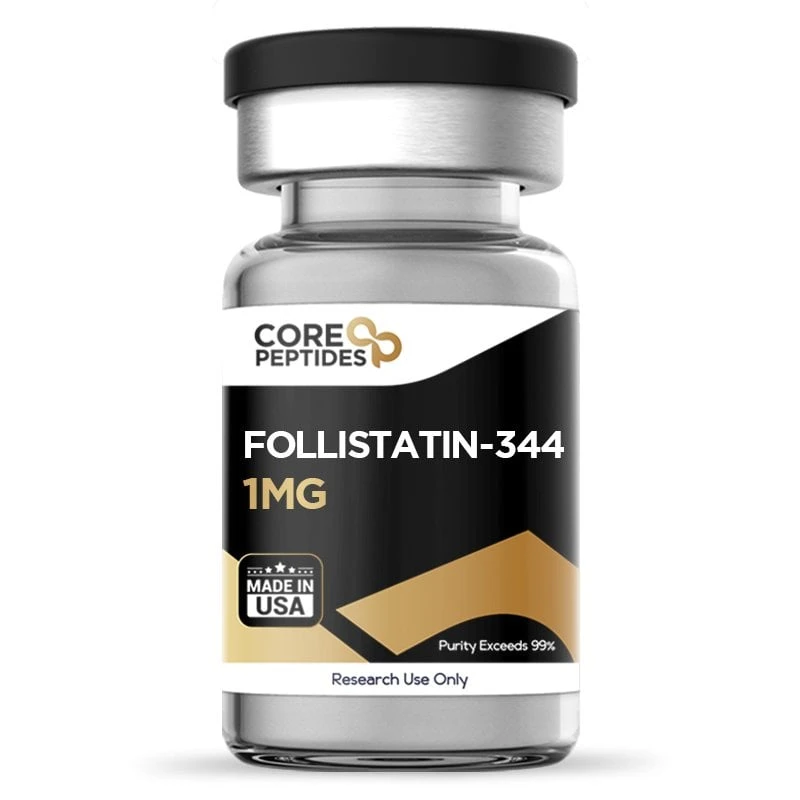

Follistatin-344 (1mg) – Research Peptide for Myostatin & Activin Studies
Follistatin-344 (1mg) is a research-grade follistatin preparation supplied for laboratory and in-vitro research. Follistatin is a naturally occurring secreted glycoprotein that has attracted significant scientific interest because of its ability to interact with members of the transforming growth factor beta (TGF-β) superfamily, including myostatin (GDF-8) and activins.
Research into follistatin has focused particularly on the regulation of skeletal muscle development, muscle mass, cellular signalling and the interaction between myostatin, activin and follistatin pathways. Experimental studies have investigated follistatin-mediated inhibition of myostatin signalling as a potential research strategy in muscle-related disorders and other areas of molecular biology.
The referenced Follistatin-344 (1mg) product is supplied as a lyophilised powder and is listed with a stated purity of >99%. It is intended exclusively for laboratory and scientific research rather than human or veterinary use.
What Is Follistatin-344?
Follistatin-344, commonly abbreviated as FS344 or FST-344, refers to a follistatin isoform associated with the human follistatin protein. Human follistatin is a secreted glycoprotein involved in the regulation of several signalling molecules within the TGF-β superfamily.
Follistatin is particularly well known for its interaction with myostatin, a signalling protein that acts as an important negative regulator of skeletal muscle growth. By binding to myostatin and related ligands, follistatin can modify signalling pathways involved in muscle development and tissue regulation.
Scientific literature has therefore examined follistatin as an experimental tool for studying muscle biology, myostatin inhibition, activin signalling and related molecular mechanisms.
Follistatin-344 (1mg) Product Highlights
- Product: Follistatin-344
- Alternative names: Follistatin 344, FS344, FST-344
- Quantity: 1mg
- Material type: Research peptide/protein
- Physical form: Lyophilised powder
- Stated purity: >99%
- Primary research area: Myostatin and activin signalling
- Additional research areas: Muscle biology, TGF-β signalling and cellular growth regulation
- Intended use: Laboratory and in-vitro research only
The product specifications above are based on the referenced product listing. Researchers should always consult the batch-specific Certificate of Analysis and manufacturer documentation for analytical information applicable to a particular lot.
Follistatin-344 and the Myostatin Pathway
One of the most important areas of follistatin research involves the myostatin pathway.
Myostatin, also known as growth differentiation factor 8 (GDF-8), belongs to the TGF-β superfamily and functions as a negative regulator of skeletal muscle growth. It is produced as a precursor protein and undergoes processing to generate the biologically active signalling molecule.
Follistatin can bind myostatin and interfere with its interaction with its receptors. This makes the follistatin-myostatin relationship an important model for studying how extracellular proteins regulate muscle growth and cellular signalling.
Preclinical research has demonstrated that inhibition of the myostatin pathway can result in increased muscle mass in experimental models. However, the magnitude and biological significance of these effects vary according to the experimental system, delivery method and biological context.
Follistatin and Activin Signalling
Follistatin is not exclusively associated with myostatin. It also interacts with activins and other members of the TGF-β superfamily.
Activin signalling participates in a wide range of biological processes, including reproductive biology, tissue development, cellular differentiation and regulation of hormone-related pathways.
The ability of follistatin to bind activins is therefore an important consideration when studying its biological effects. Research literature has highlighted that follistatin can influence the activin-inhibin axis as well as myostatin signalling.
This broad ligand-binding activity is one reason why follistatin is an interesting experimental molecule for researchers investigating complex growth-factor signalling networks.
Follistatin-344 and Skeletal Muscle Research
Skeletal muscle biology is one of the principal research fields associated with follistatin.
Myostatin normally contributes to the regulation of skeletal muscle development and growth. Experimental suppression of myostatin signalling has been associated with increased muscle mass in several animal models.
Because follistatin can bind myostatin, researchers have investigated whether manipulating follistatin expression or signalling can modify muscle-related phenotypes.
Research has included animal studies and experimental gene-transfer approaches investigating follistatin-related mechanisms. These studies provide useful information about the biology of the pathway but should not be interpreted as evidence that a commercially supplied Follistatin-344 peptide is an established muscle-building treatment in humans.
Follistatin-344 Research and Muscle Growth
The relationship between follistatin and muscle growth is closely linked to the biological role of myostatin.
Experimental studies have shown that disruption or inhibition of myostatin signalling can produce substantial changes in skeletal muscle mass. Follistatin has been investigated as one mechanism capable of regulating this pathway.
Preclinical research has reported increases in muscle size and strength following experimental follistatin pathway manipulation. However, research involving gene delivery or genetically modified expression should be distinguished from studies involving isolated or synthetic peptide preparations.
This distinction is particularly important when evaluating claims surrounding Follistatin-344, as evidence from gene-therapy models cannot automatically be transferred to other forms of follistatin research material.
Follistatin-344 and TGF-β Superfamily Research
The transforming growth factor beta (TGF-β) superfamily contains numerous signalling proteins that regulate development, differentiation, tissue maintenance and cellular responses.
Myostatin and activins belong to this broader signalling network. Follistatin acts as an extracellular binding protein capable of regulating the activity of certain ligands within the family.
Researchers can therefore use follistatin-related models to investigate:
- Ligand-receptor interactions.
- Extracellular growth-factor regulation.
- Myostatin signalling.
- Activin signalling.
- SMAD-dependent cellular pathways.
- Skeletal muscle differentiation.
- Cellular growth and tissue development.
- Interactions between multiple TGF-β family members.
Follistatin-344 and SMAD Signalling
Myostatin and activin signalling can involve SMAD proteins, which function as intracellular signalling mediators that transmit extracellular signals to the nucleus.
Following ligand interaction with appropriate receptors, downstream SMAD pathways can influence gene transcription and cellular behaviour.
By interacting with extracellular ligands such as myostatin and activin, follistatin provides researchers with an opportunity to investigate how changes in ligand availability influence downstream signalling.
This makes the follistatin system relevant to molecular studies examining the connection between extracellular growth factors and intracellular transcriptional responses.
Follistatin-344 and Muscle Disease Research
Follistatin has also been investigated in the context of neuromuscular disease research.
Because myostatin signalling can act as a regulator of muscle mass, researchers have explored pathway inhibition as a potential strategy for experimental investigation of muscle-wasting conditions.
Preclinical studies have examined follistatin-based approaches in models of muscular dystrophy and other muscle disorders. Research has also progressed into gene-transfer studies using follistatin constructs.
These studies are scientifically significant because they help researchers understand whether modulation of the myostatin pathway can influence muscle phenotype. However, results from gene therapy studies should not be interpreted as clinical evidence for injectable Follistatin-344 products.
Follistatin-344 Gene Therapy Research
One notable area of follistatin research involves gene therapy.
Researchers have investigated delivery of follistatin genetic material using viral vectors to produce follistatin within skeletal muscle. One research programme examined an FS344-based gene-transfer approach in the context of Becker muscular dystrophy.
Published literature describes follistatin gene transfer as an experimental strategy for increasing muscle size and investigating muscle function. These studies are important for understanding follistatin biology, but the experimental delivery system is fundamentally different from administering an isolated peptide preparation.
Consequently, scientific claims about Follistatin-344 should always specify whether the evidence comes from gene therapy, recombinant protein research, animal models or isolated peptide experiments.
Follistatin-344 and Reproductive Biology
Follistatin’s interaction with activin signalling also makes it relevant to research involving the reproductive system.
Activin and inhibin participate in regulation of reproductive hormone pathways, while follistatin can bind activins and influence their biological availability.
Scientific literature has therefore identified the interaction between follistatin and the activin-inhibin system as an important consideration when studying the biological effects of follistatin manipulation.
This illustrates why follistatin should not be viewed solely as a muscle-related molecule. Its biological interactions extend across several physiological signalling systems.
Follistatin-344 Molecular Biology
Human follistatin is a relatively large protein compared with many commonly discussed short research peptides. The human follistatin protein is reported as consisting of 344 amino acids, with a molecular weight of approximately 38 kDa in its precursor form.
Alternative splicing and post-translational processing contribute to different follistatin isoforms, including forms commonly designated FS288 and FS315. The nomenclature surrounding FS344 and processed follistatin products can therefore require careful interpretation in research contexts.
| Property | Research Information |
|---|---|
| Protein | Follistatin |
| Common research designation | Follistatin-344 / FS344 |
| Human protein length | 344 amino acids |
| Approximate molecular mass | Approximately 38 kDa |
| Protein family | Follistatin family |
| Major research ligands | Myostatin and activins |
| Signalling family | TGF-β superfamily |
Protein sequence information for human follistatin is available through established biological databases and published molecular research.
Follistatin-344 vs Myostatin
Follistatin and myostatin have complementary roles within muscle-regulation research.
| Feature | Follistatin | Myostatin |
|---|---|---|
| General role | Extracellular binding/regulatory protein | Negative regulator of skeletal muscle growth |
| Protein family | Follistatin family | TGF-β superfamily |
| Major research interaction | Binds myostatin and activins | Signals through activin receptors |
| Muscle research relevance | Investigated as an inhibitor/modulator of myostatin signalling | Investigated as a regulator limiting muscle growth |
Studying both proteins together can provide a clearer picture of how extracellular signalling controls skeletal muscle development and growth.
Research Applications of Follistatin-344
Follistatin-344 can be relevant to a range of laboratory research areas, including:
- Myostatin research: Investigation of myostatin binding and pathway regulation.
- Activin research: Study of activin-follistatin interactions.
- Muscle biology: Investigation of skeletal muscle growth and differentiation.
- Muscular disease research: Experimental investigation of muscle-wasting pathways.
- TGF-β signalling: Study of growth-factor signalling networks.
- Cell signalling: Investigation of ligand-receptor and downstream SMAD pathways.
- Protein biology: Characterisation of follistatin structure and function.
- Gene therapy research: Investigation of follistatin expression and delivery systems.
- Reproductive biology: Study of activin, inhibin and follistatin interactions.
Follistatin-344 (1mg) Research Specifications
| Specification | Details |
|---|---|
| Product name | Follistatin-344 |
| Quantity | 1mg |
| Alternative designations | FS344, FST-344 |
| Product form | Lyophilised powder |
| Stated purity | >99% |
| Primary target areas | Myostatin and activin signalling |
| Research fields | Muscle biology, TGF-β signalling and molecular biology |
| Intended use | Laboratory and in-vitro research only |
Follistatin-344 Purity and Quality Considerations
Analytical quality is particularly important when working with large protein-based research materials.
The referenced product listing states that Follistatin-344 (1mg) has a purity of >99%. Researchers should verify the specific batch through the applicable Certificate of Analysis and analytical documentation.
Common analytical techniques used for characterising research proteins include reverse-phase HPLC for purity assessment and mass spectrometry for molecular identity confirmation. Additional analytical methods may be appropriate depending on the experimental application.
Researchers should avoid assuming that a stated percentage purity alone establishes biological activity, correct folding, aggregation state or functional performance. These characteristics can require additional analytical testing.
Why Researchers Study Follistatin-344
Follistatin-344 is of interest because it sits at the intersection of several important biological pathways.
Its research significance includes:
- Direct relevance to the myostatin pathway.
- Interaction with activin signalling.
- Connection with skeletal muscle growth regulation.
- Relevance to TGF-β superfamily biology.
- Use in experimental muscle-disease research.
- Investigation in gene-transfer and molecular biology studies.
- Potential value as a model for extracellular growth-factor regulation.
Rather than viewing follistatin exclusively as a muscle-related compound, researchers can use it to explore how extracellular ligand-binding proteins regulate multiple signalling pathways simultaneously.
Current Scientific Evidence for Follistatin
The scientific evidence surrounding follistatin includes cellular, animal, molecular and translational research.
Preclinical studies have provided evidence that manipulating the follistatin-myostatin pathway can affect muscle mass. Research has also explored follistatin-based gene-transfer approaches in animal models and early human clinical research.
However, evidence involving genetically delivered follistatin should be distinguished from evidence involving commercially supplied peptide or protein preparations. The route and method of delivery can substantially affect biological exposure and activity.
Consequently, Follistatin-344 remains primarily a subject of experimental research rather than an established clinical intervention.
Limitations of Follistatin-344 Research
Despite extensive scientific interest, several limitations should be considered when evaluating Follistatin-344 research:
- Limited peptide-specific clinical evidence: Human research has not established standard clinical use of isolated Follistatin-344 preparations.
- Delivery differences: Gene-transfer studies cannot automatically be applied to isolated protein or peptide products.
- Multiple biological targets: Follistatin interacts with more than one signalling ligand, making its biology complex.
- Model dependence: Results from cell and animal models may not translate directly to humans.
- Long-term effects: Long-term consequences of manipulating follistatin-related signalling require further investigation.
- Functional characterisation: Purity alone does not necessarily establish biological activity.
These limitations are particularly important when distinguishing established biological mechanisms from claims made about performance, muscle growth or therapeutic outcomes.
Frequently Asked Questions About Follistatin-344 (1mg)
What is Follistatin-344?
Follistatin-344 is a research designation associated with the follistatin protein and its precursor form. Follistatin is a secreted protein involved in regulating signalling molecules such as myostatin and activins.
What is Follistatin researched for?
Research focuses on myostatin inhibition, activin signalling, skeletal muscle biology, TGF-β pathways, cellular signalling, neuromuscular disease models and related molecular processes.
Why is Follistatin associated with muscle growth?
Follistatin can bind myostatin, a negative regulator of skeletal muscle growth. Experimental inhibition of myostatin signalling has been associated with increased muscle mass in animal models.
Is Follistatin-344 the same as myostatin?
No. Follistatin and myostatin are different proteins with different biological roles. Follistatin can bind myostatin and influence its signalling activity.
What is FS344?
FS344 is a commonly used designation associated with a follistatin isoform and related research constructs. Scientific literature may use FS344 in the context of follistatin gene-transfer research.
How many amino acids are in human follistatin?
The human follistatin protein is reported to contain 344 amino acids. Molecular processing and alternative splicing can produce different follistatin forms.
Does Follistatin only interact with myostatin?
No. Follistatin also interacts with activins and other members of the TGF-β superfamily. This broader ligand-binding activity is an important part of its biological function.
Has Follistatin been studied in humans?
Yes. Follistatin-related approaches have been investigated in translational and clinical research, including gene-transfer studies. However, these studies should not be equated with evidence establishing commercially supplied Follistatin-344 peptide preparations as approved human treatments.
Is Follistatin-344 an approved medicine?
No. The referenced product is presented as a laboratory research material and should not be represented as an approved medicine or treatment.
What does the 1mg specification mean?
The 1mg specification refers to the quantity of research material supplied. It is not a recommended human dose.
What form is Follistatin-344 supplied in?
The referenced product is supplied as a lyophilised powder.
What purity is listed for Follistatin-344 (1mg)?
The referenced product listing states a purity of >99%. Researchers should consult the applicable batch-specific Certificate of Analysis for detailed analytical information.
Follistatin-344 vs Other Myostatin Research Approaches
Follistatin is one of several experimental approaches researchers have investigated for modifying myostatin signalling.
| Research approach | General research focus |
|---|---|
| Follistatin | Extracellular binding of myostatin and activins |
| Myostatin antibodies | Direct antibody-mediated neutralisation of myostatin |
| Myostatin receptor approaches | Modification or blockade of receptor-mediated signalling |
| Gene therapy | Experimental modification of follistatin or myostatin expression |
| Genetic models | Investigation of muscle phenotypes following pathway modification |
Comparing these approaches helps researchers understand why results from one experimental strategy cannot necessarily be extrapolated to another.
Research-Use Disclaimer
Follistatin-344 (1mg) is intended strictly for laboratory and scientific research purposes. It is not a medicine, dietary supplement, food product or approved therapeutic treatment.
This product description is provided for scientific and educational purposes. It does not constitute medical advice and does not establish that Follistatin-344 can diagnose, treat, cure or prevent any disease or medical condition.
Research involving follistatin, myostatin or activin pathways should be interpreted according to the specific experimental model, formulation, delivery method and study design. Findings from animal studies, cell cultures or gene-transfer experiments should not automatically be applied to isolated Follistatin-344 preparations or human use.
This content does not provide instructions for human administration, dosing, injection, reconstitution for human use or self-experimentation. Researchers should follow appropriate institutional laboratory procedures, applicable regulations, supplier documentation and relevant safety requirements when handling research materials.
Be the first to review “Follistatin-344 (1mg)”
Related products

Peptides for Sale

Peptides for Sale
Peptides for Sale

Peptides for Sale
Peptides for Sale
Peptides for Sale

Peptides for Sale

Peptide Blends for Sale
Reviews
There are no reviews yet.