
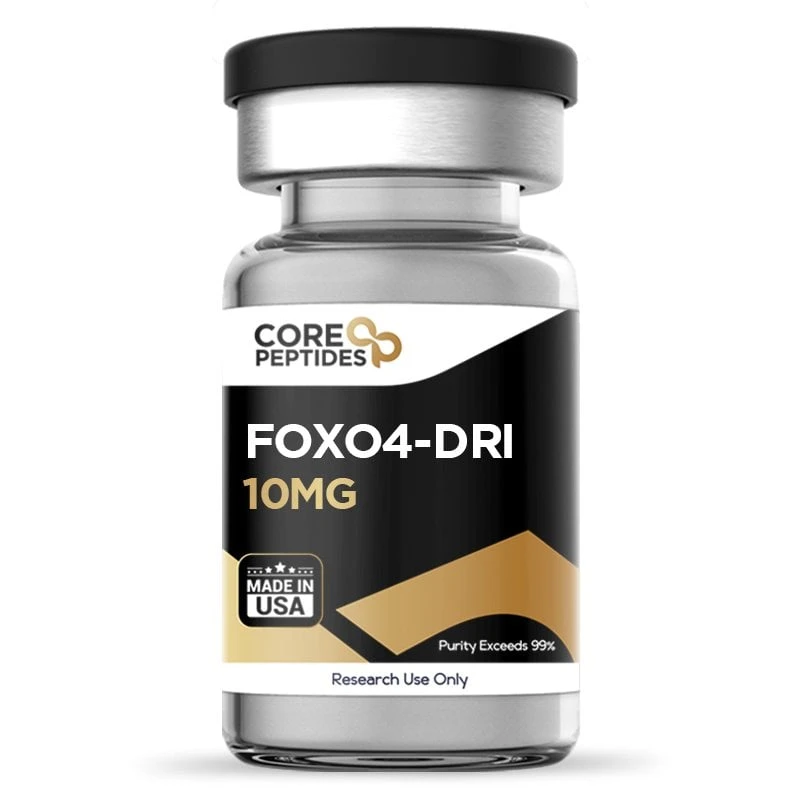
FOXO4-DRI (10mg) – Research Peptide for Cellular Senescence Studies
FOXO4-DRI (10mg) is a synthetic research peptide derived from a functional region of the FOXO4 (Forkhead Box O4) transcription factor.
Also known as FOXO4-D-Retro-Inverso or Proxofim, this modified peptide has attracted scientific interest because of its ability to interfere with the interaction between FOXO4 and the tumour-suppressor protein p53.
FOXO4-DRI is primarily studied in the field of cellular senescence and experimental senolytic research. Preclinical work has investigated whether disrupting the FOXO4-p53 interaction can promote apoptosis in senescent cells.
The original research reported effects in cell and mouse models, including changes associated with ageing and chemotherapy-induced damage. These findings remain preclinical and should not be interpreted as evidence of an established human anti-ageing treatment.
The referenced FOXO4-DRI (10mg) product is supplied as a lyophilised powder and is listed with a stated purity of >99%. It is intended for laboratory and scientific research rather than human or veterinary use. :contentReference[oaicite:1]{index=1}
What Is FOXO4-DRI?
FOXO4-DRI is a modified peptide based on a specific region of the FOXO4 transcription factor. The “DRI” designation refers to a D-retro-inverso peptide design, in which the peptide is constructed using D-amino acids and reversed sequence orientation.
This structural modification is designed to reproduce important spatial characteristics of the parent peptide while potentially increasing resistance to enzymatic degradation. The altered stereochemistry also means that FOXO4-DRI is not chemically identical to the naturally occurring FOXO4 protein or peptide sequence.
Research has focused particularly on the region of FOXO4 involved in interaction with p53. By studying this interaction experimentally, researchers can investigate mechanisms governing the survival and removal of senescent cells.
FOXO4-DRI (10mg) Product Highlights
- Product name: FOXO4-DRI
- Alternative names: FOXO4-D-Retro-Inverso, Proxofim
- Quantity: 10mg
- Product form: Lyophilised powder
- Stated purity: >99%
- Peptide type: Synthetic D-retro-inverso peptide
- Parent protein: FOXO4
- Primary research area: Cellular senescence
- Key research interaction: FOXO4-p53
- Additional research areas: Senolysis, apoptosis, ageing biology and cellular signalling
- Intended application: Laboratory and scientific research only
The quantity, physical form and stated purity are based on the referenced Core Peptides product listing. Researchers should consult the applicable batch-specific Certificate of Analysis for additional analytical information.
FOXO4-DRI and FOXO4 Research
FOXO4 belongs to the forkhead box O family of transcription factors, which includes FOXO1, FOXO3, FOXO4 and FOXO6.
FOXO transcription factors participate in a wide range of cellular processes, including responses to cellular stress, metabolism, cell-cycle regulation, apoptosis and longevity-related signalling.
FOXO4 is particularly relevant to senescence research because studies have identified interactions between FOXO4 and p53 in senescent cells. The FOXO4-p53 interaction has therefore become an important experimental target when investigating how senescent cells maintain their viability.
FOXO4-DRI and the FOXO4-p53 Interaction
The interaction between FOXO4 and p53 is central to much of the research surrounding FOXO4-DRI.
p53 is a major tumour-suppressor protein involved in cellular responses to DNA damage, cellular stress and abnormal proliferation. Depending on the cellular context, activation of p53 can contribute to cell-cycle arrest, DNA-repair responses or programmed cell death.
Research has proposed that FOXO4 can interact with p53 in senescent cells, contributing to the maintenance of their survival. FOXO4-DRI was designed to interfere with this protein-protein interaction.
In experimental models, disrupting FOXO4-p53 binding has been investigated as a way of changing the fate of senescent cells and promoting apoptosis.
FOXO4-DRI and Cellular Senescence
Cellular senescence describes a state in which cells permanently or persistently stop proliferating while remaining metabolically active.
Senescent cells can develop a characteristic senescence-associated secretory phenotype (SASP), involving the release of various signalling molecules and inflammatory mediators. Accumulation of senescent cells has been investigated in connection with ageing and multiple age-associated biological processes.
Because of this, researchers are investigating compounds capable of selectively affecting senescent cells. Such compounds are broadly described as senolytic research agents.
FOXO4-DRI became particularly notable following research demonstrating that a FOXO4-derived peptide designed to interfere with FOXO4-p53 binding could reduce senescent-cell viability in experimental models.
FOXO4-DRI as a Senolytic Research Tool
A senolytic is generally described as an experimental agent investigated for its ability to selectively induce the death of senescent cells.
FOXO4-DRI is studied within this research field because its proposed mechanism involves disrupting a survival-related protein interaction in senescent cells.
The foundational research reported that the FOXO4-derived peptide reduced senescent-cell viability in laboratory experiments and produced beneficial phenotypic observations in certain mouse models.
Importantly, these results do not establish FOXO4-DRI as a clinically validated senolytic for humans. Translation from cellular and animal models to human biology requires substantially more research.
FOXO4-DRI and Apoptosis Research
Apoptosis is a regulated form of programmed cell death that allows organisms to remove cells that are damaged, unnecessary or no longer required.
The FOXO4-p53 interaction is relevant to apoptosis because p53 can activate cellular pathways leading to programmed cell death under appropriate conditions.
Experimental FOXO4-DRI research has examined whether disrupting the FOXO4-p53 interaction releases p53 from this association and facilitates apoptotic signalling in senescent cells.
Nature Reviews Drug Discovery summarised the original findings as evidence that a FOXO4-derived peptide designed to inhibit FOXO4-p53 interaction reduced senescent-cell viability through a p53-mediated apoptotic mechanism.
FOXO4-DRI and Ageing Biology
The accumulation of senescent cells is an important area of investigation within modern ageing biology.
Researchers are studying whether senescent-cell accumulation contributes to age-associated tissue dysfunction and whether selectively removing these cells can influence biological outcomes.
The original FOXO4-DRI research investigated this concept in mouse models of ageing and chemotherapy-induced damage. Reported experimental observations included improvements in certain measures of tissue function and physical performance.
These findings provide a scientific rationale for continued research into FOXO4-p53 signalling and senolytic strategies, but they should not be interpreted as proof that FOXO4-DRI reverses human ageing.
FOXO4-DRI and Senescent Cells
Senescent cells differ from actively proliferating cells in several ways, including altered gene expression, cell-cycle activity and secretory behaviour.
The selective targeting of senescent cells is an important goal in senolytic research because indiscriminate destruction of healthy cells could be harmful.
FOXO4-DRI research is particularly interesting because the peptide was designed around a protein interaction associated with senescent-cell survival rather than acting as a general cytotoxic compound.
However, biological selectivity is dependent on experimental conditions and cellular context. It should therefore not be assumed that a research preparation will exclusively affect senescent cells under every circumstance.
FOXO4-DRI and p53 Research
p53 is one of the most extensively studied tumour-suppressor proteins in molecular biology.
It regulates numerous processes, including:
- Cell-cycle arrest.
- DNA-damage responses.
- DNA repair.
- Cellular stress responses.
- Apoptosis.
- Cellular senescence.
Because p53 has such a central role in maintaining cellular integrity, research involving the FOXO4-p53 interaction requires careful consideration of cellular context.
FOXO4-DRI provides researchers with a molecular tool for studying how interference with this protein-protein interaction can affect the behaviour of senescent cells.
FOXO4-DRI D-Retro-Inverso Design
The D-retro-inverso approach is a peptide-engineering strategy designed to create molecules that can reproduce aspects of the three-dimensional arrangement of a conventional peptide while incorporating D-amino acids.
D-amino acids are stereoisomers of the naturally prevalent L-amino acids found in most biological proteins.
Replacing L-amino acids with D-amino acids can substantially change a peptide’s susceptibility to proteolytic degradation. This is one of the reasons D-retro-inverso peptides are investigated in peptide engineering.
For FOXO4-DRI, this structural design is intended to produce a more degradation-resistant research molecule while retaining the relevant molecular recognition characteristics required for FOXO4-p53 interaction studies.
FOXO4-DRI Chemical Information
| Property | Details |
|---|---|
| Peptide | FOXO4-DRI |
| Alternative designation | Proxofim |
| Parent protein | FOXO4 |
| Peptide design | D-retro-inverso |
| Quantity | 10mg |
| Physical form | Lyophilised powder |
| Stated purity | >99% |
| Molecular formula | C228H388N86O64 |
| Molecular weight | 5358.05 g/mol |
| Primary research target | FOXO4-p53 interaction |
The molecular formula, molecular weight and product specifications above correspond to the referenced product information. :contentReference[oaicite:8]{index=8}
FOXO4-DRI and Cellular Signalling Research
FOXO4-DRI provides researchers with a way to investigate the relationship between transcription factors, tumour-suppressor signalling and cellular fate.
Research can examine how changes in FOXO4-p53 interaction affect:
- p53 localisation and activity.
- Apoptotic signalling.
- Cellular survival.
- Senescent-cell viability.
- Cell-cycle regulation.
- Stress-response pathways.
- Cellular phenotype during ageing.
Such studies can contribute to a broader understanding of how cells respond to accumulated stress and damage.
FOXO4-DRI and Senescence-Associated Research
The senescence-associated secretory phenotype (SASP) is one of the characteristics that makes cellular senescence particularly relevant to ageing research.
Senescent cells can release cytokines, chemokines, growth factors and other signalling molecules that influence neighbouring cells and tissue environments.
Researchers are therefore investigating whether reducing senescent-cell burden can alter these tissue environments.
FOXO4-DRI is relevant to this field because its proposed senolytic mechanism is based on interfering with a survival interaction involving FOXO4 and p53.
It should nevertheless be emphasised that evidence for downstream tissue effects remains primarily preclinical.
FOXO4-DRI Research in Animal Models
The most widely cited FOXO4-DRI research includes experiments conducted in mouse models.
The original study reported that the FOXO4-derived peptide affected senescent cells and produced improvements in several experimental measures in aged mice and mice experiencing chemotherapy-induced damage. Reported observations included effects involving kidney function, physical fitness and tissue characteristics.
Animal research can provide important mechanistic information, but it does not establish safety, effectiveness or appropriate use in humans.
For this reason, FOXO4-DRI should currently be regarded as an experimental research compound rather than a clinically established longevity intervention.
Potential Research Applications of FOXO4-DRI
FOXO4-DRI can be investigated across several areas of experimental biology:
- Cellular senescence: Study of senescent-cell survival mechanisms.
- Senolytic research: Investigation of experimental approaches for targeting senescent cells.
- FOXO biology: Study of FOXO4-dependent signalling.
- p53 research: Investigation of FOXO4-p53 protein interactions.
- Apoptosis: Study of programmed cell-death pathways.
- Ageing biology: Investigation of cellular processes associated with ageing.
- Cell-cycle research: Study of cellular proliferation and arrest.
- Stress-response research: Investigation of cellular responses to damage and stress.
- Drug discovery: Exploration of senolytic mechanisms and candidate compounds.
- Protein interaction studies: Investigation of peptide-mediated disruption of protein-protein interactions.
FOXO4-DRI (10mg) Research Specifications
| Specification | Details |
|---|---|
| Product name | FOXO4-DRI |
| Quantity | 10mg |
| Also known as | Proxofim, FOXO4-D-Retro-Inverso |
| Peptide design | D-retro-inverso |
| Form | Lyophilised powder |
| Stated purity | >99% |
| Molecular weight | 5358.05 g/mol |
| Primary research pathway | FOXO4-p53 |
| Research field | Cellular senescence and senolytic biology |
| Intended use | Laboratory research only |
FOXO4-DRI Purity and Analytical Considerations
The referenced product listing specifies a purity of >99%.
For research applications, purity should be considered alongside identity, molecular mass, aggregation state and biological activity.
Researchers may use analytical techniques such as HPLC and mass spectrometry to characterise peptide identity and purity. Additional analytical methods may be appropriate depending on the research objective.
A Certificate of Analysis should be consulted for batch-specific information rather than relying exclusively on a general product-page specification.
Why Is FOXO4-DRI Important in Senescence Research?
FOXO4-DRI is scientifically interesting because it targets a specific protein interaction rather than functioning simply as a non-specific cytotoxic compound.
The FOXO4-p53 relationship provides a model for investigating how senescent cells maintain survival despite persistent cellular damage and stress.
By experimentally disrupting this interaction, researchers can examine whether senescent cells become more susceptible to programmed cell death.
This concept has contributed to wider interest in senolytic strategies, an area of research focused on understanding whether selective removal of senescent cells could influence tissue biology.
Limitations of Current FOXO4-DRI Research
Although FOXO4-DRI has generated considerable scientific interest, important limitations remain:
- Predominantly preclinical evidence: Much of the foundational evidence comes from cell and animal models.
- Limited human evidence: The preclinical findings cannot establish human efficacy or safety.
- Complex p53 biology: p53 regulates many important cellular processes, so manipulating its interactions requires careful investigation.
- Cell-specific responses: FOXO4 and p53 activity can differ substantially between cell types and biological conditions.
- Long-term effects remain uncertain: The consequences of altering senescent-cell populations over extended periods require further study.
- Product differences: Results obtained with a specific research preparation may not apply automatically to every commercially available FOXO4-DRI material.
These limitations are important when distinguishing scientifically established mechanisms from broader claims about longevity, rejuvenation or human health.
Frequently Asked Questions About FOXO4-DRI (10mg)
What is FOXO4-DRI?
FOXO4-DRI is a synthetic D-retro-inverso peptide derived from a functional region of the FOXO4 transcription factor. It is primarily researched for its interaction with p53 and its potential role in senescence-related cellular pathways.
What does DRI mean in FOXO4-DRI?
DRI refers to D-retro-inverso, a peptide-engineering strategy involving reversed sequence orientation and D-amino-acid stereochemistry.
What is FOXO4-DRI researched for?
Research focuses mainly on cellular senescence, senolytic mechanisms, FOXO4-p53 signalling, apoptosis, ageing biology and protein-protein interactions.
How does FOXO4-DRI relate to p53?
FOXO4-DRI was designed to interfere with the interaction between FOXO4 and p53. Experimental studies have investigated whether this can influence p53-mediated apoptotic signalling in senescent cells.
Is FOXO4-DRI a senolytic?
FOXO4-DRI is commonly studied as an experimental senolytic peptide. Preclinical research has reported reduced senescent-cell viability following disruption of the FOXO4-p53 interaction. However, this does not establish it as an approved senolytic treatment for humans.
Has FOXO4-DRI been studied in animals?
Yes. The foundational research included mouse models of ageing and chemotherapy-induced damage and reported several experimental improvements following treatment with the FOXO4-derived peptide.
Does FOXO4-DRI reverse ageing?
No clinical evidence currently establishes that FOXO4-DRI reverses human ageing. Research findings involving cellular senescence and animal models should not be interpreted as proof of human rejuvenation or lifespan extension.
What does the 10mg specification mean?
The 10mg specification refers to the quantity of research material supplied. It is not a recommended human dose.
What form is FOXO4-DRI (10mg) supplied in?
The referenced product is supplied as a lyophilised powder.
What purity is listed for FOXO4-DRI (10mg)?
The referenced product listing states a purity of >99%. Researchers should consult the relevant batch-specific Certificate of Analysis for detailed analytical information.
Is FOXO4-DRI approved for human use?
The referenced material is presented as a research product and should not be represented as an approved medicine or human therapeutic.
FOXO4-DRI (10mg) Research Summary
FOXO4-DRI (10mg) is a synthetic D-retro-inverso peptide designed around a functional region of the FOXO4 transcription factor. Its primary research significance comes from its ability to interfere with the FOXO4-p53 protein interaction, a pathway investigated in relation to senescent-cell survival and apoptosis.
The peptide has become an important experimental tool in cellular senescence, senolytic research, ageing biology and molecular signalling. Foundational studies reported effects on senescent cells in laboratory models and beneficial observations in certain mouse models of ageing and chemotherapy-induced damage.
However, the existing evidence remains predominantly preclinical. FOXO4-DRI should therefore be regarded as a research compound rather than an established human anti-ageing or rejuvenation treatment.
Research-Use Disclaimer
FOXO4-DRI (10mg) is intended strictly for laboratory and scientific research purposes. It is not a medicine, dietary supplement, food product or approved therapeutic treatment.
The information provided above is intended for scientific and educational purposes. It does not constitute medical advice and should not be interpreted as evidence that FOXO4-DRI can diagnose, treat, cure or prevent any disease or medical condition.
Experimental findings from cell cultures and animal models should not automatically be extrapolated to humans. In particular, the effects of modifying FOXO4-p53 signalling require careful scientific investigation because p53 is involved in numerous fundamental cellular processes.
This content does not provide instructions for human administration, dosing, injection, reconstitution for human use or self-experimentation. Researchers should follow appropriate laboratory protocols, supplier documentation, institutional requirements and applicable laws and regulations when handling experimental peptide materials.
Be the first to review “FOXO4-DRI (10mg)”
Related products

Peptides for Sale
Peptides for Sale
Peptides for Sale

Peptides for Sale
Peptides for Sale
Peptides for Sale
Peptides for Sale

Peptides for Sale
Reviews
There are no reviews yet.