

Buy Humanin (10mg) – Mitochondrial-Derived Peptide Research Material
Humanin (10mg) is a short mitochondrial-derived peptide (MDP) that has attracted significant scientific interest for its role in cellular stress responses, mitochondrial biology, metabolism and cytoprotective signalling. Humanin was first identified in research investigating mechanisms associated with neuronal cell survival and has subsequently been studied in a wide range of cellular and animal models.
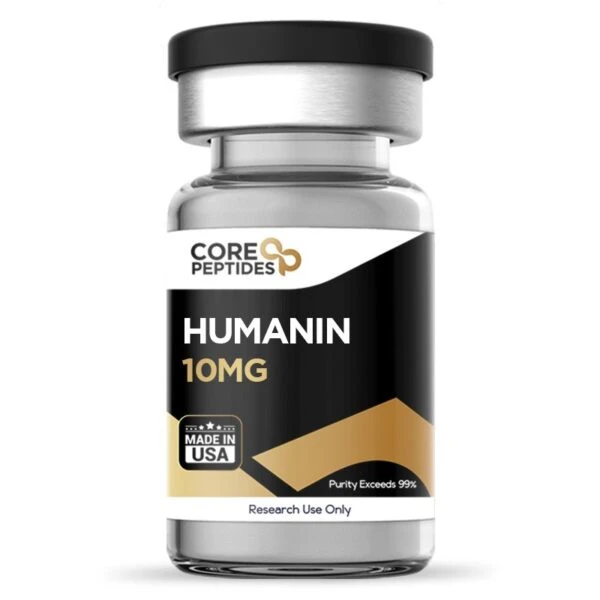
The referenced product contains 10mg of Humanin in lyophilised powder form, with the supplier listing a reported purity of >99%. It is presented as a research material for laboratory and analytical applications.
Humanin is particularly relevant to research involving mitochondrial function, oxidative stress, apoptosis, cellular metabolism, neurobiology, ageing biology and intracellular signalling. Although preclinical research has reported potentially protective biological effects, these findings should not be interpreted as establishing clinical efficacy or suitability for human treatment.
What Is Humanin?
Humanin is a small peptide encoded by the mitochondrial genome. It belongs to the emerging family of mitochondrial-derived peptides, which are produced from short open reading frames within mitochondrial DNA. Research has identified Humanin as one of the best-characterised peptides in this group.
Humanin was originally identified as a peptide capable of protecting neuronal cells from certain cell-death stimuli. Subsequent research has expanded considerably, examining its potential involvement in mitochondrial function, metabolic regulation, oxidative stress responses and cellular survival mechanisms.
Unlike conventional peptides encoded by nuclear DNA, Humanin originates from the mitochondrial genome, making it especially interesting for researchers investigating communication between mitochondria and the rest of the cell.
Humanin (10mg) – Product Highlights
- Product name: Humanin
- Quantity: 10mg
- Peptide classification: Mitochondrial-derived peptide
- Form: Lyophilised powder
- Reported purity: >99%
- Research focus: Mitochondrial and cellular biology
- Research areas: Oxidative stress, apoptosis, metabolism, neurobiology and cellular stress responses
- Research format: Laboratory research material
- Intended use: Scientific, analytical and laboratory research
Current batch specifications, analytical documentation and handling information should always be checked against the supplier’s accompanying documentation.
Humanin and Mitochondrial Biology
Mitochondria are essential cellular organelles involved in energy production, metabolic regulation, apoptosis and cellular signalling. Mitochondria also contain their own genome, from which several small regulatory peptides can be produced.
Humanin is one of the best-studied mitochondrial-derived peptides. Research suggests that mitochondrial-derived peptides can act as signalling molecules involved in cellular stress responses and communication between mitochondria and other cellular compartments.
This makes Humanin an important research subject for scientists examining how mitochondrial activity influences broader cellular processes.
Humanin and Cellular Stress Research
Cellular stress can result from factors including oxidative damage, metabolic imbalance and mitochondrial dysfunction. Humanin has been investigated in experimental models examining how cells respond to these types of stress.
Research has reported cytoprotective effects of Humanin in several experimental systems. These studies have investigated its relationship with pathways associated with oxidative stress, apoptosis and mitochondrial function.
For researchers, this makes Humanin useful as a model compound for investigating how mitochondrial-derived signalling peptides may influence cellular responses to stress.
Humanin and Oxidative Stress
Oxidative stress occurs when the production of reactive oxygen species (ROS) exceeds the capacity of cellular antioxidant systems to maintain balance.
Humanin has been investigated in experimental models involving oxidative stress. For example, research using human retinal pigment epithelial cells reported that Humanin treatment reduced oxidative-stress-associated reactive oxygen species formation and helped preserve mitochondrial bioenergetics under experimental conditions.
These findings have contributed to interest in Humanin as a research tool for studying the relationship between mitochondrial-derived peptides, oxidative stress and cellular resilience.
Humanin and Apoptosis Research
Apoptosis is a regulated form of cell death that plays an essential role in normal tissue development and cellular homeostasis.
Humanin research has explored interactions between the peptide and proteins involved in apoptotic signalling. Experimental studies have examined Humanin’s relationship with apoptosis-associated pathways and proteins, including Bax-related mechanisms.
These investigations are relevant to researchers studying the molecular mechanisms that determine whether cells survive or undergo programmed cell death.
Humanin and Mitochondrial Function
Humanin has been studied extensively in relation to mitochondrial function. Mitochondrial-derived peptides are increasingly recognised as signalling molecules that can communicate information about mitochondrial status to other parts of the cell and, potentially, to other tissues.
Research involving Humanin has examined mitochondrial respiration, bioenergetics, oxidative stress and mitochondrial biogenesis. In human retinal pigment epithelial cell models, for example, Humanin was reported to restore aspects of mitochondrial bioenergetics following oxidative stress.
This research provides a foundation for further investigations into mitochondrial signalling and cellular energy regulation.
Humanin and Cellular Metabolism
Humanin has also become a subject of metabolic research. Mitochondrial-derived peptides are increasingly being investigated for their potential role in metabolic regulation and stress adaptation.
Scientific reviews describe Humanin as a mitochondrial-derived peptide associated with metabolic and cytoprotective signalling. Research has explored relationships between Humanin and conditions involving metabolic dysfunction, while experimental models have investigated its effects on metabolic health markers.
These findings make Humanin relevant to laboratory research into mitochondrial metabolism and cellular energy homeostasis.
Humanin and Neurobiology Research
Humanin was initially identified through research into neuronal cell survival, and neurobiology remains one of the major areas of interest surrounding the peptide.
Research reviews describe Humanin as a peptide with neuroprotective and cytoprotective activity in various experimental models. Studies have investigated its interactions with cellular proteins and receptors associated with neuronal signalling and survival.
These investigations have made Humanin relevant to laboratory studies of neuronal stress, apoptosis and mitochondrial signalling.
Humanin and FPR Receptor Research
Humanin research has identified interactions with members of the formyl peptide receptor family, including FPR2 and related receptor systems.
These receptors belong to the G protein-coupled receptor family and participate in cellular signalling processes. Experimental research has investigated how Humanin-receptor interactions may contribute to the peptide’s biological effects.
Receptor-based research provides another way of investigating how a mitochondrial-derived peptide can communicate with cells beyond the mitochondria itself.
Humanin and Cellular Longevity Research
Humanin has also attracted interest in the field of ageing biology.
Experimental research has investigated Humanin levels and activity across different organisms and age groups. A published study reported associations between Humanin and healthspan-related measures and found that experimental Humanin analogue treatment influenced metabolic and inflammatory parameters in animal models.
These findings are part of an expanding research area examining whether mitochondrial-derived peptides participate in biological mechanisms associated with ageing and cellular resilience.
Importantly, observations from animal and laboratory studies do not establish that Humanin extends human lifespan or provides an anti-ageing treatment.
Humanin and Inflammation Research
Inflammatory signalling is another area in which Humanin has been investigated.
Research reviews have described Humanin and other mitochondrial-derived peptides as potential regulators of cellular stress and metabolic signalling, with experimental studies examining relationships between Humanin and inflammatory pathways.
Further research is required to establish the precise mechanisms and biological significance of these observations across different experimental systems.
Humanin and Cardiovascular Research
Humanin has been investigated in cardiovascular biology because mitochondria play an important role in cardiovascular cellular metabolism and oxidative stress.
A review of Humanin research in cardiovascular disorders describes the peptide as a mitochondrial-derived signalling molecule potentially relevant to oxidative stress, metabolic regulation and cardiovascular biology.
Research in this field remains primarily experimental, and proposed cardiovascular applications should not be confused with established clinical treatments.
Humanin and Retinal Cell Research
Retinal pigment epithelial cells have provided an important experimental model for studying Humanin.
Research published in Investigative Ophthalmology & Visual Science investigated Humanin in human retinal pigment epithelial cells exposed to oxidative stress. The study reported reduced reactive oxygen species formation, preservation of mitochondrial bioenergetics and reduced oxidative-stress-associated cell death following Humanin treatment under the experimental conditions used.
These findings have contributed to interest in Humanin’s relationship with mitochondrial dysfunction, oxidative stress and cellular ageing.
Humanin and Mitochondrial-Derived Peptides
Humanin belongs to a broader family of mitochondrial-derived peptides (MDPs). Other members include MOTS-c and small humanin-like peptides (SHLPs).
These peptides are encoded by short open reading frames within mitochondrial DNA and are increasingly recognised as signalling molecules with potential roles in metabolism, stress responses and cellular communication. :contentReference[oaicite:16]{index=16}
| Peptide Group | General Research Interest |
|---|---|
| Humanin | Cellular stress, mitochondrial function, apoptosis and neurobiology |
| MOTS-c | Metabolic regulation and cellular stress responses |
| SHLPs | Mitochondrial signalling and cellular biology |
The exact mechanisms and biological roles of these mitochondrial-derived peptides remain active areas of scientific investigation.
Humanin Research Applications
Humanin may be relevant to a range of laboratory and scientific research areas, including:
- Mitochondrial biology: Investigation of mitochondrial-derived signalling and cellular communication.
- Cellular stress research: Study of cellular responses to oxidative and metabolic stress.
- Apoptosis research: Investigation of pathways regulating programmed cell death.
- Neurobiology: Study of neuronal survival and mitochondrial signalling.
- Metabolic research: Investigation of mitochondrial peptides and cellular energy regulation.
- Ageing research: Examination of mitochondrial-derived peptides in healthspan and ageing models.
- Cardiovascular research: Investigation of Humanin in mitochondrial and oxidative-stress models.
- Cell signalling: Study of peptide-receptor and intracellular signalling pathways.
- Oxidative stress research: Investigation of reactive oxygen species and mitochondrial bioenergetics.
Humanin Chemical Information
The supplier lists the following chemical information for its Humanin research product.
| Specification | Details |
|---|---|
| Product | Humanin |
| Quantity | 10mg |
| Form | Lyophilised powder |
| Reported purity | >99% |
| Molecular formula | C119H204N34O32S2 |
| Molecular weight | 2687.3 g/mol |
| Alternative title | HNGF6A protein |
| Research classification | Mitochondrial-derived peptide |
Humanin Peptide Research Overview
| Research Parameter | Overview |
|---|---|
| Peptide family | Mitochondrial-derived peptides |
| Genetic origin | Mitochondrial genome |
| Primary research themes | Mitochondrial function, cellular stress and cytoprotection |
| Additional research areas | Neurobiology, metabolism, apoptosis, ageing and cardiovascular biology |
| Experimental models | Cellular, biochemical and animal research models |
| Research status | Experimental research compound |
Why Researchers Study Humanin
Humanin is particularly interesting because it connects mitochondrial genetics with cellular signalling. Mitochondria are not only involved in energy production but also participate in apoptosis, oxidative-stress responses and metabolic regulation.
The discovery of mitochondrial-derived peptides has expanded scientific understanding of how mitochondrial DNA can generate signalling molecules with effects beyond traditional mitochondrial protein production.
Humanin is currently one of the most extensively investigated examples of this class, with published research covering neurobiology, metabolism, mitochondrial function, oxidative stress, ageing and cardiovascular biology.
Frequently Asked Questions About Humanin
What is Humanin?
Humanin is a small mitochondrial-derived peptide encoded by the mitochondrial genome. It was originally identified in research investigating neuronal cell survival and has subsequently been studied in numerous cellular and animal models.
What does Humanin research focus on?
Research commonly focuses on mitochondrial function, cellular stress responses, apoptosis, oxidative stress, metabolism, neurobiology and ageing-related biology.
Is Humanin a mitochondrial-derived peptide?
Yes. Humanin belongs to the mitochondrial-derived peptide family and is encoded within the mitochondrial genome.
What is the relationship between Humanin and mitochondria?
Humanin originates from mitochondrial DNA and has been investigated as a signalling peptide involved in cellular responses associated with mitochondrial function, oxidative stress and metabolic regulation.
Has Humanin been studied in cells?
Yes. Humanin has been investigated in multiple cellular models. For example, research in human retinal pigment epithelial cells examined its effects on oxidative stress, mitochondrial bioenergetics, apoptosis and cellular senescence.
Has Humanin been studied in animal models?
Yes. Experimental animal research has investigated Humanin and Humanin analogues in areas including metabolism, inflammatory markers and healthspan-related outcomes.
Is Humanin an anti-ageing treatment?
Humanin is being investigated in ageing research, but laboratory and animal findings do not establish that Humanin is an approved anti-ageing treatment or that it extends human lifespan.
What quantity does this product contain?
The referenced product contains 10mg of Humanin in lyophilised powder form, with the supplier reporting purity above 99%.
Is Humanin intended for human consumption?
No. The referenced supplier identifies its Humanin product as a research material and states that its products are intended for research, laboratory or analytical purposes rather than human consumption.
Can Humanin research findings be considered medical advice?
No. Experimental findings should be interpreted within the specific context of the study in which they were generated. Research information does not establish clinical safety, efficacy or an appropriate therapeutic use.
Research Summary
Humanin (10mg) is a synthetic research peptide corresponding to Humanin, a naturally occurring mitochondrial-derived peptide. Humanin has become an important subject in modern mitochondrial research because it provides a potential molecular link between mitochondrial genetic activity and wider cellular signalling.
Published research has investigated Humanin in relation to mitochondrial function, oxidative stress, apoptosis, cellular metabolism, neuronal survival, cardiovascular biology and ageing. Experimental studies have reported cytoprotective and metabolic effects in various models, although the mechanisms and translational significance of these observations remain areas of ongoing research.
Research involving Humanin therefore provides opportunities to investigate how mitochondrial-derived peptides participate in cellular stress responses, mitochondrial bioenergetics and communication between mitochondria and other cellular systems.
Research-Use Disclaimer
Humanin (10mg) is intended for laboratory, analytical and scientific research purposes only. It is not a food product, dietary supplement or approved treatment.
The information provided on this page is intended for educational and scientific purposes and does not constitute medical advice. Research findings should not be interpreted as evidence that Humanin can diagnose, treat, cure or prevent any disease or medical condition.
Results from biochemical, cellular and animal studies may not translate directly into clinical outcomes in humans. Appropriate laboratory procedures, institutional requirements and applicable regulations should be followed when handling research peptides.
This content does not provide instructions for human administration, dosing, injection, reconstitution for human use or self-experimentation.
Be the first to review “Humanin (10mg)”
Related products
Peptides for Sale

Peptides for Sale
Peptides for Sale
Peptides for Sale

Peptides for Sale
Peptides for Sale

Peptide Blends for Sale

Peptides for Sale
Reviews
There are no reviews yet.