
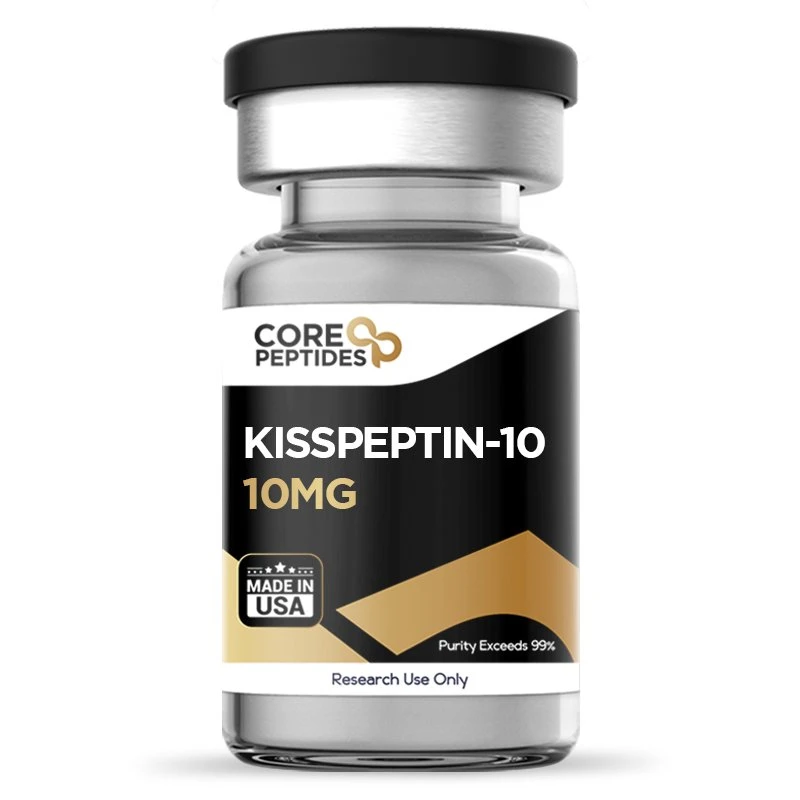


Kisspeptin-10 (10mg) – Research Peptide for Reproductive Endocrinology Studies
Kisspeptin-10 (10mg) is a peptide research material associated with the KISS1/KISS1R signalling pathway and is widely studied in reproductive neuroendocrinology. Kisspeptin signalling plays an important role in regulating gonadotrophin-releasing hormone (GnRH), linking hypothalamic signalling with downstream reproductive hormone activity.
The referenced product is supplied as 10mg of Kisspeptin-10 in lyophilised powder form, with the supplier listing a reported purity of >99%. It is presented for laboratory, analytical and research applications rather than human or veterinary use.
Kisspeptin-10 is particularly relevant to research involving kisspeptin receptor biology, GnRH signalling, LH and FSH secretion, reproductive endocrinology, puberty, fertility research and hypothalamic-pituitary-gonadal axis regulation.
What Is Kisspeptin-10?
Kisspeptin-10 (KP-10) is a short bioactive peptide derived from the larger kisspeptin precursor encoded by the KISS1 gene. Human KISS1 produces a 145-amino-acid precursor that is processed into several biologically active kisspeptin forms, including kisspeptin-54, kisspeptin-14, kisspeptin-13 and kisspeptin-10.
Kisspeptin-10 represents the C-terminal portion of the kisspeptin sequence and retains the conserved C-terminal motif required for high-affinity activation of the kisspeptin receptor, KISS1R, formerly known as GPR54.
The peptide has become an important experimental tool for investigating how kisspeptin signalling regulates the hypothalamic-pituitary-gonadal axis and communicates reproductive and metabolic information to the reproductive endocrine system.
Kisspeptin-10 (10mg) Product Highlights
- Product name: Kisspeptin-10
- Quantity: 10mg
- Form: Lyophilised powder
- Reported purity: >99%
- Alternative designation: Kisspeptin 45-54
- Peptide classification: Kisspeptin neuropeptide
- Primary receptor: KISS1R / GPR54
- Primary research pathway: Kisspeptin-GnRH signalling
- Research areas: Reproductive endocrinology, neuroendocrinology, fertility and hormone signalling
- Intended application: Laboratory and scientific research
The supplier’s current listing identifies the product as a 10mg lyophilised powder with reported purity above 99%. Researchers should consult the applicable batch documentation for current analytical and quality-control information.
How Does Kisspeptin-10 Work?
Kisspeptin-10 is primarily studied through its interaction with KISS1R, a G protein-coupled receptor expressed on the neural pathways controlling reproductive hormone secretion.
Activation of kisspeptin signalling can stimulate GnRH neurons. GnRH then acts on the pituitary to regulate secretion of the gonadotrophins luteinising hormone (LH) and follicle-stimulating hormone (FSH). This places kisspeptin upstream of GnRH within the reproductive endocrine pathway.
This signalling relationship is one of the main reasons Kisspeptin-10 is used in experimental studies investigating the communication between the hypothalamus, pituitary gland and gonads.
Kisspeptin-10 and the KISS1R Receptor
KISS1R, previously referred to as GPR54, is the principal receptor through which kisspeptins exert their established neuroendocrine effects.
Research has demonstrated that kisspeptin signalling through KISS1R is closely connected with activation of GnRH neurons and subsequent gonadotrophin secretion. Loss or disruption of kisspeptin signalling has been associated with impaired reproductive development and hypogonadotrophic hypogonadism in experimental and human research.
Because of this central role, Kisspeptin-10 is a useful research compound for studying GPCR signalling, neuronal activation and reproductive hormone regulation.
Kisspeptin-10 and GnRH Research
The relationship between Kisspeptin-10 and gonadotrophin-releasing hormone (GnRH) is a major focus of kisspeptin research.
Kisspeptin signalling acts upstream of GnRH neurons and can influence the pulsatile secretion of GnRH. This provides an important mechanism through which the brain regulates downstream reproductive endocrine activity.
Experimental research has therefore used Kisspeptin-10 to investigate how activation of kisspeptin pathways affects GnRH neuronal activity and subsequent LH and FSH secretion.
Kisspeptin-10 and LH Research
Luteinising hormone (LH) is one of the principal gonadotrophins regulated by the hypothalamic-pituitary-gonadal axis.
Human research has demonstrated that kisspeptin administration can stimulate LH secretion. In a controlled study involving healthy men, Kisspeptin-10 produced a rapid, dose-dependent increase in serum LH, while infusion studies also examined changes in LH pulse frequency and secretory burst characteristics.
These findings have made Kisspeptin-10 an important experimental model for studying the neuroendocrine mechanisms responsible for LH secretion.
Kisspeptin-10 and FSH Research
Follicle-stimulating hormone (FSH) is another gonadotrophin regulated through the reproductive endocrine axis.
Research has investigated the effects of kisspeptin signalling on FSH alongside LH. Experimental studies have reported increases in gonadotrophin secretion following kisspeptin exposure, although responses can vary according to species, sex, reproductive state, experimental conditions and the kisspeptin preparation used.
This makes Kisspeptin-10 relevant to laboratory research investigating differential regulation of LH and FSH.
Kisspeptin-10 and the Hypothalamic-Pituitary-Gonadal Axis
The hypothalamic-pituitary-gonadal (HPG) axis is the central endocrine system responsible for coordinating reproductive function.
Kisspeptin occupies an important upstream position within this system. Signals involving kisspeptin neurons can influence GnRH neurons, which subsequently regulate pituitary gonadotrophin secretion. LH and FSH then act on the gonads to influence reproductive processes and sex-steroid production.
| Stage | Research Role |
|---|---|
| KISS1 / kisspeptin | Upstream neuroendocrine signalling |
| KISS1R | Kisspeptin receptor and signal transduction |
| GnRH neurons | Regulation of GnRH secretion |
| Pituitary gland | LH and FSH secretion |
| Gonads | Downstream reproductive and steroidogenic signalling |
Kisspeptin-10 and Reproductive Endocrinology
Kisspeptin has become a major area of interest in reproductive endocrinology because it provides a link between central nervous system signalling and the regulation of reproductive hormones.
Reviews of the scientific literature describe kisspeptin as a key regulator of the mammalian reproductive axis, with research examining its role in puberty, fertility, gonadotrophin secretion and sex-steroid feedback.
Kisspeptin-10 is particularly useful for experimental work because it provides a defined peptide fragment with activity at KISS1R.
Kisspeptin-10 and Puberty Research
The kisspeptin system has an important role in research into pubertal development.
Activation of the reproductive axis at puberty requires coordinated changes in GnRH secretion and downstream gonadotrophin activity. Research indicates that kisspeptin signalling is a critical component of this process, and genetic disruption of the kisspeptin pathway can impair normal reproductive development.
Experimental studies have therefore used Kisspeptin-10 to investigate the mechanisms linking hypothalamic signalling with the initiation and regulation of reproductive endocrine activity.
Kisspeptin-10 and Fertility Research
Because kisspeptin is positioned upstream of GnRH, its signalling pathway has become an important subject in fertility research.
Scientific reviews report that kisspeptin can stimulate physiological gonadotrophin responses in humans and that the pathway is being investigated in reproductive disorders involving abnormal GnRH and LH secretion.
Research into kisspeptin signalling has included studies of hypothalamic reproductive dysfunction, infertility and disorders involving altered reproductive hormone pulsatility.
These studies are primarily intended to improve understanding of reproductive neuroendocrinology and should not be interpreted as establishing a specific therapeutic use for research-grade Kisspeptin-10.
Kisspeptin-10 and Female Reproductive Research
Kisspeptin signalling is relevant to multiple aspects of female reproductive endocrinology, including the regulation of GnRH and gonadotrophin secretion.
Research has examined kisspeptin pathways in relation to ovulation, reproductive hormone dynamics and conditions involving altered HPG-axis function. A 2022 review describes emerging research into kisspeptin-GnRH signalling and potential clinical applications in female reproduction, while emphasising the need for further clinical investigation.
Kisspeptin-10 therefore provides a useful experimental compound for researchers investigating the molecular mechanisms underlying female reproductive hormone regulation.
Kisspeptin-10 and Male Reproductive Research
Kisspeptin signalling is also relevant to male reproductive endocrinology.
Human studies have investigated Kisspeptin-10 in healthy men and reported increases in LH and, under certain experimental conditions, testosterone alongside changes in LH pulse dynamics.
These observations support continued research into the kisspeptin-GnRH-LH pathway and its role in male reproductive hormone regulation.
Kisspeptin-10 and Neuroendocrine Signalling
Kisspeptin is not simply a reproductive hormone signal; it is part of a broader neuroendocrine network that integrates information from multiple physiological systems.
Research has investigated interactions between kisspeptin neurons and other neuropeptide systems, including neurokinin B and dynorphin. Together, these signalling systems form part of the KNDy neuronal network involved in the regulation of GnRH pulsatility.
This makes Kisspeptin-10 relevant to research extending beyond individual hormone measurements into the wider study of hypothalamic neuronal circuits.
Kisspeptin-10 and Metabolic Signalling
Researchers have also investigated connections between kisspeptin signalling and metabolic status.
Scientific reviews describe kisspeptin as a potential interface between metabolic signals and reproductive function. This is important because reproductive activity is closely linked to nutritional and energetic status.
Experimental research into Kisspeptin-10 has consequently explored neural pathways involved in appetite, energy balance and reproductive signalling. These findings remain an active area of laboratory research.
Kisspeptin-10 and the KNDy Network
The KNDy network refers to neurons expressing kisspeptin, neurokinin B and dynorphin. This neuronal system has become an important model for understanding the generation and modulation of GnRH pulses.
| Signalling Component | Research Relevance |
|---|---|
| Kisspeptin | Stimulation of GnRH neuronal activity |
| Neurokinin B | Coordination of KNDy neuronal signalling |
| Dynorphin | Inhibitory modulation within the KNDy network |
| GnRH | Downstream regulation of pituitary gonadotrophin secretion |
Research into these interconnected pathways has significantly advanced understanding of pulsatile reproductive hormone secretion.
Kisspeptin-10 Research Applications
Kisspeptin-10 may be relevant to a broad range of laboratory and scientific research areas, including:
- Reproductive endocrinology: Investigation of hormonal regulation within the HPG axis.
- Neuroendocrinology: Study of hypothalamic signalling and neuropeptide pathways.
- GnRH research: Investigation of mechanisms controlling GnRH neuronal activity.
- Gonadotrophin research: Study of LH and FSH secretion.
- KISS1R pharmacology: Investigation of kisspeptin receptor activation.
- Puberty research: Study of the neuroendocrine mechanisms associated with reproductive maturation.
- Fertility research: Investigation of central reproductive hormone regulation.
- Metabolic-reproductive research: Study of interactions between energy status and reproductive signalling.
- Neurobiology: Investigation of kisspeptin-related neuronal pathways.
- Endocrine pharmacology: Study of peptide-receptor interactions and downstream signalling.
Kisspeptin-10 Chemical Information
The referenced Core Peptides listing identifies Kisspeptin-10 as a 10mg lyophilised research peptide with reported purity above 99%. It also lists the molecular formula and molecular weight shown below.
| Specification | Details |
|---|---|
| Product | Kisspeptin-10 |
| Quantity | 10mg |
| Form | Lyophilised powder |
| Reported purity | >99% |
| Molecular formula | C63H83N17O14 |
| Molecular weight | 1302.4 g/mol |
| Alternative title | Kisspeptin 45-54 |
| Receptor | KISS1R / GPR54 |
Kisspeptin-10 Versus Kisspeptin-54
Kisspeptin exists in several biologically active forms generated from the KISS1 precursor. These include KP-54, KP-14, KP-13 and KP-10. The shorter forms share a conserved C-terminal sequence and can activate KISS1R.
| Feature | Kisspeptin-10 | Kisspeptin-54 |
|---|---|---|
| Classification | Short kisspeptin peptide | Longer endogenous kisspeptin isoform |
| Origin | Derived from the KISS1 precursor | Derived from the KISS1 precursor |
| Receptor | KISS1R | KISS1R |
| Research focus | KISS1R activation and reproductive neuroendocrinology | Kisspeptin signalling and reproductive physiology |
The two forms are related but should not automatically be considered interchangeable in experimental protocols.
Why Researchers Study Kisspeptin-10
Kisspeptin-10 is particularly valuable for research because the kisspeptin system occupies a strategic position within reproductive neuroendocrine signalling.
Research into the peptide can help investigators examine:
- How KISS1R activation influences GnRH neurons.
- How GnRH signalling controls LH and FSH secretion.
- How the brain regulates reproductive hormone pulsatility.
- How metabolic signals interact with reproductive function.
- How kisspeptin pathways contribute to pubertal development.
- How reproductive endocrine disorders affect kisspeptin signalling.
- How KNDy neuronal circuits regulate reproductive physiology.
Reviews of the field describe kisspeptin as a central regulator of reproductive function and an important upstream mediator of GnRH secretion.
Frequently Asked Questions About Kisspeptin-10
What is Kisspeptin-10?
Kisspeptin-10 is a short bioactive peptide derived from the KISS1 gene product. It is studied primarily for its activity at the KISS1R receptor and its role in reproductive neuroendocrine signalling.
What receptor does Kisspeptin-10 activate?
Kisspeptin-10 activates the kisspeptin receptor KISS1R, formerly known as GPR54. This receptor is involved in signalling pathways that regulate GnRH neuronal activity.
What is Kisspeptin-10 mainly researched for?
It is mainly researched in reproductive neuroendocrinology, particularly in relation to GnRH, LH, FSH, puberty, fertility and the hypothalamic-pituitary-gonadal axis.
Does Kisspeptin-10 affect GnRH?
Research indicates that kisspeptin signalling acts upstream of GnRH neurons and can stimulate GnRH secretion.
Has Kisspeptin-10 been studied in humans?
Yes. Human studies have examined Kisspeptin-10 and other kisspeptin forms in relation to reproductive hormone secretion. For example, controlled research in men found that Kisspeptin-10 stimulated LH secretion and altered LH pulse characteristics under the experimental conditions used.
Is Kisspeptin-10 the same as Kisspeptin-54?
No. Both are derived from the KISS1 precursor and share the conserved C-terminal region involved in KISS1R activation, but they are different peptide isoforms.
What quantity does this product contain?
The referenced product contains 10mg of Kisspeptin-10 in lyophilised powder form, with the supplier reporting purity above 99%.
Is Kisspeptin-10 a fertility treatment?
Kisspeptin is being investigated in reproductive medicine and fertility research, but research-grade Kisspeptin-10 should not be represented as an approved fertility treatment. Scientific findings and clinical applications are separate considerations.
Is Kisspeptin-10 intended for human consumption?
No. The referenced supplier states that its Kisspeptin-10 product is intended for research and laboratory purposes and is not for human or animal consumption.
Can Kisspeptin-10 research findings be considered medical advice?
No. Laboratory, animal and clinical research findings must be interpreted according to the specific experimental design and do not constitute medical advice or establish an appropriate use of research-grade material.
Research Summary
Kisspeptin-10 (10mg) is a lyophilised research peptide associated with the KISS1/KISS1R signalling system. As a short bioactive fragment of the KISS1 gene product, it provides researchers with a defined experimental tool for investigating kisspeptin receptor activation and reproductive neuroendocrine signalling.
Published research has established kisspeptin as a major upstream regulator of GnRH secretion, with downstream effects on gonadotrophin signalling. Human and animal studies have investigated Kisspeptin-10 in relation to LH and FSH secretion, reproductive hormone pulsatility, puberty, fertility and the broader hypothalamic-pituitary-gonadal axis.
For laboratory researchers, Kisspeptin-10 is therefore particularly relevant to studies of KISS1R pharmacology, GnRH neuronal signalling, reproductive endocrinology and neuroendocrine regulation.
Research-Use Disclaimer
Kisspeptin-10 (10mg) is intended for laboratory, analytical and scientific research purposes only. It is not a food product, dietary supplement or approved medicine.
The information presented here is intended for educational and scientific purposes and does not constitute medical advice. Research findings should not be interpreted as evidence that Kisspeptin-10 can diagnose, treat, cure or prevent any disease or medical condition.
Human studies referenced in the scientific literature were conducted under controlled research conditions and should not be interpreted as instructions for self-administration. This page does not provide dosing, injection, reconstitution or self-experimentation instructions.
Researchers should follow appropriate laboratory procedures, supplier documentation, institutional requirements and all applicable laws and regulations when handling research peptides.
Be the first to review “Kisspeptin-10 (10mg)”
Related products
Peptides for Sale
Peptides for Sale

Peptides for Sale

Peptides for Sale

Peptide Blends for Sale
Peptides for Sale

Peptides for Sale

Peptides for Sale
Reviews
There are no reviews yet.