
KLOW (BPC-157, KPV, TB-500, GHK-Cu) Blend (80mg) – Multi-Peptide Research Blend
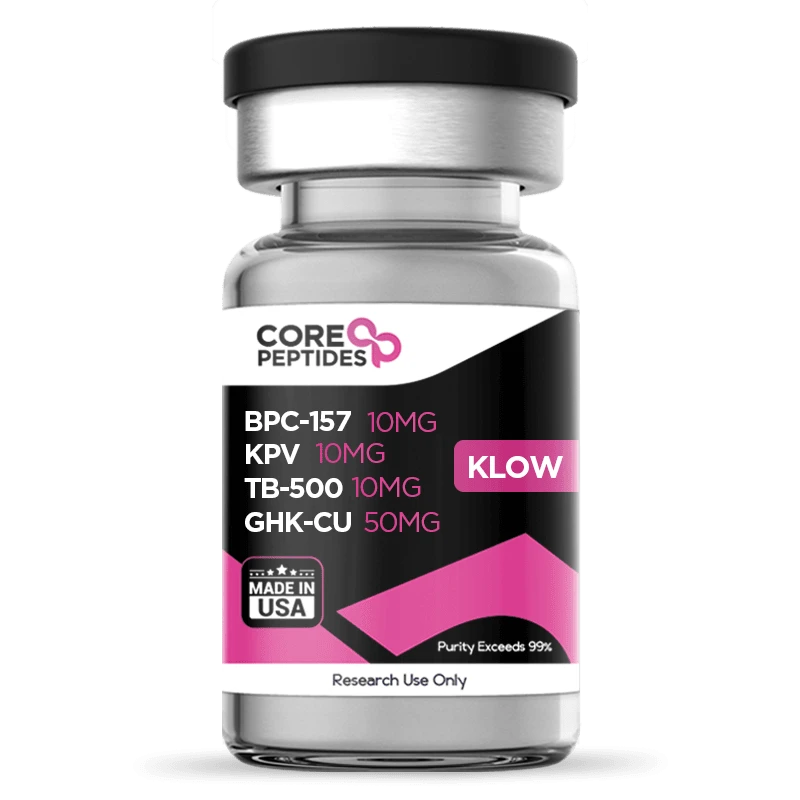
KLOW (BPC-157, KPV, TB-500, GHK-Cu) Blend (80mg) is a four-component peptide research formulation combining BPC-157, KPV, TB-500 and GHK-Cu in a single lyophilised powder. The referenced product contains 80mg total peptide material, comprising 10mg BPC-157, 10mg KPV, 10mg TB-500 and 50mg GHK-Cu, with the supplier reporting a purity of >99%.
KLOW is designed as a research formulation for investigating several interconnected biological pathways, including inflammatory signalling, cellular migration, extracellular-matrix activity, angiogenesis and tissue-remodelling mechanisms.
The four components have distinct structures and individual research histories, making the blend relevant to multidisciplinary peptide and cell-biology research. Importantly, the scientific evidence for KLOW should be distinguished from the evidence for its individual ingredients.
Research on BPC-157, KPV, TB-500 or GHK-Cu does not establish that the exact four-peptide KLOW formulation produces the same effects, and current sources indicate that the combination itself has not been evaluated in controlled human studies.
What Is KLOW Peptide Blend?
KLOW is a research-oriented blend containing four chemically distinct peptides:
- BPC-157 – 10mg: a synthetic pentadecapeptide investigated in experimental models involving cellular migration, vascular signalling and tissue-repair mechanisms.
- KPV – 10mg: a tripeptide corresponding to the C-terminal portion of alpha-melanocyte-stimulating hormone (α-MSH), investigated particularly for inflammatory signalling.
- TB-500 – 10mg: a synthetic peptide associated with thymosin beta-4 research, including studies of cellular migration, cytoskeletal organisation and wound-related processes.
- GHK-Cu – 50mg: a copper-containing tripeptide complex investigated in relation to extracellular-matrix remodelling, collagen-related processes and cellular signalling.
The total formulation therefore contains 80mg of peptide material in a 50:10:10:10 ratio, with GHK-Cu accounting for the largest proportion by mass.
KLOW (80mg) Product Highlights
| Specification | Details |
|---|---|
| Product | KLOW Blend |
| Total peptide content | 80mg |
| BPC-157 | 10mg |
| KPV | 10mg |
| TB-500 | 10mg |
| GHK-Cu | 50mg |
| Form | Lyophilised powder |
| Reported purity | >99% |
| Research category | Peptide blend |
| Primary research areas | Inflammatory signalling, cellular migration, angiogenesis and tissue-remodelling pathways |
The composition and product format above are based on the referenced Core Peptides listing. Researchers should always consult the applicable batch-specific certificate of analysis and product documentation for current specifications.
The Four Peptides in the KLOW Blend
BPC-157
BPC-157 is a synthetic pentadecapeptide that has been investigated predominantly in preclinical research. Studies have examined BPC-157 in relation to cellular migration, fibroblast behaviour, vascular signalling and various experimental tissue-repair models.
Research involving tendon-derived fibroblasts, for example, has investigated changes in cellular migration and spreading following exposure to BPC-157. These findings provide a mechanistic basis for continued laboratory investigation of the peptide’s interaction with cellular repair pathways.
Within the KLOW formulation, BPC-157 represents one of the components studied in connection with cell migration and vascular or repair-associated signalling.
KPV
KPV is a tripeptide consisting of lysine, proline and valine. It corresponds to the C-terminal portion of alpha-MSH and has attracted scientific interest because of its reported activity in inflammatory signalling models.
Experimental research has investigated KPV in relation to pathways including NF-κB and MAPK signalling and the regulation of inflammatory cytokine production. Other studies have explored its interaction with nitric-oxide-related signalling and epithelial or intestinal inflammatory models. :contentReference[oaicite:5]{index=5}
In KLOW research, KPV provides the formulation’s primary focus on inflammatory signalling, complementing the other components’ distinct areas of investigation.
TB-500
TB-500 is a synthetic peptide associated with research into thymosin beta-4-related biological pathways. Research involving thymosin beta-4 and related peptide sequences has examined cellular migration, cytoskeletal organisation, angiogenesis and wound-related cellular processes.
Actin-related mechanisms are particularly relevant to this research. Cellular movement requires coordinated changes in the actin cytoskeleton, and experimental work has investigated how thymosin beta-4-related signalling can influence cell migration and structural organisation.
Within the KLOW formulation, TB-500 is therefore relevant to studies investigating cell mobility, cytoskeletal dynamics and vascular or tissue-remodelling pathways.
GHK-Cu
GHK-Cu is a copper-containing complex formed from the tripeptide glycyl-L-histidyl-L-lysine and a divalent copper ion. It has a substantially different chemical structure from BPC-157, KPV and TB-500.
GHK-Cu has been studied extensively in relation to extracellular-matrix biology, collagen-related processes, cellular signalling and tissue remodelling. Research has also examined its potential influence on fibroblasts, endothelial cells and genes involved in matrix regulation.
Because GHK-Cu makes up 50mg of the 80mg KLOW formulation, it represents the largest component by mass.
How the KLOW Blend Is Structured
KLOW is not a single newly discovered peptide molecule. Instead, it is a co-formulation containing four separate peptide compounds. Each component retains its own chemical identity and research profile.
| Component | Quantity | Approx. Share of Total | Primary Research Focus |
|---|---|---|---|
| GHK-Cu | 50mg | 62.5% | Matrix signalling and cellular remodelling |
| BPC-157 | 10mg | 12.5% | Cellular migration and repair-associated signalling |
| TB-500 | 10mg | 12.5% | Cell migration and cytoskeletal research |
| KPV | 10mg | 12.5% | Inflammatory signalling |
The 50mg GHK-Cu plus three 10mg components gives the product its total 80mg content.
KLOW Blend and Inflammatory Signalling Research
Inflammation is a complex biological process involving immune cells, cytokines, intracellular signalling pathways and changes in the local tissue environment. Several KLOW components have independently been investigated in this area.
KPV is particularly relevant to inflammatory research because experimental studies have examined its relationship with NF-κB and MAPK pathways and inflammatory mediator production. TB-500-related research has also examined inflammation-associated cellular signalling, while BPC-157 and GHK-Cu have been studied in models where inflammatory processes interact with tissue remodelling.
The combination therefore provides a research model in which several distinct peptide pathways can be investigated simultaneously.
However, these observations should not be interpreted as proof of an additive or synergistic effect from the complete KLOW formulation. The exact blend requires direct experimental investigation before combination-specific conclusions can be made.
KLOW and Cellular Migration Research
Cellular migration is an essential biological process involved in wound closure, vascular development, tissue remodelling and many other physiological events.
Research involving BPC-157 has examined fibroblast migration and spreading in laboratory models, while thymosin beta-4-related research has investigated the role of actin dynamics in cellular movement. These separate research areas provide complementary scientific contexts for investigating migration-related mechanisms.
Researchers can therefore use the individual components of KLOW as experimental tools for investigating different molecular pathways involved in cell movement.
KLOW and Angiogenesis Research
Angiogenesis refers to the formation of new blood vessels from existing vascular structures. It is an important process in development, tissue remodelling and experimental wound models.
Research into TB-500-related pathways has investigated endothelial cell migration and tube formation, while GHK-Cu studies have examined endothelial behaviour and VEGF-associated signalling. BPC-157 has also been investigated in experimental models involving vascular growth and angiogenic pathways.
These findings explain why the individual KLOW components are of interest in laboratory research involving vascular biology.
It is important, however, to distinguish component-level evidence from evidence relating to the complete KLOW blend. Current research does not establish that combining these four peptides produces a specific angiogenic outcome.
KLOW and Tissue-Remodelling Research
Tissue remodelling involves a complex interaction between cells, extracellular-matrix proteins, inflammatory mediators and vascular signalling.
GHK-Cu has attracted particular research interest in extracellular-matrix biology and collagen-related processes. BPC-157 has been studied in experimental models involving connective tissues and fibroblast activity, while thymosin beta-4-related research has examined cellular movement and wound-associated processes. KPV adds a separate area of interest involving inflammatory signalling.
These complementary research themes provide the scientific rationale for investigating KLOW as a multi-component research formulation.
KLOW and Extracellular-Matrix Research
The extracellular matrix (ECM) provides structural support to cells and also participates in signalling processes that regulate cell behaviour.
GHK-Cu is particularly relevant to ECM research because studies have investigated its relationship with collagen synthesis, fibroblast activity and matrix-associated gene expression. Copper availability can also influence the function of several enzymes involved in connective-tissue biology.
BPC-157 and TB-500-related research provides additional models for studying how cells interact with and move through extracellular structures.
This makes KLOW potentially useful as an experimental framework for studying the interaction between inflammatory, migratory and matrix-associated pathways.
KLOW Blend Research Applications
The four-component formulation may be relevant to several laboratory research disciplines:
- Peptide pharmacology: Investigation of interactions between multiple peptide research compounds.
- Cell biology: Study of cellular migration, proliferation and signalling.
- Inflammation research: Investigation of NF-κB, MAPK and cytokine-associated pathways.
- Angiogenesis research: Study of endothelial migration and vascular signalling.
- Extracellular-matrix research: Investigation of collagen and matrix-associated processes.
- Wound-model research: Experimental investigation of cellular responses associated with tissue remodelling.
- Receptor and signalling research: Investigation of pathways affected by individual peptide components.
- Comparative peptide research: Comparison of individual peptides with multi-component formulations.
Why Researchers Study Multi-Peptide Blends
Multi-component formulations can provide an experimental framework for investigating several biological pathways at the same time.
In the case of KLOW, the four components have different research profiles. KPV is primarily associated with inflammatory signalling research, GHK-Cu with matrix and copper-related biology, BPC-157 with cellular migration and repair-associated pathways, and TB-500 with cellular movement and cytoskeletal processes.
This creates an opportunity for researchers to examine whether pathways operating in the same broad biological environment interact with one another.
Nevertheless, combination research must be performed directly. Evidence concerning one peptide cannot automatically be transferred to a formulation containing four different compounds. Current sources specifically note the absence of controlled studies evaluating the complete KLOW combination.
KLOW Versus GLOW Blend
KLOW is closely related in concept to the research blend sometimes referred to as GLOW. The primary distinction is the inclusion of KPV.
| Feature | KLOW | GLOW |
|---|---|---|
| GHK-Cu | Included | Included |
| BPC-157 | Included | Included |
| TB-500 | Included | Included |
| KPV | Included | Not included |
Adding KPV gives KLOW an additional research focus on inflammatory signalling. The two formulations should nevertheless be treated as distinct experimental materials rather than interchangeable products.
KLOW Blend Chemical Information
The four components of KLOW have substantially different molecular structures and chemical characteristics. The supplier’s product listing provides the following component information.
| Component | Common Description | Formula Listed by Supplier |
|---|---|---|
| BPC-157 | Body Protection Compound-157 | C62H98N16O22 |
| KPV | MSH(11-13), ACTH(11-13), α-MSH(11-13) | C16H30N4O4 |
| TB-500 | Synthetic thymosin beta-4-related peptide | C212H350N56O78S |
| GHK-Cu | Glycyl-L-histidyl-L-lysine copper complex | C14H23CuN6O4 |
Because the blend consists of four separate compounds, its overall analytical profile should be assessed using batch-specific testing rather than inferred solely from the characteristics of any individual component.
KLOW (80mg) and Laboratory Research
KLOW can be considered within the broader field of multi-peptide research, where scientists investigate whether multiple signalling compounds influence overlapping biological pathways.
For laboratory applications, the key scientific advantage of a defined blend is that the relative quantities of the individual components are established. The referenced formulation contains a fixed 50mg GHK-Cu component alongside 10mg each of BPC-157, KPV and TB-500.
Researchers can consequently investigate the formulation as a defined mixture while maintaining the ability to study each component independently.
Frequently Asked Questions About KLOW Blend
What is KLOW?
KLOW is a four-component peptide research blend containing BPC-157, KPV, TB-500 and GHK-Cu. The referenced 80mg formulation contains 50mg GHK-Cu and 10mg each of BPC-157, KPV and TB-500.
What does KLOW contain?
The referenced formulation contains BPC-157 (10mg), KPV (10mg), TB-500 (10mg) and GHK-Cu (50mg), giving a total peptide content of 80mg.
Why is KLOW called a blend?
KLOW is a blend because it contains four separate peptide compounds in one formulation. It is not a single chemical entity or a new peptide sequence.
What is KPV studied for?
KPV is primarily investigated in laboratory research involving inflammatory signalling, including pathways associated with NF-κB, MAPK and inflammatory cytokines.
What is GHK-Cu studied for?
GHK-Cu is a copper-containing peptide complex studied extensively in relation to extracellular-matrix biology, collagen-associated processes, fibroblast activity and cellular signalling.
What is BPC-157 studied for?
BPC-157 has been investigated primarily in preclinical models involving cellular migration, vascular signalling and tissue-repair-associated mechanisms.
What is TB-500 studied for?
TB-500 is associated with research into thymosin beta-4-related mechanisms, including cellular migration, actin organisation and angiogenesis-related processes.
Has the complete KLOW blend been tested in humans?
Current sources indicate that the exact four-peptide KLOW formulation has not been evaluated in controlled human studies. Most evidence used to describe the blend comes from research on its individual components.
Does research on the individual peptides prove that KLOW works as a combination?
No. Findings involving individual peptides cannot establish the safety, efficacy, compatibility or synergistic activity of the complete KLOW formulation. Combination-specific conclusions require direct experimental studies.
What form is KLOW supplied in?
The referenced Core Peptides product is supplied as a lyophilised powder, with a total peptide content of 80mg and a reported purity above 99%.
Is KLOW intended for human or animal use?
No. The referenced supplier states that its KLOW product is intended for research and laboratory purposes and is not for human or animal consumption.
Does this page provide dosing or administration instructions?
No. This description is intended to provide scientific and product information only. It does not provide instructions for human administration, dosing, injection, reconstitution for human use or self-experimentation.
Research Summary
KLOW (BPC-157, KPV, TB-500, GHK-Cu) Blend (80mg) is a defined four-peptide research formulation containing 10mg BPC-157, 10mg KPV, 10mg TB-500 and 50mg GHK-Cu. The product is supplied as lyophilised powder and the referenced supplier reports purity above 99%.
Each component contributes a distinct research focus. BPC-157 is investigated in relation to cellular migration and repair-associated signalling; KPV is studied for inflammatory pathways; TB-500 is associated with cellular migration and cytoskeletal research; and GHK-Cu is extensively investigated in matrix, collagen and cellular signalling research.
The combination provides an interesting experimental model for investigating interactions between inflammation, cell migration, angiogenesis and extracellular-matrix remodelling. However, the current evidence base is primarily component-specific, and the complete KLOW blend has not been established through controlled human studies.
Research-Use Disclaimer
KLOW (BPC-157, KPV, TB-500, GHK-Cu) Blend (80mg) is intended for laboratory, analytical and scientific research purposes only. It is not a food, dietary supplement or approved medicinal product.
The scientific information presented on this page is intended for educational and research purposes. It should not be interpreted as evidence that KLOW can diagnose, treat, cure or prevent any disease or medical condition.
Evidence obtained from individual peptide studies, cell cultures or animal models cannot automatically be applied to the complete KLOW formulation or interpreted as evidence of human clinical efficacy.
This page does not provide instructions for human administration, dosing, injection, reconstitution for human use or self-experimentation. Researchers should follow appropriate laboratory procedures, supplier documentation, institutional requirements and all applicable laws and regulations when handling research peptides.
Be the first to review “KLOW (BPC-157, KPV, TB-500, GHK-Cu) Blend (80mg)”
Related products
Peptides for Sale
Peptides for Sale
Peptides for Sale
Peptides for Sale
Peptides for Sale
Peptides for Sale
Peptides for Sale
Peptides for Sale
Reviews
There are no reviews yet.