
Livagen (20mg) – KEDA Research Peptide
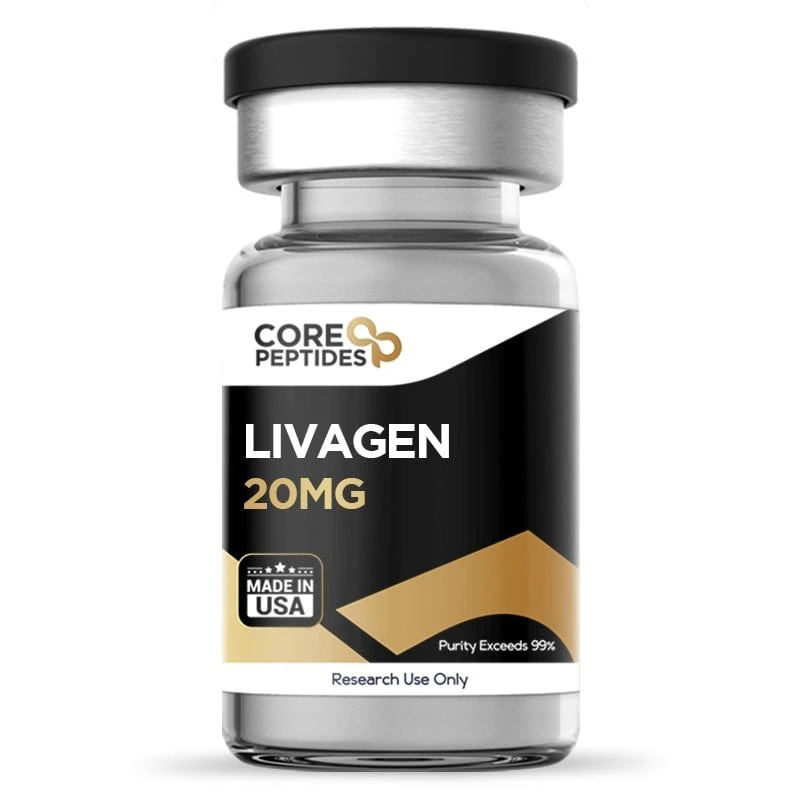
Livagen (20mg) is a synthetic tetrapeptide supplied as a lyophilised research material for laboratory and analytical applications. The referenced Core Peptides product lists Livagen with a quantity of 20mg, a reported purity of >99% and a molecular weight of approximately 461.5 g/mol.
Also known as KEDA, Livagen consists of the four-amino-acid sequence Lys-Glu-Asp-Ala. It belongs to the group of short synthetic peptides associated with the Khavinson peptide bioregulator research programme. Scientific interest in Livagen has centred on chromatin structure, gene regulation, cellular biology and tissue-specific peptide activity.
The available literature remains predominantly experimental. Research has examined Livagen in cell and tissue models, including investigations of chromatin organisation and enzyme activity. These findings provide areas for further laboratory study but should not be interpreted as established evidence of clinical efficacy or therapeutic use.
What Is Livagen (20mg)?
Livagen is a short synthetic tetrapeptide with the sequence Lys-Glu-Asp-Ala, abbreviated as KEDA. Its small molecular structure makes it useful for controlled laboratory research into peptide-mediated biological processes.
The Core Peptides listing describes the material as a lyophilised powder with a reported purity greater than 99%. Its listed molecular formula is C18H31N5O9 and its molecular weight is approximately 461.5 g/mol.
Livagen has attracted research interest because of proposed interactions with chromatin and cellular gene-expression processes. Early studies examined whether short peptide bioregulators could influence chromatin organisation and tissue-specific cellular activity.
Livagen (20mg) Product Specifications
| Specification | Details |
|---|---|
| Product Name | Livagen |
| Quantity | 20mg |
| Alternative Name | KEDA |
| Peptide Sequence | Lys-Glu-Asp-Ala |
| Form | Lyophilised powder |
| Reported Purity | >99% |
| Molecular Formula | C18H31N5O9 |
| Molecular Weight | 461.5 g/mol |
| Research Areas | Chromatin biology, gene expression, cellular biology and peptide research |
| Intended Application | Laboratory and scientific research |
The specifications above reflect the referenced product listing. Researchers should always consult the current batch-specific certificate of analysis and product documentation for definitive analytical specifications.
Livagen Chemical Structure
Livagen is a tetrapeptide composed of four amino acids:
- Lysine (Lys/K)
- Glutamic acid (Glu/E)
- Aspartic acid (Asp/D)
- Alanine (Ala/A)
The resulting sequence is written as Lys-Glu-Asp-Ala or simply KEDA. Independent chemical databases and research suppliers similarly identify Livagen by this sequence and report a molecular weight of approximately 461.47 g/mol.
As a relatively short peptide, KEDA provides a useful model for investigating how small peptide sequences may interact with cellular and molecular systems under controlled experimental conditions.
Livagen and Chromatin Research
One of the primary areas of scientific interest surrounding Livagen is chromatin biology.
Chromatin is the complex of DNA and associated proteins that packages genetic material within the nucleus. Its organisation influences how accessible particular regions of DNA are to the molecular machinery involved in gene expression.
Early research into synthetic peptide bioregulators proposed that peptides such as Livagen could influence chromatin organisation. A study examining tissue-specific peptide effects reported activity of synthetic peptides including Livagen in organotypic culture models.
Further research involving lymphocyte cultures investigated changes in chromatin organisation following exposure to short peptide bioregulators. These experiments provide a basis for studying peptide–chromatin interactions, although they do not establish equivalent effects in living humans.
Livagen and Gene Expression Research
Gene expression refers to the process by which information encoded within DNA is used to produce functional RNA and proteins. Regulation of gene expression is influenced by chromatin structure, transcription factors, DNA modifications and numerous other cellular mechanisms.
Livagen has been investigated as part of research into whether short peptide bioregulators can influence chromatin accessibility and cellular gene-expression patterns.
The proposed mechanism is sometimes described as chromatin decondensation or deheterochromatinisation. In experimental contexts, this refers to changes in the compact organisation of chromatin that may alter access to particular DNA regions. Research reported by the supplier describes Livagen-associated changes in chromatin organisation in lymphocyte models.
These observations remain an area of experimental investigation and should not be presented as proof that Livagen can selectively reactivate genes or reverse age-related changes in humans.
Livagen and Lymphocyte Research
Lymphocytes are a group of white blood cells that play important roles in adaptive and innate immune responses. Because lymphocytes contain highly organised chromatin, they can serve as useful experimental models for studying relationships between cellular differentiation, chromatin organisation and gene expression.
Research associated with the Khavinson peptide programme has examined Livagen and related peptides in lymphocyte cultures. The reported objective was to investigate whether peptide bioregulators could influence the structural organisation of chromatin in cells obtained from older donors.
These experiments are useful for mechanistic research but should be distinguished from clinical studies involving administration of Livagen to human participants.
Livagen and Tissue-Specific Peptide Research
Short synthetic peptides in the Khavinson research programme have historically been investigated for possible tissue-specific activity.
A published study by V. K. Khavinson reported that synthetic peptides including Cortagen, Epitalon, Livagen and Vilon produced tissue-specific effects in organotypic cultures from different rat tissues. Livagen was included among the compounds studied for tissue-related peptide activity.
Such research is relevant to understanding whether small peptide sequences can produce different biological responses depending on the cellular or tissue environment.
Livagen and Enzyme Research
Livagen has also been investigated in biochemical experiments involving enzymes associated with the endogenous opioid system.
A PubMed-indexed study examined the effects of Livagen and Epitalon on enkephalin-degrading enzymes in human serum. The researchers reported inhibition of these enzymes in vitro and calculated an IC50 for Livagen under the experimental conditions used.
Because this was an in-vitro biochemical study, the results demonstrate experimental activity under controlled laboratory conditions rather than a confirmed therapeutic effect in humans.
Livagen and Cellular Biology
Livagen is particularly relevant to researchers studying relationships between short peptides and cellular processes.
Potential research endpoints include:
- Chromatin organisation.
- Heterochromatin structure.
- Gene-expression patterns.
- Cellular differentiation.
- Nuclear organisation.
- Enzyme activity.
- Cellular signalling.
- Tissue-specific responses.
These areas allow researchers to investigate the biological activity of a defined four-amino-acid peptide without introducing the complexity of larger proteins or multifunctional biological molecules.
Livagen Research Applications
Livagen (20mg) may be of interest for laboratory investigations involving:
- Chromatin research: Studying structural changes in DNA-protein complexes.
- Gene regulation research: Investigating relationships between chromatin organisation and gene expression.
- Cell biology: Examining peptide-associated changes in cellular processes.
- Lymphocyte research: Investigating chromatin organisation in immune-cell models.
- Biochemical research: Evaluating interactions between Livagen and selected enzymes.
- Peptide science: Characterising the activity of short synthetic peptides.
- Tissue culture research: Studying peptide activity in controlled cellular and tissue models.
- Comparative peptide research: Comparing Livagen with other short peptide bioregulators.
Livagen and Liver-Related Research
Livagen is frequently described within the Khavinson peptide literature as a peptide associated with liver or hepatic tissue research. The proposed tissue-specific concept is based partly on early organotypic culture research and subsequent investigations of peptide bioregulators.
However, claims concerning liver protection, liver regeneration or improved liver function require careful interpretation. The available evidence includes experimental studies, while modern independent clinical evidence remains limited.
Accordingly, Livagen should be regarded as an investigational research compound rather than an established treatment for liver disease or impaired liver function.
Livagen and Ageing Research
Livagen is sometimes discussed within the broader field of peptide and ageing research because of hypotheses concerning chromatin organisation and age-associated changes in cellular function.
The underlying research question is whether age-related changes in chromatin organisation could be influenced by short peptide compounds. Experimental work involving lymphocytes from older donors has reported chromatin-related changes following exposure to peptide bioregulators.
However, these observations should not be interpreted as evidence that Livagen is an anti-ageing treatment. Available sources emphasise that clinical efficacy and long-term safety in humans have not been adequately established.
Livagen Compared With Other Peptide Bioregulators
Livagen belongs to a broader group of short synthetic peptides that have been investigated as tissue-associated bioregulators.
| Peptide | Sequence | General Research Focus |
|---|---|---|
| Livagen | Lys-Glu-Asp-Ala | Chromatin, gene regulation and hepatic-related research |
| Epithalon | Ala-Glu-Asp-Gly | Cellular ageing and telomere-related research |
| Vilon | Lys-Glu | Immune and thymus-related research |
| Cortagen | Ala-Glu-Asp-Pro | Neural and brain-related research |
These peptides have different amino acid sequences and should not be considered interchangeable. Their proposed biological activities also arise from different experimental research programmes.
Why Researchers Study Short Peptides
Short peptides offer several advantages as experimental research tools. Their defined sequences make them suitable for controlled studies investigating molecular interactions, cellular responses and structure–activity relationships.
Livagen contains only four amino acids, allowing researchers to investigate how a relatively small molecular structure interacts with complex biological systems.
Research questions may include:
- How does peptide sequence influence cellular activity?
- Can short peptides interact with nuclear or chromatin-associated processes?
- How do peptide structures influence enzyme activity?
- Are biological effects dependent on tissue or cell type?
- Can experimental chromatin changes be reproduced independently?
Livagen (20mg) Storage and Laboratory Handling
The referenced product is supplied as a lyophilised powder. Laboratory researchers should consult the current certificate of analysis, safety documentation and supplier handling instructions for batch-specific storage and handling requirements.
Research materials should be handled using appropriate laboratory procedures and environmental controls. The precise handling conditions can depend on the experimental design, analytical method and form in which the material is used.
Researchers should avoid relying on generic peptide-handling instructions when batch-specific documentation is available.
Frequently Asked Questions About Livagen (20mg)
What is Livagen?
Livagen is a synthetic tetrapeptide also known as KEDA. Its amino acid sequence is Lys-Glu-Asp-Ala. It has been investigated in laboratory research involving chromatin, gene regulation, cellular biology and tissue-specific peptide activity.
What is the amino acid sequence of Livagen?
The sequence of Livagen is Lys-Glu-Asp-Ala, commonly abbreviated to KEDA.
What does KEDA stand for?
KEDA represents the four amino acids in the Livagen sequence: Lysine (K), Glutamic acid (E), Aspartic acid (D) and Alanine (A).
What is the molecular weight of Livagen?
Livagen has a reported molecular weight of approximately 461.5 g/mol. Its molecular formula is C18H31N5O9.
What is Livagen researched for?
Research has investigated Livagen in relation to chromatin organisation, gene expression, lymphocyte biology, tissue-specific peptide activity and biochemical enzyme interactions.
Has Livagen been clinically proven?
No. The available evidence should not be considered sufficient to establish Livagen as a clinically proven treatment. Much of the published evidence concerns laboratory, cell or experimental models, and independent assessments note significant gaps in modern clinical evidence.
Is Livagen approved as a medicine?
Livagen should not be treated as an approved medicinal product. Research sources describe it as an investigational peptide rather than an established pharmaceutical therapy.
Is Livagen the same as Epithalon?
No. Livagen and Epithalon are different peptides with different amino acid sequences. Livagen is Lys-Glu-Asp-Ala, whereas Epithalon is Ala-Glu-Asp-Gly.
What form is Livagen (20mg) supplied in?
The referenced Core Peptides product is supplied as a lyophilised powder containing 20mg, with a reported purity greater than 99%.
Can Livagen be used as a supplement?
The referenced product is presented as a research material rather than a food supplement. It should not be described or marketed as a dietary supplement or medicinal treatment.
Does Livagen improve immunity?
Experimental research has investigated Livagen in lymphocyte and chromatin models, and some supplier materials discuss possible immune-related mechanisms. However, these laboratory observations do not establish that Livagen improves immune function in humans.
Does Livagen have anti-ageing effects?
Livagen is sometimes discussed in connection with ageing research because of its proposed effects on chromatin organisation. However, experimental chromatin findings should not be equated with demonstrated anti-ageing effects in humans.
Research Summary: Livagen (20mg)
Livagen (20mg) is a synthetic tetrapeptide identified by the sequence Lys-Glu-Asp-Ala (KEDA). The referenced product is supplied as a lyophilised powder with a reported purity of >99% and a molecular weight of approximately 461.5 g/mol.
Its main scientific interest centres on the relationship between short peptide sequences and cellular processes. Experimental research has examined Livagen in connection with chromatin organisation, gene regulation, lymphocyte biology, tissue-specific activity and biochemical enzyme interactions.
Research involving lymphocyte cultures has reported changes in chromatin organisation following exposure to peptide bioregulators, while biochemical studies have investigated Livagen’s effects on enkephalin-degrading enzymes in vitro.
Despite this scientific interest, the evidence base should be interpreted cautiously. Experimental findings do not establish clinical efficacy, appropriate human dosing or long-term safety. Independent sources note that modern human clinical evidence for Livagen remains limited or insufficient.
Research-Use Disclaimer
Livagen (20mg) is intended for laboratory and scientific research purposes only. It is not presented as a medicine, dietary supplement or treatment for any disease or medical condition.
The information on this page is provided for educational and research purposes and should not be interpreted as medical advice. Experimental findings involving Livagen should not be used to claim that the peptide can prevent, diagnose, treat or cure disease.
Researchers should review applicable regulations, institutional requirements, supplier documentation and batch-specific analytical data before working with any research peptide. Human or veterinary use should not be inferred from laboratory research findings.
Be the first to review “Livagen (20mg)”
Related products
Peptides for Sale
Peptides for Sale
Peptides for Sale
Peptides for Sale
Peptides for Sale
Peptides for Sale
Peptide Blends for Sale
Peptides for Sale
Reviews
There are no reviews yet.