
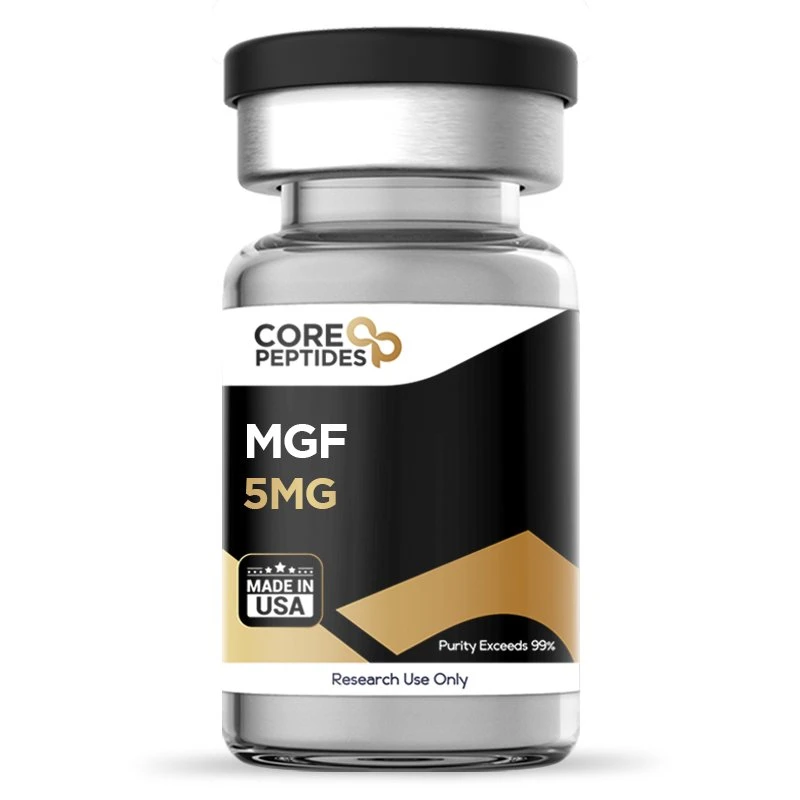

MGF (5mg) – Mechano Growth Factor Research Peptide
MGF (5mg), commonly known as Mechano Growth Factor, is a peptide associated with the insulin-like growth factor 1 (IGF-1) system and has been investigated extensively in cellular, molecular and tissue research.
MGF is also referred to in the scientific literature as IGF-1Ec, although terminology can vary depending on whether researchers are discussing the naturally occurring IGF-1 splice variant or a synthetic peptide corresponding to part of its E-domain.
The referenced Core Peptides product is supplied as 5mg of lyophilised powder and lists a stated purity of >99%. The supplier identifies the material as being intended for research and laboratory purposes only.
MGF has attracted particular scientific interest because expression of IGF-1 splice variants can change in response to mechanical stress and tissue injury. Research has examined MGF-related signalling in muscle cells, cartilage, bone, neural tissue and other experimental systems. However, findings remain context-dependent, and some studies have reported results that do not reproduce earlier claims about synthetic MGF peptides.
What Is MGF?
Mechano Growth Factor (MGF) is a term associated with an IGF-1 splice variant that has been investigated particularly in relation to mechanically stimulated tissue. IGF-1 is produced in several molecular forms as a result of alternative splicing of the IGF1 gene, with differences in the C-terminal region distinguishing individual isoforms.
The scientific literature has also used the name MGF for synthetic peptides corresponding to the C-terminal region of IGF-1Ec. This distinction is important because the naturally occurring IGF-1 splice variant and synthetic MGF-derived peptides are not necessarily biologically equivalent. A detailed review specifically highlights the difference between the endogenous IGF-1 splice product and synthetic MGF peptides used experimentally.
MGF (5mg) Product Overview
| Specification | Details |
|---|---|
| Product Name | MGF |
| Common Name | Mechano Growth Factor |
| Related Terminology | IGF-1Ec, MGF-E, MGF-Ct24E |
| Quantity | 5mg |
| Form | Lyophilised powder |
| Reported Purity | >99% |
| Molecular Formula Listed by Supplier | C124H204N42O41S |
| Molecular Weight Listed by Supplier | 2971.99 g/mol |
| Research Areas | IGF-1 biology, cellular signalling, muscle and tissue research |
| Intended Application | Research and laboratory use only |
The product format and specifications above are based on the referenced Core Peptides listing. Researchers should consult the current batch-specific certificate of analysis for definitive analytical information.
MGF and the IGF-1 System
MGF research is closely connected with insulin-like growth factor 1 (IGF-1), an important signalling molecule involved in growth, development and cellular processes.
The IGF1 gene can undergo alternative splicing, generating different transcripts with distinct C-terminal regions. Research into mechanically stimulated muscle has focused particularly on the IGF-1Ec splice variant, which has also been described as MGF.
This relationship makes MGF a useful subject for research into how mechanical stimuli and tissue stress can influence gene expression and peptide signalling.
MGF and Alternative Splicing
Alternative splicing enables a single gene to produce multiple related RNA transcripts and protein products. In the case of IGF1, differences in the C-terminal region produce several isoforms.
Research into MGF originated partly from observations that specific IGF-1 transcripts become more prominent following mechanical stress or muscle damage. The IGF-1Eb/IGF-1Ec-related pathway therefore became an area of interest in studies of muscle adaptation and tissue repair.
Importantly, scientific reviews have noted that the relationship between the naturally occurring IGF-1 splice variant and the synthetic peptide historically called MGF is more complicated than early descriptions suggested.
MGF-E and Synthetic MGF Peptides
Some experimental studies have investigated a synthetic peptide corresponding to the 24 C-terminal amino acids of the MGF E-domain. This material is often referred to as MGF-Ct24E, MGF-E or simply synthetic MGF in research literature.
Early experimental work reported effects on myogenic precursor cells, including changes in proliferation, migration and differentiation. These findings generated substantial interest in MGF as a potential research tool for studying muscle-cell biology.
Nevertheless, subsequent research has produced mixed findings. One independent investigation reported that synthetic MGF peptides did not increase proliferation of C2C12 cells or primary human skeletal muscle myoblasts under the tested conditions.
MGF and Muscle Cell Research
Muscle tissue provides one of the principal experimental contexts for MGF research.
Mechanical loading, exercise and muscle injury can influence expression of different IGF-1 splice variants. Researchers have therefore investigated whether MGF-related signalling contributes to the cellular response to mechanical stress and tissue damage.
Experimental studies involving synthetic MGF-derived peptides have examined:
- Myoblast proliferation.
- Myogenic precursor-cell migration.
- Myoblast differentiation.
- Myotube formation.
- Cell survival.
- Muscle tissue remodelling.
- Responses to experimentally induced muscle injury.
Results vary between experimental models, peptide constructs and research conditions, so findings from one model should not automatically be generalised to human physiology.
MGF and Muscle Progenitor Cells
Muscle progenitor cells, including satellite-cell populations, play an important role in skeletal muscle regeneration.
Some early studies of synthetic MGF-E peptides reported increased activity of myogenic precursor cells and changes in their capacity to migrate or fuse. For example, a study investigating a synthetic 24-amino-acid MGF E-domain peptide reported pro-migratory activity in human myogenic precursor cells.
Another study reported that an MGF-E peptide influenced the fusion potential of human muscle progenitor cells in experimental systems.
These findings are useful for investigating muscle-cell biology but should not be interpreted as evidence that research-grade MGF is an established treatment for muscle injury or a clinically proven performance-enhancing product.
MGF and Tissue Repair Research
MGF has been investigated in experimental models of tissue injury because IGF-1 signalling is involved in several processes relevant to cellular growth and tissue remodelling.
Animal research has examined synthetic MGF in models of skeletal muscle injury and reported changes in inflammatory and extracellular-matrix markers. One study of experimentally induced muscle contusion reported that MGF exposure was associated with alterations in inflammatory cytokines, chemokines, oxidative-stress markers and matrix metalloproteinases.
These findings remain preclinical. They do not establish that MGF is an effective or approved therapy for injuries in humans.
MGF and Cellular Signalling
Research into MGF explores how IGF-1-related peptides may interact with cellular signalling pathways.
Full-length MGF and synthetic MGF-derived peptides should be distinguished when interpreting receptor studies. Experimental research has found that full-length MGF can activate the human IGF-1 receptor under certain in-vitro conditions, while one study reported that shorter human MGF and a stabilised MGF analogue did not activate IGF-1R in the same assay.
This illustrates an important point in MGF research: peptide structure and molecular form can substantially influence biological activity.
MGF and Bone Research
Beyond muscle biology, MGF has also been investigated in skeletal and cartilage research.
Experimental studies have examined MGF-related signalling in chondrocytes and bone-associated cells. A review of MGF research in cartilage describes the peptide as a mechanically sensitive IGF-1-related factor and discusses its potential involvement in chondrocyte proliferation, migration, differentiation and inflammatory responses.
Animal studies have also investigated synthetic MGF in experimental bone-defect models. Such work is useful for understanding possible mechanisms of tissue signalling but remains preclinical and cannot establish clinical efficacy in humans.
MGF and Neural Research
MGF has also attracted interest in neuroscience and neuroprotection research.
Experimental work has investigated MGF-related peptides in models of cerebral ischaemia and neuronal stress. Research using animal and cellular models has explored possible relationships between MGF signalling, neuronal survival and neurogenesis.
These studies are relevant to understanding IGF-1-related signalling in neural tissue, but they do not establish MGF as a treatment for stroke, neurological disorders or brain injury.
MGF and Cellular Survival Research
Cell survival and apoptosis are additional areas of experimental interest.
Research has examined whether MGF-derived peptides influence cellular responses to hypoxia and other forms of stress. Experimental work involving cardiac cells has investigated possible changes in apoptosis-related signalling and stem-cell migration.
Such findings are hypothesis-generating and should be interpreted within the limitations of the relevant experimental models.
MGF Research Applications
MGF (5mg) may be relevant to qualified researchers investigating:
- IGF-1 biology: Studying alternative IGF-1 isoforms and their expression.
- Alternative splicing: Investigating how IGF1 transcript processing produces different molecular forms.
- Muscle biology: Examining myoblast and satellite-cell responses.
- Cell proliferation: Studying experimental changes in cellular growth and division.
- Cell differentiation: Investigating myogenic differentiation and myotube formation.
- Tissue remodelling: Examining signalling associated with mechanically stimulated tissues.
- Bone and cartilage research: Studying MGF-related responses in skeletal tissues.
- Neuroscience: Investigating experimental neuroprotective and neurogenic pathways.
- Peptide pharmacology: Comparing full-length and synthetic MGF-derived constructs.
- Analytical chemistry: Characterising peptide identity, purity and stability.
MGF vs IGF-1
| Characteristic | MGF | IGF-1 |
|---|---|---|
| Relationship | Associated with an IGF-1 splice variant | Primary insulin-like growth factor |
| Gene | IGF1 | IGF1 |
| Research Interest | Mechanical stress, tissue responses and alternative splicing | Growth, metabolism and cellular signalling |
| Structural Consideration | Distinct C-terminal region associated with IGF-1 isoforms | Canonical mature IGF-1 structure |
| Research Complexity | Terminology can include endogenous isoforms and synthetic MGF-derived peptides | More clearly defined molecular entity |
The distinction between endogenous MGF/IGF-1Ec and synthetic MGF-derived peptides is especially important. Scientific literature has highlighted uncertainty surrounding whether the synthetic 24-amino-acid peptide commonly called MGF represents a naturally produced, independently functioning peptide in vivo.
MGF and Mechanical Stress
The name Mechano Growth Factor reflects the early observation that specific IGF-1 transcripts can be regulated by mechanical loading.
Studies have investigated IGF-1 splice-variant expression following resistance exercise and muscle damage. The research suggests that mechanical stimuli can influence IGF1 mRNA expression, although the exact physiological role of the individual splice variants remains an active area of scientific investigation.
This makes MGF particularly relevant to research examining the molecular relationship between mechanical stress and tissue adaptation.
MGF and Exercise Research
MGF has frequently appeared in scientific discussions of exercise physiology because mechanical loading can alter IGF-1 isoform expression in skeletal muscle.
Research has investigated changes in IGF-1 mRNA following resistance exercise and muscle damage, including changes in transcripts associated with MGF. These studies provide a basis for examining how muscle responds to mechanical stimuli at the molecular level.
However, the presence of increased MGF-related mRNA or expression does not by itself demonstrate that administering synthetic MGF produces the same physiological response.
MGF and Peptide Structure
MGF research demonstrates why peptide structure is important when interpreting biological studies.
The literature may use “MGF” to describe different materials, including:
- The endogenous IGF-1Ec/IGF-1Eb-related splice variant.
- The C-terminal region associated with the MGF E-domain.
- Synthetic 24-amino-acid MGF-Ct24E peptides.
- Recombinant or full-length MGF-related proteins.
- Modified or stabilised synthetic MGF analogues.
These materials should not automatically be assumed to have identical biological properties. Research comparing different MGF constructs demonstrates that molecular form can influence receptor activity and experimental outcomes.
MGF and Scientific Research Limitations
MGF is an interesting but scientifically complex research subject. Early studies produced promising observations regarding muscle-cell proliferation and tissue responses, while later work has challenged some interpretations of the synthetic peptide’s biological activity.
For this reason, researchers should avoid treating proposed mechanisms as established facts. Findings from cell cultures, animal models and molecular assays should be interpreted according to the specific experimental design.
In particular, evidence concerning a synthetic MGF peptide should not automatically be extrapolated to the naturally occurring IGF-1 splice variant.
Frequently Asked Questions About MGF (5mg)
What is MGF?
MGF stands for Mechano Growth Factor. The term is associated with an IGF-1 splice variant and is also used for synthetic peptides corresponding to part of the IGF-1Ec E-domain.
What does MGF stand for?
MGF stands for Mechano Growth Factor. It is also referred to in scientific literature as IGF-1Ec in the context of an IGF-1 splice variant.
Is MGF related to IGF-1?
Yes. MGF is closely associated with the IGF-1 system and is described as an IGF-1 splice variant or MGF-derived peptide depending on the research context.
What is MGF-Ct24E?
MGF-Ct24E refers to a synthetic peptide corresponding to 24 amino acids from the C-terminal region of the MGF E-domain. It has been investigated experimentally in muscle-cell and other biological models.
What is MGF researched for?
Research areas include IGF-1 alternative splicing, muscle-cell biology, tissue remodelling, cellular signalling, bone and cartilage research, neural biology and peptide structure-activity relationships.
Does MGF increase muscle mass?
Research has investigated MGF-related peptides in muscle-cell models, including proliferation and myotube formation. However, these experimental findings do not establish that research-grade MGF increases muscle mass in humans. Evidence concerning synthetic MGF peptides is mixed, with some studies failing to reproduce earlier proliferation findings.
Is MGF the same as IGF-1?
No. MGF is associated with an alternative IGF-1 splice form, while IGF-1 refers to a broader and distinct set of molecular products. The terminology surrounding MGF can also refer to synthetic peptides derived from the IGF-1 E-domain.
What form is MGF (5mg) supplied in?
The referenced Core Peptides product is listed as 5mg of lyophilised powder with a stated purity of greater than 99%.
Is MGF approved as a medicine?
Research-grade MGF is not an authorised medicine. It should not be represented as a treatment for muscle injury, neurological disease, bone disorders or other medical conditions.
Is MGF used in sports?
MGF-related peptides have attracted attention in sports pharmacology and anti-doping research. Scientific literature notes that MGF peptide has been prohibited under World Anti-Doping Agency regulations.
Why is MGF scientifically interesting?
MGF provides a research model for examining how IGF-1 alternative splicing and mechanically responsive signalling may influence cellular behaviour. Its study also illustrates the importance of distinguishing endogenous splice variants from synthetic peptide constructs.
MGF (5mg) Research Summary
MGF (5mg) is a research peptide associated with the IGF-1 family and the study of mechanically responsive cellular signalling. The referenced product is supplied as lyophilised powder with a stated purity above 99% and is designated for research and laboratory purposes.
Scientific research has examined MGF in relation to IGF-1 alternative splicing, muscle progenitor cells, cellular proliferation, tissue remodelling, bone and cartilage biology, neural signalling and cell survival. Early experimental findings generated interest in synthetic MGF-derived peptides, while later studies have highlighted important uncertainties and inconsistent results.
For qualified researchers, MGF therefore represents a useful subject for studying the relationship between mechanical stress, IGF-1 biology, peptide structure and cellular signalling. Any experimental conclusions should be based on the specific MGF construct, model and analytical methods used rather than broad claims about the MGF family.
Research-Use Disclaimer
MGF (5mg) is intended for research, laboratory and analytical purposes only. It is not intended for human or animal consumption, self-administration, diagnosis, treatment, cure or prevention of any disease.
Research-grade MGF should not be marketed as an established muscle-building, recovery, injury-treatment or performance-enhancing medicine. Researchers should distinguish carefully between endogenous IGF-1 splice variants, synthetic MGF-derived peptides and full-length recombinant MGF because these materials may have different molecular and biological characteristics.
Qualified researchers should consult the current certificate of analysis and relevant safety documentation for the specific material and conduct all work according to applicable legislation, institutional requirements and laboratory safety procedures.
Be the first to review “MGF (5mg)”
Related products

Peptides for Sale

Peptide Blends for Sale
Peptides for Sale

Peptides for Sale

Peptides for Sale

Peptides for Sale

Peptides for Sale

Peptides for Sale
Reviews
There are no reviews yet.