
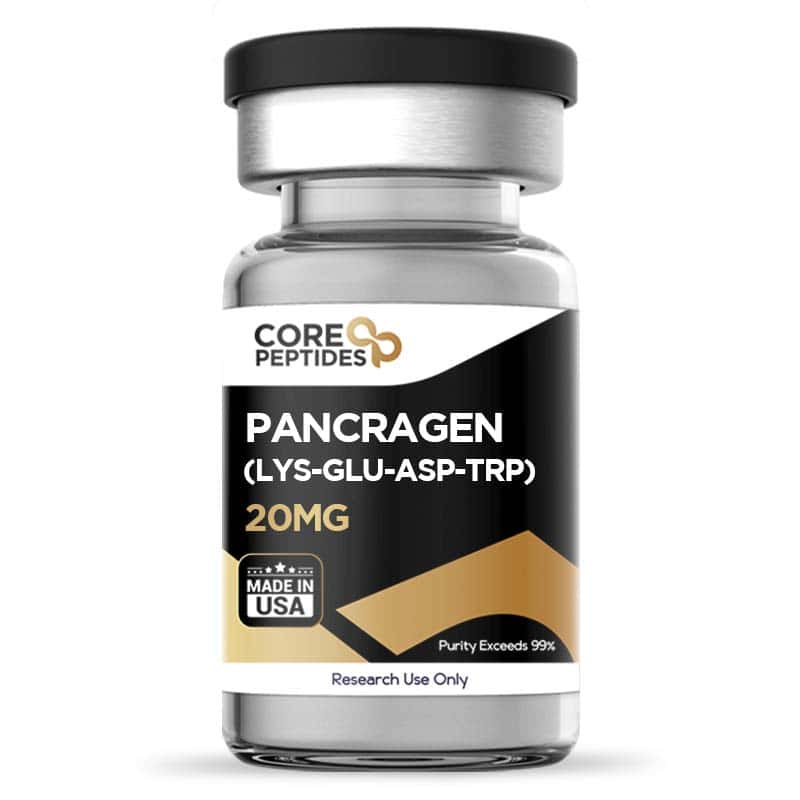


Pancragen (20mg) – KEDW Research Peptide
Pancragen (20mg) is a synthetic tetrapeptide commonly identified by the sequence Lys-Glu-Asp-Trp (KEDW). It has been investigated within the field of tissue-specific peptide research, particularly in relation to pancreatic tissue, endocrine function, cellular differentiation and glucose metabolism. The referenced product is supplied as a 20mg research material intended for qualified laboratory and analytical applications.
Research on Pancragen includes experimental studies involving pancreatic cell cultures, animal models and a small study involving older adults. Reported findings have explored pancreatic differentiation markers, insulin and C-peptide responses and glucose tolerance.
However, the available evidence remains limited and should not be interpreted as establishing Pancragen as an approved treatment for diabetes, pancreatic disorders or age-related metabolic conditions.
For laboratories investigating short peptide bioregulators, Pancragen provides a defined tetrapeptide for studying pancreatic biology and related cellular pathways under controlled experimental conditions.
What Is Pancragen?
Pancragen is a synthetic tetrapeptide associated with the short-peptide bioregulator research programme developed by researchers at the St Petersburg Institute of Bioregulation and Gerontology. Its commonly reported amino-acid sequence is Lys-Glu-Asp-Trp (KEDW).
The compound has been studied because of its proposed relationship with pancreatic tissue and pancreatic endocrine function. Experimental research has investigated whether Pancragen can influence markers associated with pancreatic-cell differentiation and the regulation of insulin- and glucagon-related processes.
Pancragen is therefore of interest to researchers working in peptide biology, pancreatic-cell research, ageing-related biology and metabolic research.
Pancragen (20mg) Specifications
| Specification | Details |
|---|---|
| Product Name | Pancragen |
| Alternative Name | KEDW |
| Peptide Sequence | Lys-Glu-Asp-Trp |
| Peptide Type | Synthetic tetrapeptide |
| Quantity | 20mg |
| Primary Research Area | Pancreatic and endocrine biology |
| Additional Research Areas | Cellular differentiation, glucose metabolism and ageing-related research |
| Intended Use | Laboratory and research purposes only |
The Core Peptides reference identifies the product as a 20mg Pancragen research peptide. Other research suppliers similarly identify Pancragen as the KEDW tetrapeptide and describe it as a lyophilised research material.
Pancragen Peptide Sequence
The Pancragen sequence is:
- Lysine (Lys / K)
- Glutamic acid (Glu / E)
- Aspartic acid (Asp / D)
- Tryptophan (Trp / W)
These four amino acids form the sequence commonly abbreviated as KEDW. PubMed-indexed research identifies Pancragen as the tetrapeptide Lys-Glu-Asp-Trp.
Researchers studying Pancragen should distinguish the exact molecular form specified by their experimental material, as some literature concerning short peptide bioregulators can describe closely related peptide forms or nomenclature.
Pancragen and Pancreatic Research
Pancragen has primarily attracted research interest because of its proposed relationship with pancreatic tissue. Experimental studies have examined pancreatic cells and tissues to investigate whether the tetrapeptide influences cellular differentiation and functional markers.
One PubMed-indexed study examined Pancragen alongside other tissue-specific synthetic peptides in organotypic cultures from young and aged rats. The researchers reported tissue-specific effects at the experimental concentration used in the study, including an observed response in pancreatic tissue cultures.
Additional research has investigated Pancragen in pancreatic cell systems and animal models of impaired glucose regulation. These studies provide experimental evidence for further investigation but do not establish clinical efficacy.
Pancragen and Pancreatic Cell Differentiation
Cell differentiation describes the process through which cells develop specialised characteristics and functions. Pancreatic differentiation is particularly relevant because the pancreas contains several specialised cell populations, including endocrine and exocrine cells.
Research cited by Core Peptides has investigated Pancragen in pancreatic-cell cultures, focusing on transcription factors associated with pancreatic-cell differentiation, including Ptf1a and Pdx1. The reported findings suggested changes in the expression of differentiation-associated markers following experimental exposure to the tetrapeptide.
Separate PubMed-indexed research also reported tissue-specific stimulation of differentiation-related markers by short peptides, with Pancragen investigated in pancreatic cell cultures.
These findings make Pancragen relevant to laboratory research exploring how short peptides may interact with pathways involved in tissue-specific cellular differentiation.
Pancragen and Insulin Research
Insulin is a pancreatic hormone involved in the regulation of blood glucose. Because pancreatic endocrine function is one of the principal research areas associated with Pancragen, several experimental studies have investigated insulin-related responses.
Animal research has examined Pancragen in models of impaired pancreatic function and reported changes in insulin-producing pancreatic cells. Other research has examined insulin and C-peptide responses following glucose administration in older rhesus monkeys.
These findings are of interest to researchers studying pancreatic endocrine physiology. They should not, however, be interpreted as evidence that Pancragen is an established insulin-regulating medicine or a treatment for diabetes.
Pancragen and C-Peptide Research
C-peptide is released alongside endogenous insulin and is commonly measured as a marker of pancreatic beta-cell insulin production.
A study involving older rhesus monkeys investigated the effect of Pancragen on pancreatic endocrine function and reported changes in insulin and C-peptide dynamics following glucose administration. The researchers observed that some measures moved towards patterns seen in younger animals.
These observations provide a research basis for examining Pancragen in experimental models of age-related pancreatic dysfunction, although animal findings cannot automatically be translated into human clinical outcomes.
Pancragen and Glucose Metabolism Research
Glucose metabolism is another important area associated with Pancragen research. Experimental studies have investigated the tetrapeptide in models involving altered glucose tolerance and pancreatic endocrine function.
A PubMed-indexed study involving older adults reported changes in glucose-related measures following administration of Pancragen. The study included healthy older participants and older participants with type 2 diabetes and reported reductions in certain glucose and insulin-resistance measures.
Although this study provides human data, it represents a limited evidence base. The findings have not established Pancragen as an authorised medical treatment, and further high-quality, independently replicated clinical research would be required to determine its clinical relevance.
Pancragen and Glucagon Research
Glucagon is another pancreatic hormone involved in glucose regulation. Experimental research has examined the balance between insulin-producing beta cells and glucagon-producing alpha cells in pancreatic models.
Core Peptides describes animal research in which Pancragen was investigated in a model of diabetes and reports changes involving insulin- and glucagon-producing pancreatic cells.
This area of research may be relevant to laboratories studying pancreatic endocrine balance and the molecular mechanisms underlying glucose regulation.
Pancragen and Pancreatic Ageing Research
Pancragen is also associated with research into age-related changes in pancreatic function.
Ageing can affect tissue structure, cellular differentiation and endocrine responses. Research involving Pancragen has therefore examined whether short peptide bioregulators influence markers associated with pancreatic-cell function in aged experimental systems. Studies have included aged cell cultures and older non-human primates.
In the rhesus-monkey study, researchers reported changes in glucose disappearance and insulin and C-peptide responses following experimental Pancragen administration.
Such findings are relevant to gerontology and pancreatic biology research but should not be presented as proof of an anti-ageing treatment.
Pancragen and Cellular Markers
Laboratory research has investigated several cellular proteins and markers in pancreatic systems exposed to Pancragen.
Core Peptides reports experimental observations involving markers including MMP2, MMP9, Mcl1, PCNA, Ki67 and p53, alongside other cellular markers. The reported changes have been interpreted within research examining pancreatic-cell vitality, proliferation and apoptosis.
These molecular markers can be useful experimental endpoints when researchers investigate cellular responses to peptide compounds. Their alteration in an experimental model does not by itself establish a therapeutic effect in humans.
Pancragen and Pancreatic Transcription Factors
Transcription factors regulate the expression of genes involved in cell identity and function. Several pancreatic transcription factors are important for the development and maintenance of specialised pancreatic cells.
Research described by Core Peptides has investigated Pancragen in relation to pancreatic differentiation factors including Ptf1a, Pdx1, Pax6, Foxa2, Nkx2.2 and Pax4.
Understanding how short peptides interact with differentiation-associated pathways may help researchers investigate mechanisms involved in pancreatic development, ageing and cellular function.
Pancragen in Cell Culture Research
Cell culture models provide researchers with controlled environments in which peptide–cell interactions can be examined independently of many variables present in whole organisms.
Pancragen has been investigated in pancreatic cell cultures, including experimental systems comparing younger and older cultures. PubMed-indexed research reported tissue-specific effects of Pancragen on differentiation-related markers in pancreatic cells.
Another study using organotypic tissue cultures reported effects of short tissue-specific peptides, including Pancragen, in pancreatic tissue preparations from young and aged rats.
Pancragen in Animal Research
Animal models have provided another area of investigation for Pancragen. Research has included models of diabetes and aged non-human primates.
In a rhesus-monkey study, researchers administered Pancragen to older animals and evaluated glucose disappearance, insulin and C-peptide responses following glucose administration. The researchers reported improvements in several measured endocrine parameters compared with the control period.
A separate study compared Pancragen with glimepiride in older rhesus monkeys and reported differences in glucose, insulin and C-peptide responses.
Animal research can help identify biological questions for further study, but it cannot substitute for robust human clinical evidence.
Human Research on Pancragen
Human evidence concerning Pancragen is considerably more limited than the broader body of laboratory and animal research.
A PubMed-indexed publication examined older adults, including individuals with type 2 diabetes, and reported changes in glucose-related measurements following Pancragen administration. The study involved 30 healthy older people and 33 people with type 2 diabetes.
The existence of a human study is important when evaluating the evidence base, but a single small study is insufficient to establish efficacy or safety for clinical use. Larger, well-controlled and independently replicated clinical studies would be necessary to draw reliable conclusions.
Potential Research Areas for Pancragen
Qualified researchers may investigate Pancragen in areas including:
- Pancreatic biology: Investigation of pancreatic-cell function and tissue-specific responses.
- Endocrine research: Study of insulin, C-peptide and glucagon-associated pathways.
- Cell differentiation: Examination of pancreatic differentiation markers and transcription factors.
- Ageing research: Comparison of pancreatic cellular responses in younger and older experimental models.
- Glucose metabolism: Investigation of glucose-related pathways in controlled experimental systems.
- Cellular signalling: Analysis of molecular markers associated with pancreatic-cell activity.
- Apoptosis research: Investigation of markers associated with programmed cell death.
- Cell proliferation: Examination of proliferation-associated markers such as Ki67 and PCNA.
- Peptide biology: Investigation of short synthetic peptide bioregulators.
- Comparative peptide research: Evaluation alongside other tissue-associated peptide sequences.
Why Researchers Study Pancragen
Pancragen is particularly interesting because it represents a very short, defined peptide sequence associated with a specific area of tissue biology. Its KEDW sequence makes it straightforward to identify and compare with other short peptide bioregulators.
Researchers can investigate how such a small peptide interacts with cellular systems and whether its presence is associated with measurable changes in differentiation markers, endocrine responses or other molecular endpoints.
The combination of cell-culture, animal and limited human research also provides several experimental levels at which Pancragen can be studied, while highlighting the need for further independent investigation.
Pancragen vs Other Tissue-Specific Peptides
| Peptide | Common Sequence | Associated Research Area |
|---|---|---|
| Pancragen | Lys-Glu-Asp-Trp (KEDW) | Pancreatic tissue and endocrine research |
| Livagen | Short tissue-associated peptide | Liver and hepatic research |
| Cardiogen | Short tissue-associated peptide | Cardiovascular and cardiac research |
| Bronchogen | Ala-Glu-Asp-Leu | Bronchial and respiratory tissue research |
These peptides are associated with the broader research programme involving short synthetic peptides and tissue-specific biological responses. PubMed-indexed research has investigated Pancragen, Bronchogen and other peptides in tissue-specific cell cultures.
Pancragen Research Evidence
The available literature on Pancragen includes several experimental models. Cell-culture studies have examined differentiation-associated markers, while animal studies have explored pancreatic endocrine function and glucose responses. A small human study has also reported metabolic findings.
At the same time, the evidence base has important limitations. Much of the literature originates from the same research tradition, many studies are preclinical, and the available human evidence is limited. Consequently, laboratory findings should be treated as research observations rather than established clinical outcomes.
For scientific and commercial accuracy, Pancragen should therefore be described as a research peptide rather than as an approved therapy for diabetes, metabolic disease, pancreatic disease or ageing.
Frequently Asked Questions About Pancragen (20mg)
What is Pancragen?
Pancragen is a synthetic tetrapeptide commonly identified by the sequence Lys-Glu-Asp-Trp (KEDW). It has been investigated in pancreatic and endocrine research.
What does KEDW stand for?
KEDW represents the four amino acids in the commonly reported Pancragen sequence: Lysine, Glutamic acid, Aspartic acid and Tryptophan.
How much Pancragen is in this product?
The referenced product is offered in a 20mg quantity. The product is intended for laboratory and research applications rather than human use.
What is Pancragen studied for?
Research has investigated Pancragen in relation to pancreatic-cell differentiation, pancreatic endocrine function, insulin and C-peptide responses, glucose metabolism and ageing-related pancreatic changes.
Has Pancragen been studied in humans?
Yes. A small PubMed-indexed study involving older adults examined Pancragen in relation to glucose metabolism and insulin resistance. However, the available human evidence is limited and does not establish Pancragen as an approved medical treatment.
Has Pancragen been studied in animals?
Yes. Research has included experimental animal models and older rhesus monkeys. One study reported changes in glucose disappearance and insulin and C-peptide responses in older monkeys following experimental Pancragen administration.
Is Pancragen an insulin medication?
No. Pancragen is a synthetic tetrapeptide studied experimentally in relation to pancreatic endocrine function. It should not be represented as insulin or as a substitute for prescribed diabetes medication.
Is Pancragen a treatment for diabetes?
Pancragen has been investigated in experimental models and in a small human study involving type 2 diabetes, but the available evidence is insufficient to establish it as an approved treatment for diabetes.
Is Pancragen an anti-ageing treatment?
Pancragen has been investigated in ageing-related pancreatic research, including studies involving older cells and non-human primates. However, experimental findings should not be interpreted as proof that Pancragen is an anti-ageing treatment.
What research is associated with pancreatic differentiation?
Studies have examined Pancragen in relation to pancreatic differentiation-associated transcription factors and cellular markers. PubMed-indexed research reported tissue-specific stimulation of differentiation-related markers in pancreatic cell cultures.
What form is Pancragen supplied in?
Research suppliers commonly describe Pancragen as a lyophilised research material. The exact physical and analytical specifications should be verified against the batch-specific product documentation supplied with the material.
Is Pancragen approved for human use?
Pancragen should not be presented as an approved medicinal product. The referenced product is intended for research and laboratory use, and the available clinical evidence remains limited.
Pancragen (20mg) Research Summary
Pancragen (20mg) is a synthetic tetrapeptide commonly identified as Lys-Glu-Asp-Trp (KEDW). It has been investigated primarily in pancreatic research, with studies examining cellular differentiation, endocrine function, insulin and C-peptide responses, glucose metabolism and age-related changes in pancreatic tissue.
Experimental evidence includes pancreatic cell cultures, animal models and a small human study. Reported observations include changes in pancreatic differentiation markers and alterations in glucose and endocrine measurements. Nevertheless, the evidence base remains limited, and these findings should be regarded as research observations rather than established therapeutic effects.
For qualified laboratories, Pancragen provides a defined short peptide for controlled investigations into pancreatic biology, endocrine signalling, cellular differentiation, glucose-related pathways and ageing research.
Research-Use Disclaimer
Pancragen (20mg) is intended for qualified research, laboratory, analytical and in-vitro experimental purposes only. It is not intended for human or animal consumption, self-administration, diagnosis, treatment, cure or prevention of any disease.
References to insulin, glucagon, glucose metabolism, diabetes, pancreatic function, cellular differentiation or ageing describe areas of scientific investigation and should not be interpreted as medical claims or recommendations for treatment.
Researchers should consult the applicable certificate of analysis, safety documentation and institutional laboratory procedures before conducting experiments. All work should be performed by appropriately qualified personnel in accordance with applicable legislation and laboratory safety requirements.
For research use only. Not for human or veterinary use.
Be the first to review “Pancragen (20mg)”
Related products

Peptides for Sale

Peptides for Sale

Peptides for Sale
Peptides for Sale
Peptides for Sale

Peptides for Sale

Peptides for Sale
Peptides for Sale
Reviews
There are no reviews yet.