
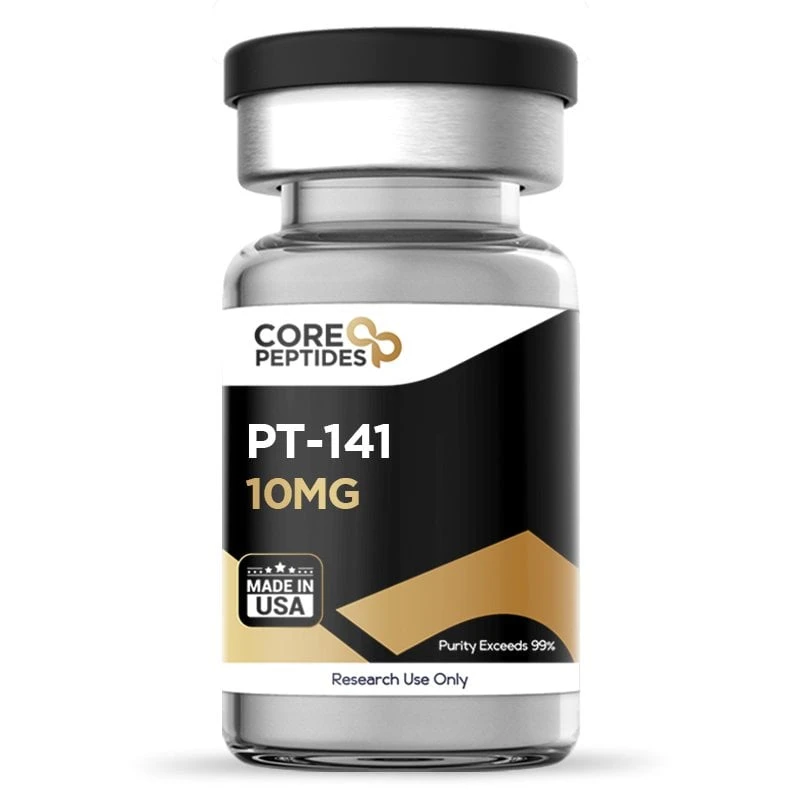
PT-141 (Bremelanotide) – 10mg Research Peptide
PT-141 (Bremelanotide) – 10mg is a synthetic cyclic peptide and melanocortin receptor agonist investigated extensively in biomedical research, particularly in studies involving melanocortin signalling, sexual-function pathways and central nervous system receptor activity.
PT-141 is the research name commonly associated with bremelanotide, a synthetic analogue of alpha-melanocyte-stimulating hormone (α-MSH). Bremelanotide acts on several melanocortin receptor subtypes, with MC1R and MC4R particularly relevant to its pharmacological activity.
Research has explored how activation of these receptors can influence physiological processes including sexual desire and arousal. The precise mechanism through which clinically administered bremelanotide improves hypoactive sexual desire disorder (HSDD) is not fully established.
The 10mg PT-141 format is intended as a research material rather than a representation of an approved pharmaceutical dosage. Researchers should distinguish between research-grade PT-141 material and the authorised medicinal product containing bremelanotide, which is supplied in a substantially different formulation and strength.
What Is PT-141 (Bremelanotide)?
PT-141, also known as bremelanotide, is a synthetic cyclic heptapeptide derived from research into melanocortin pathways. It is structurally related to α-MSH, a naturally occurring melanocortin peptide involved in several physiological processes.
Unlike many peptide compounds that are studied primarily for peripheral biological effects, PT-141 has received particular scientific interest because melanocortin receptors are expressed throughout the central nervous system. Research has therefore examined the relationship between melanocortin receptor activation and sexual behaviour, arousal and desire.
Early clinical research investigated PT-141 in both female sexual arousal disorders and male erectile dysfunction, while later development focused on bremelanotide for acquired, generalised HSDD in premenopausal women.
PT-141 (Bremelanotide) – 10mg Product Overview
| Specification | Details |
|---|---|
| Product Name | PT-141 (Bremelanotide) |
| Research Name | PT-141 |
| Active Peptide | Bremelanotide |
| Peptide Class | Synthetic cyclic melanocortin peptide |
| Quantity | 10mg |
| Primary Research Area | Melanocortin receptor signalling and sexual-function research |
| Key Receptors | MC1R, MC3R, MC4R and MC5R |
| Research Format | Research-grade peptide material |
| Intended Use | Laboratory and scientific research |
Published pharmacological information identifies bremelanotide as a melanocortin receptor agonist that activates several melanocortin receptor subtypes. At clinically studied concentrations, MC1R and MC4R are particularly relevant.
How Does PT-141 Work?
PT-141 works through the melanocortin receptor system. Bremelanotide binds to melanocortin receptors, with activity reported across MC1R, MC3R, MC4R and MC5R. MC4R is especially important in research into central melanocortin signalling and sexual-function pathways.
The melanocortin system is involved in multiple biological processes, including sexual behaviour, energy balance and pigmentation. Because different melanocortin receptor subtypes are expressed in different tissues, activation of these receptors can produce a range of physiological effects.
Although the exact mechanism by which medicinal bremelanotide improves HSDD remains unknown, research suggests that its effects involve activation of endogenous melanocortin pathways associated with sexual desire and arousal.
PT-141 and Melanocortin Receptors
Melanocortin receptors are a family of G-protein-coupled receptors involved in diverse physiological functions. The five principal melanocortin receptor subtypes are MC1R, MC2R, MC3R, MC4R and MC5R.
| Receptor | Research Relevance |
|---|---|
| MC1R | Associated with melanocyte activity and pigmentation. |
| MC3R | Investigated in metabolic and central melanocortin signalling. |
| MC4R | Strongly associated with central nervous system melanocortin signalling, appetite regulation and sexual-function research. |
| MC5R | Investigated in a variety of peripheral physiological processes. |
According to FDA pharmacological information, bremelanotide activates several melanocortin receptor subtypes, with MC1R and MC4R particularly relevant at therapeutic exposure levels.
PT-141 and Sexual-Function Research
One of the most extensively investigated areas involving PT-141 is sexual-function research.
Early studies evaluated whether melanocortin receptor activation could influence sexual arousal and erectile responses. A clinical study involving men examined subcutaneous PT-141 in healthy participants and men with erectile dysfunction who had reported inadequate responses to sildenafil.
The researchers observed erectile responses following PT-141 administration in the experimental setting. Separate research investigated intranasal PT-141 in premenopausal women with female sexual arousal disorder.
The study examined physiological and subjective measures of sexual arousal and reported significant treatment-related effects compared with placebo under the experimental conditions.
These early studies helped establish the scientific rationale for further investigation of melanocortin receptor agonists in sexual-function disorders.
PT-141 and HSDD Research
Hypoactive sexual desire disorder (HSDD) became a major focus of later bremelanotide development.
Clinical trials evaluated subcutaneous bremelanotide in premenopausal women with acquired, generalised HSDD. A randomised dose-finding trial involving 327 participants reported improvements in satisfying sexual events, female sexual-function scores and measures of sexual distress with the higher studied doses compared with placebo.
Two Phase 3 trials subsequently evaluated bremelanotide in more than 1,200 women. The studies reported statistically significant improvements in sexual desire and reductions in distress associated with low sexual desire compared with placebo.
These clinical findings are specific to the authorised medicinal formulation and studied patient population. They should not be used to imply that a research-grade 10mg PT-141 product is itself an approved medicine.
PT-141 and Bremelanotide Are They the Same?
In scientific and pharmaceutical literature, PT-141 is the development designation associated with bremelanotide. The compound was developed as a synthetic melanocortin analogue and subsequently advanced into clinical development under the bremelanotide name.
The FDA describes bremelanotide as a synthetic peptide analogue of α-MSH and a melanocortin receptor agonist.
Therefore, the terms PT-141 and bremelanotide generally refer to the same active peptide compound, although the formulation, purity, salt form, strength and regulatory status of a particular product must always be verified separately.
PT-141 Molecular Structure
Bremelanotide is a synthetic cyclic heptapeptide. FDA documentation describes its structure as Ac-Nle-cyclo-(Asp-His-D-Phe-Arg-Trp-Lys-OH), with the marketed medicinal product formulated as bremelanotide acetate.
The cyclic structure is an important characteristic of bremelanotide and distinguishes it from many linear peptide research compounds.
Structural modifications relative to naturally occurring melanocortin peptides were developed to alter receptor activity and peptide stability. Researchers can use PT-141 as a model for investigating how synthetic structural changes affect melanocortin receptor signalling.
PT-141 Research in Male Sexual Function
Before bremelanotide’s later development for HSDD, PT-141 was investigated in male sexual-function research.
Clinical studies examined subcutaneous administration in healthy male participants and men with erectile dysfunction who had an inadequate response to sildenafil. Researchers measured erectile responses using objective physiological methods and reported significant responses in the experimental groups.
Intranasal formulations were also investigated. Early studies reported erectile responses and identified flushing and nausea among commonly observed adverse events.
Although these studies provide valuable pharmacological data, they do not mean that research-grade PT-141 should be used to self-treat erectile dysfunction.
PT-141 and Central Nervous System Research
The central nervous system is an important area of melanocortin research because MC4R is expressed in multiple regions of the brain.
Researchers have investigated how activation of melanocortin pathways may influence sexual motivation, arousal and related behavioural responses. The exact pathways responsible for the clinical effects of bremelanotide remain incompletely understood.
PT-141 therefore provides researchers with a useful molecular tool for studying receptor-mediated signalling within the broader melanocortin system.
PT-141 and Pigmentation Research
Because PT-141 activates MC1R as well as other melanocortin receptors, pigmentation is another relevant research consideration.
MC1R is expressed by melanocytes, and activation of this receptor can increase melanin production. FDA pharmacological information notes that bremelanotide binding to MC1R can contribute to increased pigmentation.
This receptor activity helps explain why pigmentation has been investigated as one of the pharmacological effects associated with melanocortin receptor agonism.
PT-141 Safety and Pharmacology Research
Clinical research has identified several physiological effects associated with bremelanotide exposure. These include transient increases in blood pressure, reductions in heart rate, nausea, flushing, headache and injection-site reactions.
In the clinical development programme, nausea was the most common adverse event and was also a significant reason for treatment discontinuation.
FDA prescribing information also identifies clinically important cardiovascular considerations and contraindicates the authorised medicinal product in patients with uncontrolled hypertension or known cardiovascular disease.
These safety data apply to clinical bremelanotide use and demonstrate why PT-141 should not be treated as a general-purpose supplement or self-administered research compound.
PT-141 and Blood Pressure
Transient blood-pressure elevation is a recognised pharmacodynamic effect of bremelanotide.
Clinical studies observed increases in systolic and diastolic blood pressure after administration, accompanied by transient reductions in heart rate. Blood pressure generally returned towards baseline within the subsequent hours.
Because cardiovascular responses are part of the known pharmacological profile, researchers studying PT-141 should take appropriate precautions when designing experiments involving cardiovascular endpoints.
PT-141 and Nausea
Nausea is one of the most frequently reported adverse effects associated with clinical bremelanotide administration.
FDA prescribing information reported nausea in approximately 40% of patients receiving the authorised medicinal formulation in clinical trials, with a smaller proportion requiring anti-emetic treatment.
Integrated safety analyses from the clinical development programme likewise identified nausea as the most common adverse event.
This information is relevant when interpreting pharmacological studies involving PT-141 and should be considered alongside the specific formulation and experimental conditions.
PT-141 and Hyperpigmentation
Activation of MC1R can influence melanocyte activity and melanin production. Consequently, focal hyperpigmentation has been observed during clinical bremelanotide development.
The FDA label reports hyperpigmentation involving areas such as the face, gingiva and breasts in a proportion of treated patients, with higher risk associated with more frequent exposure.
This pharmacological effect is consistent with the known activity of melanocortin pathways and is an important consideration in the overall safety profile of bremelanotide.
PT-141 Research Applications
PT-141 (Bremelanotide) may be relevant to qualified laboratories conducting research in areas such as:
- Melanocortin receptor biology involving MC1R, MC3R, MC4R and MC5R.
- Sexual-function research examining melanocortin-mediated physiological pathways.
- Central nervous system research involving MC4R signalling.
- Peptide pharmacology involving synthetic cyclic peptides.
- Receptor-binding studies investigating melanocortin receptor activation.
- Behavioural neuroscience using appropriate validated experimental models.
- Sexual arousal research in laboratory and clinical research settings.
- Vascular and cardiovascular pharmacology investigating blood-pressure responses to receptor agonism.
- Pigmentation research involving MC1R activation and melanocyte biology.
- Structure–activity relationship studies involving α-MSH analogues.
PT-141 Research and α-MSH
Alpha-melanocyte-stimulating hormone (α-MSH) is a naturally occurring melanocortin peptide that interacts with melanocortin receptors. PT-141 was developed as a synthetic analogue of this biological signalling system.
By modifying the peptide structure, researchers developed compounds capable of activating melanocortin receptors while producing pharmacological characteristics suitable for investigation.
The relationship between α-MSH and PT-141 makes bremelanotide particularly useful for research into receptor pharmacology and the physiological functions of melanocortin signalling.
PT-141 Clinical Research Evidence
The clinical evidence surrounding bremelanotide is substantially more developed than that of many experimental peptide compounds.
Early studies demonstrated physiological effects on sexual arousal and erectile responses in experimental settings.
Later randomised trials investigated subcutaneous bremelanotide in premenopausal women with HSDD and reported improvements in measures of sexual desire and reductions in distress associated with low desire.
The FDA subsequently approved bremelanotide as Vyleesi for acquired, generalised HSDD in premenopausal women. The authorised indication specifically excludes treatment of HSDD in postmenopausal women and men and does not include enhancement of sexual performance.
PT-141 Research Material vs Pharmaceutical Bremelanotide
| Feature | PT-141 Research Material | Authorised Bremelanotide Medicine |
|---|---|---|
| Purpose | Laboratory research | Approved medical treatment for a specific indication |
| Quantity discussed | 10mg research format | 1.75mg per authorised single-dose injection |
| Formulation | Research peptide material | Sterile pharmaceutical solution |
| Active compound | PT-141 / bremelanotide | Bremelanotide acetate |
| Regulatory status | Research material | Authorised medicine in the United States for a specific indication |
| Human use | Not intended for human use | Used only according to approved prescribing information |
The authorised medicinal product contains 1.75mg bremelanotide in 0.3mL of sterile solution, demonstrating that a 10mg research quantity should not be interpreted as an approved clinical dose.
PT-141 Analytical Characterisation
Analytical characterisation is important when working with synthetic peptides. Researchers may use validated analytical methods to confirm identity, purity and molecular characteristics before incorporating PT-141 into an experimental protocol.
Relevant analytical approaches may include:
- HPLC: Assessment of chromatographic purity and related substances.
- Mass spectrometry: Confirmation of molecular mass and peptide identity.
- Peptide mapping: Additional structural verification where required.
- Stability testing: Assessment under defined storage conditions.
- Batch comparison: Evaluation of consistency between research batches.
Researchers should rely on the Certificate of Analysis and batch-specific documentation supplied with their material when exact identity or purity is important to an experiment.
PT-141 Storage Considerations
Research-grade peptide materials should be stored according to the supplier’s current technical instructions. Appropriate storage helps minimise degradation and maintain material integrity.
General laboratory considerations include:
- Keep the material in its original, appropriately labelled container.
- Follow the storage temperature specified by the supplier.
- Protect lyophilised material from unnecessary moisture exposure.
- Minimise repeated temperature fluctuations.
- Use suitable laboratory handling procedures.
- Consult batch-specific documentation before experimental use.
Storage conditions can vary according to formulation, packaging and intended research application, so the supplier’s current documentation should take precedence over generic peptide-storage recommendations.
Frequently Asked Questions About PT-141 (Bremelanotide) – 10mg
What is PT-141?
PT-141 is the research designation associated with bremelanotide, a synthetic cyclic melanocortin receptor agonist investigated extensively in sexual-function and receptor-signalling research.
Is PT-141 the same as bremelanotide?
Yes. PT-141 is the development/research name associated with the active compound bremelanotide. However, the formulation and regulatory status of a specific product must be considered separately.
What receptors does PT-141 activate?
Bremelanotide activates multiple melanocortin receptor subtypes, including MC1R, MC3R, MC4R and MC5R. MC1R and MC4R are particularly relevant at therapeutic exposure levels.
What is PT-141 researched for?
PT-141 has been researched in melanocortin receptor biology, sexual arousal, sexual desire, erectile responses, central nervous system signalling and related peptide pharmacology.
Has PT-141 been studied in women?
Yes. Clinical studies investigated bremelanotide in premenopausal women with HSDD and reported improvements in sexual desire and reductions in distress associated with low sexual desire.
Has PT-141 been studied in men?
Yes. Earlier clinical studies investigated PT-141 in men with erectile dysfunction, including participants who had reported an inadequate response to sildenafil.
Is bremelanotide an approved medicine?
Bremelanotide is an FDA-approved medicine under the brand name Vyleesi for acquired, generalised HSDD in premenopausal women. The approved indication does not include men, postmenopausal women or sexual-performance enhancement.
Does FDA approval apply to a 10mg PT-141 research product?
No. Regulatory approval applies to the authorised pharmaceutical formulation and its approved indication, not automatically to research-grade PT-141 products. The authorised product contains 1.75mg of bremelanotide in a sterile 0.3mL solution.
What are the main pharmacological effects associated with bremelanotide?
Research has identified melanocortin receptor activation, transient blood-pressure increases, reductions in heart rate, pigmentation effects and effects on sexual-function pathways among the relevant pharmacological characteristics.
What adverse effects have been reported with clinical bremelanotide?
Clinical studies have reported nausea, flushing, headache, vomiting and injection-site reactions. Transient increases in blood pressure and focal hyperpigmentation are also recognised effects.
Is PT-141 intended for self-administration?
A research-grade PT-141 product should not be used for self-administration. Research materials are intended for qualified laboratory and scientific use rather than human consumption or treatment.
Why is PT-141 important in peptide research?
PT-141 provides researchers with a well-characterised synthetic melanocortin receptor agonist for studying receptor signalling, sexual-function pathways, central nervous system biology and structure–activity relationships involving melanocortin peptides.
Why Choose PT-141 (Bremelanotide) – 10mg for Research?
PT-141 (Bremelanotide) – 10mg offers researchers a defined synthetic melanocortin peptide for laboratory investigations into receptor biology and related physiological pathways.
- Recognised research compound: PT-141/bremelanotide has been investigated extensively in biomedical research.
- Defined 10mg format: Provides a research quantity for controlled laboratory work.
- Relevant receptor activity: Interacts with multiple melanocortin receptor subtypes.
- Strong research background: Supported by preclinical and clinical literature.
- Broad research potential: Relevant to receptor pharmacology, neuroscience and sexual-function studies.
- Useful structure–activity model: Provides a synthetic cyclic peptide for melanocortin research.
PT-141 (Bremelanotide) – 10mg Research Summary
PT-141 (Bremelanotide) – 10mg is a synthetic cyclic peptide associated with extensive research into melanocortin receptor signalling. Its activity at MC1R, MC3R, MC4R and MC5R has made it a valuable compound for investigating how melanocortin pathways influence physiological and behavioural processes.
Research has examined PT-141 in female sexual arousal, male erectile responses and HSDD, while additional pharmacological studies have investigated cardiovascular, pigmentation and central nervous system effects.
Importantly, the existence of an authorised pharmaceutical form of bremelanotide does not make a 10mg research-grade PT-141 product an approved medicine. Researchers should distinguish carefully between research material and the regulated pharmaceutical formulation.
For qualified laboratories, PT-141 provides a well-established research tool for investigating melanocortin receptor pharmacology, peptide structure, receptor-mediated signalling and related biological pathways.
Research-Use Disclaimer
PT-141 (Bremelanotide) – 10mg is intended solely for qualified research, laboratory, analytical and in-vitro experimental purposes. It is not intended for human or veterinary consumption, self-administration, diagnosis, treatment, cure or prevention of any disease.
References to sexual function, HSDD, erectile responses, melanocortin signalling or other physiological effects describe areas of scientific research and should not be interpreted as medical advice or as a claim that this research material is suitable for treating any condition.
Researchers should review the relevant Certificate of Analysis, product documentation, safety information and applicable legislation before working with this material. All laboratory handling, storage and disposal should be performed by appropriately trained personnel according to institutional procedures.
For research use only. Human and animal consumption prohibited.
Be the first to review “PT-141 (Bremelanotide) – 10MG”
Related products
Peptide Blends for Sale
Peptides for Sale
Peptides for Sale
Peptides for Sale
Peptides for Sale
Peptides for Sale
Peptides for Sale
Peptides for Sale
Reviews
There are no reviews yet.