
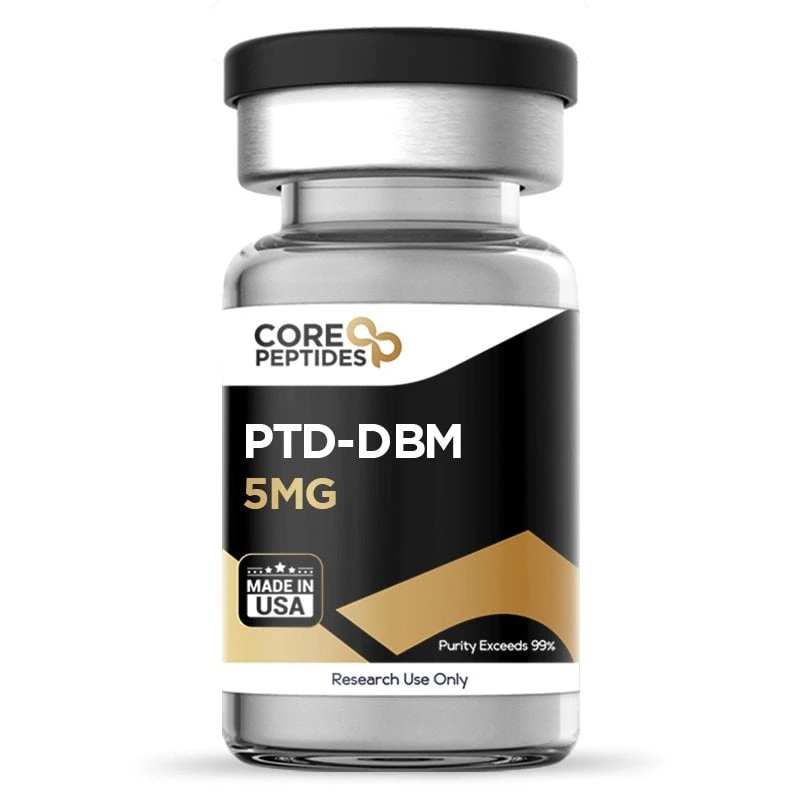


PTD-DBM (5mg) – Research Peptide
PTD-DBM (5mg) is a synthetic fusion peptide known as Protein Transduction Domain-fused Dishevelled Binding Motif (PTD-DBM). It has attracted scientific interest for its interaction with the CXXC5–Dishevelled (Dvl) protein pathway and its potential influence on Wnt/β-catenin signalling.
Research has primarily investigated PTD-DBM in experimental models involving hair follicle biology, tissue regeneration, wound repair and bone formation.
The Core Peptides product is supplied as 5mg of lyophilised PTD-DBM powder with a listed purity of >99%. The material is intended exclusively for qualified research, laboratory and analytical applications and is not intended for human or animal consumption.
Preclinical studies have reported effects associated with Wnt/β-catenin pathway modulation, including observations involving hair follicle growth and wound-induced hair follicle neogenesis in murine models. These findings remain experimental and should not be interpreted as evidence of an established clinical treatment for hair loss, wounds or other medical conditions.
What Is PTD-DBM?
PTD-DBM is a peptide constructed by combining a Protein Transduction Domain (PTD) with a Dishevelled Binding Motif (DBM). The PTD component is intended to facilitate cellular entry, while the DBM component is designed to interact with Dishevelled proteins involved in Wnt signalling.
Researchers have investigated PTD-DBM as a molecular tool for disrupting the interaction between CXXC-type zinc finger protein 5 (CXXC5) and Dishevelled (Dvl). CXXC5 has been described as a negative regulator of Wnt/β-catenin signalling, while Dvl is an important mediator within the pathway.
By potentially interfering with the CXXC5–Dvl interaction, PTD-DBM has been studied for its ability to alter downstream Wnt/β-catenin signalling in experimental systems.
PTD-DBM (5mg) Product Specifications
| Specification | Details |
|---|---|
| Product Name | PTD-DBM |
| Full Name | Protein Transduction Domain-fused Dishevelled Binding Motif peptide |
| Quantity | 5mg |
| Form | Lyophilised powder |
| Listed Purity | >99% |
| Molecular Formula | C124H223N61O28S2 |
| Listed Molecular Weight | 3,080.7 g/mol |
| Research Classification | Synthetic fusion peptide |
| Primary Research Areas | Wnt/β-catenin signalling, hair follicle biology, wound-healing and regenerative research |
| Intended Use | Laboratory, analytical and in-vitro research |
The specifications above reflect the product information published by Core Peptides.
How Does PTD-DBM Work?
PTD-DBM is primarily researched in connection with the Wnt/β-catenin signalling pathway, an important cellular signalling network involved in development, differentiation, proliferation and tissue homeostasis.
Within the proposed mechanism, CXXC5 can interact with Dishevelled proteins and negatively regulate Wnt/β-catenin signalling. PTD-DBM has been investigated as a competing peptide capable of interacting with the Dvl PDZ domain, potentially preventing CXXC5 from exerting its inhibitory effect.
This may allow greater Wnt/β-catenin pathway activity under appropriate experimental conditions. Researchers have subsequently investigated the downstream effects of this pathway modulation in hair follicles, skin and other tissue models.
PTD-DBM and Wnt/β-Catenin Signalling
The Wnt/β-catenin pathway is a complex network of signalling proteins involved in a wide range of biological processes. It has an important role in cell fate determination, proliferation, differentiation and tissue development.
Wnt signalling is also relevant to hair follicle development and regeneration. Experimental studies have therefore examined whether compounds capable of increasing Wnt/β-catenin activity can influence follicular biology.
PTD-DBM has been investigated as one such experimental approach. By potentially disrupting CXXC5–Dvl binding, the peptide may reduce an inhibitory influence on Wnt/β-catenin signalling and increase downstream pathway activity.
PTD-DBM and CXXC5
CXXC5 is a protein that has been investigated as a negative regulator of Wnt/β-catenin signalling. Research has linked increased CXXC5 activity with processes associated with hair follicle miniaturisation and impaired regenerative signalling.
Experimental work has proposed that CXXC5 interacts with Dishevelled and thereby suppresses Wnt pathway activity. PTD-DBM was developed as a competing peptide designed to interfere with this protein–protein interaction.
This makes the CXXC5–Dvl interaction an important molecular target for laboratories investigating PTD-DBM and related Wnt-pathway modulators.
PTD-DBM and Dishevelled (Dvl)
Dishevelled (Dvl) proteins are key intracellular mediators within Wnt signalling. PTD-DBM has been studied for its ability to interact with the PDZ domain of Dvl.
Researchers have proposed that PTD-DBM binding to this region can interfere with CXXC5–Dvl association. This provides a potential mechanism through which the peptide can influence downstream β-catenin signalling.
Because Dvl participates in multiple signalling processes, studies involving PTD-DBM can provide useful insights into protein–protein interactions and pathway regulation.
PTD-DBM and Hair Follicle Research
One of the most prominent areas of PTD-DBM research involves hair follicle biology.
A study published in the Journal of Investigative Dermatology investigated targeting CXXC5 with a competing peptide and reported observations consistent with increased hair regrowth and wound-induced hair follicle neogenesis in experimental models.
In murine experiments, PTD-DBM exposure was associated with changes in hair follicle density, follicle size and the hair-cycle growth phase. Researchers also investigated markers associated with follicular proliferation and function.
These results provide a scientific basis for continued investigation of PTD-DBM in hair follicle models, although the available findings are predominantly preclinical and should not be interpreted as proof of efficacy in humans.
PTD-DBM and the Anagen Phase
The hair cycle includes several stages, including anagen, the active growth phase, followed by transitional and resting stages.
Experimental research has suggested that PTD-DBM may influence the hair cycle by increasing Wnt/β-catenin signalling and promoting conditions associated with the anagen phase. In animal models, exposure to PTD-DBM was associated with observations of increased follicular growth and proliferation.
For researchers, this provides an experimental model for investigating how intracellular signalling pathways influence hair-cycle dynamics.
PTD-DBM and Hair Follicle Neogenesis
Wound-induced hair follicle neogenesis (WIHN) describes the formation of new hair follicles following certain types of skin injury in experimental models.
Research has investigated whether PTD-DBM can contribute to this process by modulating the CXXC5–Dvl interaction and activating Wnt/β-catenin signalling. Experimental observations in mice suggested that PTD-DBM may stimulate both hair regrowth and wound-induced follicle formation.
This area remains a preclinical research topic. Findings in murine models cannot be assumed to reproduce the same biological response in humans.
PTD-DBM and Hair Follicle Progenitor Cells
Hair follicle regeneration depends on populations of specialised cells, including hair follicle progenitor cells.
Experimental studies have investigated whether activation of Wnt/β-catenin signalling by PTD-DBM can influence the proliferation or activity of these cells. Reported observations included increased expression of markers associated with cell proliferation and follicular function.
These findings make PTD-DBM relevant to laboratory studies examining the relationship between intracellular signalling, progenitor-cell activity and follicle regeneration.
PTD-DBM, β-Catenin and Cellular Markers
Research involving PTD-DBM has examined several molecular markers associated with Wnt signalling and cellular proliferation.
| Marker | Research Relevance |
|---|---|
| β-catenin | Central signalling component in the canonical Wnt pathway. |
| ALP | Alkaline phosphatase; investigated as a marker associated with cellular and follicular activity. |
| PCNA | Proliferating cell nuclear antigen; commonly used as a marker of cellular proliferation. |
In experimental studies, PTD-DBM exposure in combination with Wnt3a or valproic acid was associated with changes in these markers, providing additional evidence for investigation of its interaction with Wnt-related signalling.
PTD-DBM and Wnt3a Research
Wnt3a is a Wnt ligand commonly used in laboratory research investigating canonical Wnt/β-catenin signalling.
Core Peptides reports experimental research in which PTD-DBM was studied alongside Wnt3a. The combination was associated with apparent synergistic effects on markers including β-catenin, ALP and PCNA.
These findings are useful for researchers investigating how PTD-DBM interacts with established Wnt pathway activators under controlled experimental conditions.
PTD-DBM and Valproic Acid Research
Valproic acid (VPA) has been investigated experimentally as a compound capable of influencing Wnt/β-catenin signalling, including through effects on GSK-3β.
Research cited by Core Peptides has investigated PTD-DBM together with VPA in experimental hair and wound-healing models. The combination produced more pronounced observations in some experimental settings than either intervention alone.
These studies are relevant to pathway-interaction research but should not be interpreted as evidence that PTD-DBM and VPA are suitable for combined use outside controlled research settings.
PTD-DBM and Wound-Healing Research
Beyond hair follicle studies, PTD-DBM has been investigated in relation to cutaneous wound repair.
Wnt/β-catenin signalling is involved in several cellular processes associated with tissue repair, including proliferation, differentiation, migration and stem-cell activity. Researchers have therefore explored whether PTD-DBM-mediated pathway modulation could influence wound-healing processes.
Experimental studies have examined markers including fibroblast activity, collagen deposition and re-epithelialisation. These studies provide a basis for further investigation of PTD-DBM as a molecular research tool in regenerative biology.
PTD-DBM and Fibroblast Research
Fibroblasts are connective-tissue cells that contribute to extracellular matrix production and wound repair.
Research discussed in connection with PTD-DBM has investigated the influence of CXXC5 and Wnt/β-catenin signalling on fibroblast behaviour. Experimental observations have included changes involving myofibroblast differentiation and collagen production.
These findings make PTD-DBM relevant to laboratory research examining how intracellular signalling can affect extracellular matrix formation during tissue repair.
PTD-DBM and Collagen Deposition
Collagen deposition is an important component of tissue repair because collagen contributes to the structural organisation of newly repaired tissue.
In experimental wound models, studies involving PTD-DBM have reported increased collagen deposition under certain conditions, particularly when the peptide was investigated alongside valproic acid.
Such findings remain preclinical and should be regarded as experimental observations rather than evidence of a clinically established wound-healing treatment.
PTD-DBM and Bone Research
PTD-DBM-related research has also extended into bone biology.
Studies investigating inhibitors of the Dvl–CXXC5 interaction have examined whether modulation of this pathway can influence bone formation. In experimental murine models, researchers reported bone-forming effects associated with inhibition of this protein interaction.
These findings provide an additional research direction for laboratories studying Wnt signalling, osteoblast biology and skeletal tissue regeneration.
Importantly, the available evidence does not establish PTD-DBM as an approved treatment for osteoporosis or bone loss.
PTD-DBM and Osteoblast Research
Osteoblasts are cells involved in the formation of new bone tissue. Wnt signalling plays an important role in osteoblast differentiation and skeletal biology.
Because PTD-DBM has been investigated as a modulator of the Dvl–CXXC5 interaction, researchers have examined whether this signalling pathway can influence bone-forming activity in experimental models.
The findings support continued investigation of the pathway but remain insufficient to establish therapeutic efficacy in human bone disease.
PTD-DBM Chemical Characteristics
Core Peptides lists PTD-DBM with the molecular formula C124H223N61O28S2 and a molecular weight of approximately 3,080.7 g/mol.
The compound is supplied in a lyophilised powder format. Lyophilisation is commonly used for research peptides because it provides a dry form that can be stored and subsequently prepared according to validated laboratory protocols.
PTD-DBM Research Applications
Qualified laboratories may find PTD-DBM relevant to research areas including:
- Wnt/β-catenin signalling and pathway modulation.
- CXXC5–Dishevelled protein interactions.
- Protein–protein interaction research involving Dvl.
- Hair follicle development and regeneration.
- Hair-cycle biology and anagen-phase research.
- Wound-induced hair follicle neogenesis.
- Dermal papilla and follicular-cell research.
- Cutaneous wound-healing models.
- Fibroblast and collagen research.
- Bone formation and osteoblast studies.
- Cell proliferation and differentiation research.
- Peptide structure–activity studies.
PTD-DBM Research Evidence
The scientific literature surrounding PTD-DBM is predominantly preclinical. A 2017 study published in the Journal of Investigative Dermatology investigated a competing peptide targeting CXXC5 and reported observations involving hair regrowth and wound-induced hair follicle neogenesis in experimental models.
Additional research has investigated CXXC5, Dvl and Wnt/β-catenin signalling in relation to androgenetic alopecia, wound repair and bone formation. These studies provide mechanistic context for PTD-DBM research but do not establish the compound as a clinically validated therapy.
Researchers should assess individual publications according to their model, methodology, controls, endpoints and reproducibility when evaluating the significance of PTD-DBM findings.
PTD-DBM Research Material and Laboratory Use
The PTD-DBM (5mg) product is presented as a research and laboratory material. Core Peptides lists the product as a 5mg lyophilised powder with greater than 99% purity.
Laboratories working with synthetic peptides should use appropriate analytical, storage and handling procedures. Where experimental reproducibility is important, researchers should consult the relevant batch documentation and Certificate of Analysis before commencing work.
PTD-DBM Analytical Research
Analytical characterisation can be important when using synthetic peptides in laboratory experiments. Depending on the experimental requirements, researchers may use techniques such as:
- HPLC: To assess chromatographic purity and identify related substances.
- Mass spectrometry: To support molecular identity confirmation.
- Peptide characterisation: To verify expected molecular properties.
- Batch analysis: To compare material between production lots.
- Stability studies: To investigate the integrity of the peptide under defined laboratory conditions.
Researchers should rely on the current, batch-specific Certificate of Analysis and supplier documentation when exact purity or identity is critical to an experiment.
PTD-DBM Storage Considerations
PTD-DBM should be stored according to the supplier’s current technical documentation and laboratory requirements. Appropriate handling helps reduce unnecessary exposure to moisture, heat and environmental conditions that could affect peptide integrity.
- Keep the peptide in its original labelled container.
- Follow the supplier’s recommended storage temperature.
- Protect lyophilised material from moisture.
- Minimise unnecessary temperature fluctuations.
- Use appropriate laboratory handling practices.
- Consult batch-specific documentation before experimental preparation.
Storage requirements can vary according to packaging, formulation and experimental requirements, so supplier-specific instructions should take precedence over generic recommendations.
Frequently Asked Questions About PTD-DBM (5mg)
What is PTD-DBM?
PTD-DBM stands for Protein Transduction Domain-fused Dishevelled Binding Motif peptide. It is a synthetic fusion peptide investigated for its ability to influence CXXC5–Dvl interactions and Wnt/β-catenin signalling.
What does PTD-DBM stand for?
PTD refers to Protein Transduction Domain, while DBM refers to Dishevelled Binding Motif. Together, they describe the functional components of the fusion peptide.
What is PTD-DBM researched for?
PTD-DBM has primarily been investigated in hair follicle biology, Wnt/β-catenin signalling, wound-healing research and bone-regeneration models.
How is PTD-DBM thought to work?
Researchers have proposed that PTD-DBM binds to the PDZ domain of Dishevelled, potentially disrupting the inhibitory interaction between CXXC5 and Dvl. This may increase Wnt/β-catenin pathway activity under experimental conditions.
Has PTD-DBM been studied for hair growth?
Yes. Preclinical studies have investigated PTD-DBM in murine models and reported observations involving hair regrowth, follicle development and wound-induced hair follicle neogenesis.
Has PTD-DBM been studied in humans?
The key evidence discussed for PTD-DBM is preclinical, including cell and animal research. These studies do not establish safety or efficacy in humans.
Is PTD-DBM an approved hair-loss treatment?
No. PTD-DBM is not an established or authorised medical treatment for hair loss. Research findings involving animal models should not be interpreted as evidence of clinical efficacy.
Has PTD-DBM been studied for wound healing?
Yes. Experimental research has investigated PTD-DBM in cutaneous wound models, including studies examining re-epithelialisation, collagen deposition and Wnt/β-catenin signalling.
Has PTD-DBM been investigated in bone research?
Research into inhibition of the Dvl–CXXC5 interaction has examined bone-forming effects in experimental models. These findings are preclinical and do not establish PTD-DBM as a treatment for osteoporosis or bone loss.
What is the molecular weight of PTD-DBM?
Core Peptides lists the molecular weight of PTD-DBM as approximately 3,080.7 g/mol, with the molecular formula C124H223N61O28S2.
What form is PTD-DBM (5mg) supplied in?
The product is supplied as 5mg of lyophilised powder with a listed purity greater than 99%.
What is Wnt/β-catenin signalling?
Wnt/β-catenin signalling is a cellular communication pathway involved in processes including cell proliferation, differentiation, development and tissue maintenance. It is also an important area of research in hair follicle and regenerative biology.
What is CXXC5?
CXXC5 is a protein investigated as a negative regulator of Wnt/β-catenin signalling. Its interaction with Dishevelled has been studied as a potential regulatory mechanism in hair follicle and tissue biology.
Why Researchers May Choose PTD-DBM (5mg)
PTD-DBM (5mg) provides a defined synthetic peptide for laboratories investigating Wnt signalling and protein–protein interactions.
- 5mg research format: Suitable for controlled laboratory investigations.
- Lyophilised presentation: Supplied as a dry research material.
- Listed purity above 99%: Provides a defined starting material for experimental work.
- Well-defined research mechanism: Investigated in connection with the CXXC5–Dvl interaction.
- Broad research relevance: Applicable to hair follicle, wound-healing, bone and cellular-signalling studies.
- Preclinical research background: Supported by published experimental investigations into Wnt/β-catenin signalling.
PTD-DBM (5mg) Research Summary
PTD-DBM (5mg) is a synthetic Protein Transduction Domain-fused Dishevelled Binding Motif peptide studied as a potential modulator of the CXXC5–Dishevelled interaction and the Wnt/β-catenin signalling pathway.
Research has investigated its potential relevance to hair follicle regeneration, hair-cycle biology, wound-induced hair follicle neogenesis, cutaneous wound repair and bone formation. Experimental observations include changes in β-catenin signalling and markers associated with cellular proliferation and tissue function.
However, the available evidence is predominantly preclinical. Results obtained from cells and animal models cannot be assumed to demonstrate equivalent effects, safety or efficacy in humans.
For qualified laboratories, PTD-DBM offers a research tool for investigating Wnt/β-catenin pathway regulation, CXXC5–Dvl protein interactions and related mechanisms in regenerative biology.
Research-Use Disclaimer
PTD-DBM (5mg) is intended solely for qualified research, laboratory, analytical and in-vitro experimental purposes. It is not intended for human or veterinary consumption, self-administration, diagnosis, treatment, cure or prevention of any disease.
References to hair growth, hair follicle regeneration, wound healing, bone formation, tissue repair or regenerative effects describe areas of scientific investigation and should not be interpreted as medical claims or evidence of established clinical efficacy.
Researchers should review the applicable Certificate of Analysis, product documentation, safety information and relevant legislation before working with this material. Handling, storage and disposal should be performed by appropriately trained personnel using suitable laboratory procedures.
For research use only. Human and animal consumption prohibited.
Be the first to review “PTD-DBM – 5MG”
Related products
Peptides for Sale
Peptides for Sale

Peptides for Sale
Peptides for Sale

Peptides for Sale

Peptide Blends for Sale
Peptides for Sale

Peptides for Sale
Reviews
There are no reviews yet.