
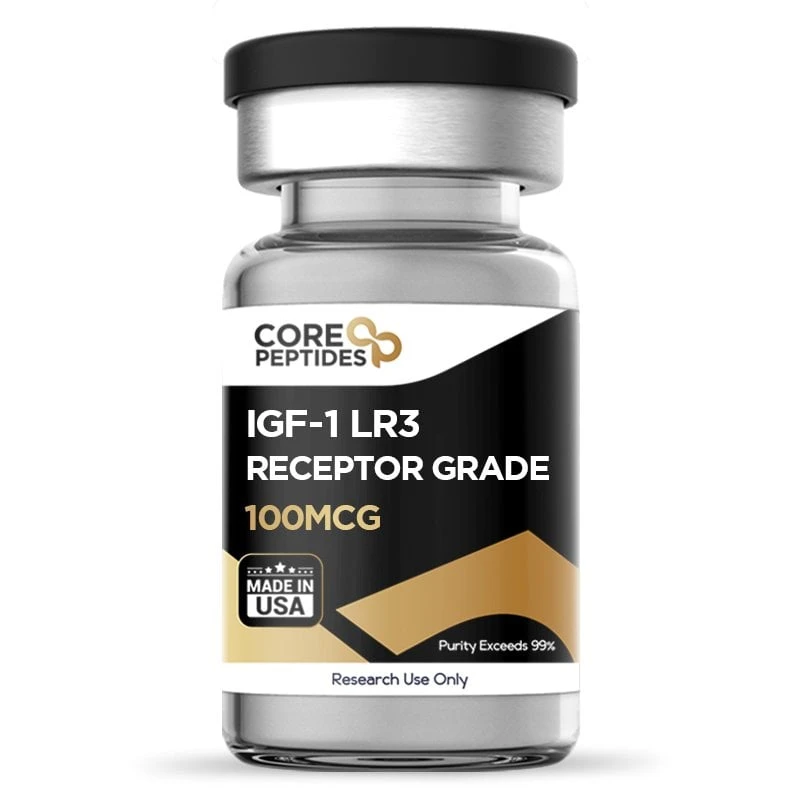
Receptor Grade IGF-1 LR3 (100mcg) – Research Peptide
Receptor Grade IGF-1 LR3 (100mcg) is a synthetic analogue of insulin-like growth factor-1 (IGF-1) developed for laboratory and in-vitro research.
Also known as Long R3 IGF-1 or Long-[Arg3]-IGF-I, the peptide differs from native human IGF-1 through a 13-amino-acid N-terminal extension and the substitution of arginine for glutamic acid at position 3.
These structural modifications have made IGF-1 LR3 an important research subject in studies examining IGF receptor signalling, cellular growth, metabolism and tissue biology.
This 100mcg Receptor Grade IGF-1 LR3 product is supplied as a lyophilised powder with a listed purity of >99%. The material is intended exclusively for qualified laboratory, analytical and research applications and is not intended for human or veterinary consumption.
What Is Receptor Grade IGF-1 LR3?
IGF-1 LR3 is a modified form of insulin-like growth factor-1, a naturally occurring peptide hormone involved in cellular growth, development and metabolic signalling.
Native human IGF-1 contains 70 amino acids. IGF-1 LR3 contains an additional 13 amino acids at the N-terminus and an amino-acid substitution at position 3, producing an 83-amino-acid analogue. The modifications were designed to alter the peptide’s interaction with IGF-binding proteins and its behaviour in experimental systems.
The term Receptor Grade refers to the research-grade classification and purity of the material rather than an indication that the product is approved for therapeutic or clinical use.
Receptor Grade IGF-1 LR3 (100mcg) Product Specifications
| Specification | Details |
|---|---|
| Product Name | Receptor Grade IGF-1 LR3 |
| Quantity | 100mcg |
| Form | Lyophilised powder |
| Listed Purity | >99% |
| Product Category | Research Peptide |
| SKU | P-IGF1LR3-100 |
| Molecular Formula | C400H625N111O115S9 |
| Molecular Weight | 9,117.5 g/mol |
| Other Names | Long-[Arg3]-IGF-I, Long R3 IGF-1, Insulin-like Growth Factor-1 Long Chain R3 |
| Intended Application | Laboratory, analytical and in-vitro research |
The product specifications above are based on the information published by Core Peptides.
IGF-1 LR3 Structure and Molecular Design
The defining characteristic of IGF-1 LR3 is its modified molecular structure. Native IGF-1 contains 70 amino acids, whereas IGF-1 LR3 contains 83 amino acids due to the addition of a 13-amino-acid N-terminal extension.
A second modification occurs at residue 3, where glutamic acid is replaced by arginine. These two structural changes account for the designation Long R3.
Researchers developed and studied this analogue to investigate how structural changes to IGF-1 influence binding behaviour, biological signalling and activity in controlled experimental environments.
IGF-1 LR3 and IGF-Binding Proteins
In biological systems, IGF-1 interacts with a family of proteins known as IGF-binding proteins (IGFBPs). These proteins can influence the distribution, availability and activity of IGF molecules.
The structural modifications incorporated into IGF-1 LR3 have been associated with reduced interaction with certain IGF-binding proteins compared with endogenous IGF-1. This characteristic makes IGF-1 LR3 particularly useful for research investigating the relationship between IGF-binding proteins, receptor signalling and peptide bioavailability.
Experimental research has also investigated how these altered binding characteristics influence the clearance and tissue distribution of IGF-1 LR3 in animal models.
IGF-1 LR3 and IGF-1 Receptor Research
The IGF-1 receptor (IGF-1R) is a cell-surface receptor involved in signalling processes associated with growth, differentiation, metabolism and cellular survival.
IGF-1 and related analogues are therefore important research tools for studying receptor-mediated signalling. Researchers have examined IGF-1 LR3 in experimental systems to better understand how modified IGF molecules interact with IGF-1R and influence downstream cellular pathways.
Because receptor signalling is highly dependent on experimental conditions, observations involving IGF-1 LR3 should be evaluated within the specific model, cell type, concentration and assay used.
IGF-1 LR3 and Cellular Signalling
Research involving IGF-1 has identified several intracellular signalling pathways that can be influenced following receptor activation. These include pathways associated with cellular metabolism, proliferation and protein synthesis.
IGF-1 LR3 has consequently been investigated as a molecular tool for studying the behaviour of modified IGF molecules and their effects on cellular signalling in controlled laboratory models.
The product should not, however, be interpreted as a therapeutic agent. Published research concerning IGF-1 LR3 remains predominantly preclinical, with animal and laboratory studies providing the principal evidence base.
Receptor Grade IGF-1 LR3 and Anabolic Research
One area of experimental interest is the potential anabolic activity of IGF-1 analogues. Research cited by Core Peptides investigated IGF-1 LR3 in murine models, including models exposed to dexamethasone-induced catabolic conditions. Some experiments reported greater effects on body weight, visceral organ weight and measures of protein breakdown compared with endogenous IGF-1 under particular experimental conditions.
These findings provide a basis for investigating IGF-1 LR3 in animal and cellular models of anabolic signalling. They should not be interpreted as evidence that the compound produces equivalent effects in humans.
IGF-1 LR3 and Muscle Cell Research
IGF signalling is relevant to the study of muscle cells, protein metabolism and cellular differentiation. Researchers have therefore examined IGF-1 analogues in experimental muscle models.
Core Peptides references research involving IGF-1 LR3 and myostatin-related mechanisms in murine models. Myostatin is a protein involved in regulating muscle development and differentiation, making it a relevant target for research into muscle-cell biology.
Such research can help investigators examine the relationship between IGF signalling, myostatin activity, cellular differentiation and muscle tissue biology.
IGF-1 LR3 and Glucose Uptake Research
IGF signalling is also connected with metabolic research, including investigations into glucose uptake and insulin-related pathways.
Studies of IGF-related proteins have explored mechanisms involving glucose transport and intracellular signalling. Core Peptides notes research suggesting that IGF-related activity may involve IGF-1 receptor-dependent and potentially receptor-independent mechanisms under certain experimental conditions.
These findings make IGF-1 LR3 relevant to laboratory research into the interaction between growth-factor signalling and cellular metabolism.
IGF-1 LR3 and Tissue Distribution
Experimental work has compared the distribution of labelled endogenous IGF-1 with labelled IGF-1 LR3 in animal models.
One study cited by Core Peptides investigated IGF-1 LR3 in pregnant rats and reported differences in plasma clearance and tissue distribution compared with native IGF-1. Researchers observed tracer distribution in tissues including the kidneys, ovaries and adrenal glands.
Differences in binding to IGF-binding proteins have been proposed as one factor contributing to these distinct distribution patterns. Such observations are useful for researchers studying the pharmacokinetic behaviour of modified IGF molecules in experimental models.
IGF-1 LR3 and Cell Growth Research
IGF-1 is involved in biological processes related to cell growth and development, making IGF-related molecules valuable tools for cell-culture and tissue research.
IGF-1 LR3 was developed partly to investigate how structural modifications influence the activity and availability of IGF molecules in experimental systems. Researchers can use such analogues to explore receptor signalling, cellular responses and interactions between growth factors and binding proteins.
The current literature should be considered primarily in the context of laboratory and animal research rather than clinical applications.
Receptor Grade IGF-1 LR3 Research Applications
Qualified laboratories may investigate Receptor Grade IGF-1 LR3 in areas including:
- IGF-1 receptor signalling and receptor-mediated cellular responses.
- Growth-factor biology and molecular signalling.
- IGF-binding protein research.
- Cell-growth and differentiation studies.
- Muscle-cell and myostatin research.
- Metabolic and glucose-uptake research.
- Protein synthesis and anabolic signalling models.
- Tissue distribution studies.
- Comparative studies of IGF-1 analogues.
- Structure–activity relationship research.
- In-vitro cell-culture experiments.
- Preclinical growth-factor research.
Receptor Grade vs Media Grade IGF-1 LR3
The distinction between Receptor Grade and Media Grade IGF-1 LR3 generally relates to the intended research application and material specifications.
Core Peptides describes Receptor Grade IGF-1 LR3 as a higher-purity research material intended for receptor and related laboratory studies. The 100mcg product is listed with a purity of greater than 99%.
| Research Consideration | Receptor Grade IGF-1 LR3 |
|---|---|
| Research focus | Receptor and cellular signalling studies |
| Listed purity | >99% |
| Presentation | Lyophilised powder |
| Product size | 100mcg |
| Intended use | Laboratory and in-vitro research |
Receptor Grade IGF-1 LR3 Chemical Information
The molecular formula listed for Receptor Grade IGF-1 LR3 is C400H625N111O115S9, with a reported molecular weight of approximately 9,117.5 g/mol.
The compound is also referred to as Long-[Arg3]-insulin-like growth factor-I and insulin-like growth factor long chain R3.
Why Choose Receptor Grade IGF-1 LR3 (100mcg)?
Receptor Grade IGF-1 LR3 (100mcg) provides researchers with a defined synthetic IGF-1 analogue for controlled laboratory investigations.
- Defined 100mcg format: A compact research quantity for laboratory studies.
- >99% listed purity: Suitable for experiments where defined research material is required.
- Lyophilised presentation: Supplied as a dry peptide material.
- Well-characterised structure: Features the Long R3 modifications that distinguish it from native IGF-1.
- Broad research relevance: Suitable for investigations involving growth-factor signalling, receptor biology and cellular responses.
- Established preclinical research background: IGF-1 LR3 has been studied in cellular and animal models.
Receptor Grade IGF-1 LR3 Storage and Laboratory Handling
Lyophilised research peptides should be handled and stored according to the supplier’s current product documentation and the requirements of the laboratory protocol.
- Keep the material in its original, appropriately labelled container.
- Protect the lyophilised peptide from unnecessary exposure to moisture.
- Follow the supplier’s specified storage temperature.
- Minimise unnecessary temperature fluctuations.
- Use suitable laboratory handling procedures.
- Consult the applicable Certificate of Analysis and technical documentation for batch-specific information.
Storage and preparation requirements can vary between peptide sequences and experimental applications. Researchers should therefore follow validated institutional procedures rather than relying solely on generic peptide-handling recommendations.
Analytical Research with IGF-1 LR3
Analytical characterisation can be important when working with synthetic growth-factor analogues. Depending on the research objective, laboratories may use techniques such as:
- Reverse-phase HPLC: For chromatographic purity assessment.
- Mass spectrometry: For molecular identity confirmation.
- Protein or peptide characterisation: To evaluate molecular properties.
- Cell-based assays: To investigate receptor-mediated responses.
- Comparative studies: To evaluate IGF-1 LR3 alongside native IGF-1 or other analogues.
For experiments where purity and identity are critical, researchers should consult the batch-specific documentation supplied with the material.
Research Evidence for IGF-1 LR3
The research history of IGF-1 LR3 includes animal and laboratory investigations into anabolic activity, tissue distribution, glucose-related signalling and muscle biology. Core Peptides cites studies involving dexamethasone-treated rats, labelled peptide distribution in pregnant rats and research into myostatin-related mechanisms.
Importantly, the published evidence for IGF-1 LR3 itself remains predominantly preclinical. A recent review of the available literature likewise describes the compound as having been studied in animal and cell models rather than controlled human trials.
Researchers should assess individual publications according to experimental design, species, cell type, endpoints, exposure conditions and statistical methodology before drawing conclusions about biological activity.
Frequently Asked Questions About Receptor Grade IGF-1 LR3 (100mcg)
What is Receptor Grade IGF-1 LR3?
Receptor Grade IGF-1 LR3 is a synthetic analogue of insulin-like growth factor-1 that contains a 13-amino-acid N-terminal extension and an arginine substitution at position 3. It is studied as a research tool for investigating IGF-related signalling and cellular biology.
What does LR3 mean?
LR3 refers to the Long R3 structure of the analogue: “Long” describes the 13-amino-acid N-terminal extension, while “R3” refers to the arginine substitution at residue 3.
How many amino acids does IGF-1 LR3 contain?
Native IGF-1 contains 70 amino acids, while IGF-1 LR3 contains 83 amino acids because of its additional 13-amino-acid N-terminal sequence.
What is Receptor Grade IGF-1 LR3 researched for?
It has been studied in relation to IGF-1 receptor signalling, cellular growth, metabolism, tissue distribution, muscle-cell biology and growth-factor research.
What is the purity of Receptor Grade IGF-1 LR3 (100mcg)?
The Core Peptides product page lists the 100mcg material with a purity of >99%.
What form is the 100mcg product supplied in?
The product is listed as a lyophilised powder.
What is the molecular weight of IGF-1 LR3?
Core Peptides lists a molecular weight of approximately 9,117.5 g/mol and the molecular formula C400H625N111O115S9.
Is IGF-1 LR3 approved for human use?
No. The Core Peptides product is supplied for research and laboratory purposes only. The available literature on IGF-1 LR3 itself is predominantly preclinical, and it should not be represented as an approved human treatment.
Has IGF-1 LR3 been studied in animals?
Yes. Published research has investigated IGF-1 LR3 in animal models, including studies examining anabolic activity, tissue distribution and muscle-related mechanisms.
Has IGF-1 LR3 been studied in humans?
The evidence base for IGF-1 LR3 itself is primarily based on laboratory and animal research rather than controlled human clinical trials.
What is the difference between IGF-1 and IGF-1 LR3?
IGF-1 LR3 is a modified analogue of native IGF-1. It contains an additional 13 amino acids at its N-terminus and an arginine substitution at position 3, which alters its interaction with IGF-binding proteins and its experimental behaviour.
Receptor Grade IGF-1 LR3 (100mcg) Research Summary
Receptor Grade IGF-1 LR3 (100mcg) is a synthetic Long R3 analogue of insulin-like growth factor-1 supplied as a lyophilised research peptide with a listed purity above 99%.
Its distinctive 83-amino-acid structure makes it a useful research subject for investigating how modifications to IGF-1 influence binding-protein interactions, receptor signalling, tissue distribution and cellular responses. Experimental research has explored areas including anabolic signalling, muscle biology, glucose-related pathways and tissue distribution.
For qualified laboratories, this 100mcg format can serve as a defined research material for controlled in-vitro, analytical and preclinical investigations. The existing evidence should be interpreted within its experimental context, as findings from animal or cell models do not establish equivalent safety or efficacy in humans.
Research-Use Disclaimer
Receptor Grade IGF-1 LR3 (100mcg) is intended solely for qualified research, laboratory, analytical and in-vitro experimental purposes. It is not intended for human or veterinary consumption, self-administration, diagnosis, treatment, cure or prevention of any disease.
References to anabolic activity, muscle biology, cellular growth, metabolism, tissue development or other biological effects describe areas of scientific investigation and should not be interpreted as medical claims or evidence of established clinical efficacy.
Researchers should review the applicable Certificate of Analysis, product documentation, safety information and relevant legislation before working with this material. Handling, storage and disposal should be carried out by appropriately trained personnel using suitable laboratory procedures.
For research use only. Human and animal consumption prohibited.
Be the first to review “Receptor Grade IGF-1 LR3 (100mcg)”
Related products
Peptides for Sale
Peptides for Sale
Peptides for Sale
Peptides for Sale
Peptides for Sale
Peptides for Sale
Peptides for Sale
Peptides for Sale
Reviews
There are no reviews yet.