
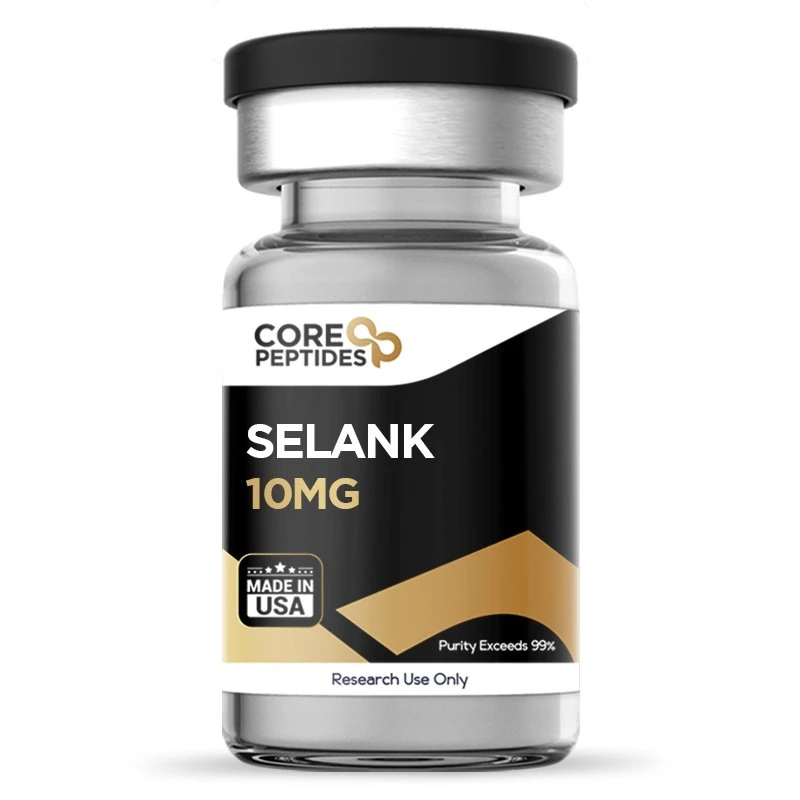
Selank – 10MG – High-Purity Research Peptide
Selank – 10MG is a synthetic heptapeptide that has been investigated in laboratory and preclinical research involving neurobiology, neurotransmitter signalling, stress-response mechanisms, gene expression and immune-related pathways.
Selank is structurally related to Tuftsin, a naturally occurring peptide fragment derived from immunoglobulin G (IgG), and incorporates a Pro-Gly-Pro (PGP) sequence within its molecular structure.
This 10mg Selank peptide is supplied as a lyophilised powder with a listed purity of >99%. The material is intended for qualified research, laboratory and analytical applications only and is not intended for human or animal consumption.
What Is Selank?
Selank is a short synthetic peptide consisting of seven amino acids. It was developed as an analogue of Tuftsin, a naturally occurring tetrapeptide associated with immunological and phagocytic functions. Researchers subsequently developed synthetic Tuftsin analogues to investigate how modifications to peptide structure could influence biological activity.
Selank is particularly interesting in neuroscience research because its structure includes the Pro-Gly-Pro (PGP) sequence. Research has explored whether this structural feature can influence the peptide’s interactions with biological barriers and systems involved in central nervous system signalling.
Rather than being treated as an established therapeutic product, Selank is best understood in this context as an experimental peptide used to investigate biological mechanisms in controlled research settings.
Selank – 10MG Product Specifications
| Specification | Details |
|---|---|
| Product Name | Selank |
| Quantity | 10mg |
| Contents | Selank (10mg) |
| Form | Lyophilised powder |
| Listed Purity | >99% |
| SKU | P-SELANK-10 |
| Category | Research Peptide |
| Molecular Formula | C33H57N11O9 |
| Molecular Weight | 751.88 g/mol |
| Other Names | TP-7, Selanc |
| Intended Use | Research, laboratory and analytical purposes |
The specifications above are based on the information published on the Core Peptides Selank product page.
Selank Peptide Structure
Selank is a heptapeptide, meaning that its primary structure consists of seven amino acids. It was designed around the Tuftsin peptide framework and incorporates a Pro-Gly-Pro (PGP) sequence towards the C-terminal portion of the molecule.
The structural characteristics of Selank are important to researchers because relatively small changes to a peptide sequence can affect properties such as molecular interactions, stability and biological activity.
Research has proposed that the PGP motif may influence the peptide’s interaction with biological barriers, including the blood-brain barrier (BBB). However, proposed transport mechanisms remain an area of scientific investigation and should not be interpreted as evidence of established human pharmacological effects.
Selank and Tuftsin Research
Selank was developed from research surrounding Tuftsin, a naturally occurring peptide fragment associated with immune-system functions. Early research into Tuftsin examined its relationship with phagocytic cells, including processes such as phagocytosis and cell motility.
Synthetic analogues such as Selank have subsequently been investigated to determine how structural modifications may affect biological activity. This connection between Tuftsin and Selank provides an important foundation for understanding why the peptide has been studied across both neurological and immunological research fields.
Selank and BDNF Research
One area of research involving Selank concerns brain-derived neurotrophic factor (BDNF). BDNF is an important neurotrophin involved in neuronal survival, development, synaptic function and neuroplasticity.
A study cited by Core Peptides investigated the effects of intranasal Selank administration on BDNF expression in the hippocampus of rats. Researchers reported changes in BDNF messenger RNA expression following exposure to the peptide.
The hippocampus is a key brain region involved in learning, memory and emotional processing, making BDNF-related findings relevant to experimental neurobiology. However, observations in animal models cannot be assumed to demonstrate equivalent effects in humans.
Selank and GABAergic Signalling
Gamma-aminobutyric acid (GABA) is an inhibitory neurotransmitter that plays an important role in regulating neuronal excitability. Selank has been investigated in relation to GABAergic neurotransmission and gene-expression mechanisms.
Research cited by Core Peptides examined the expression of genes involved in GABAergic neurotransmission following exposure to Selank or GABA in experimental cellular and animal models. The findings suggested that Selank may influence the expression of genes associated with GABA-related signalling.
These findings have contributed to interest in Selank as a research tool for investigating the relationship between peptide signalling and neurotransmitter systems.
Selank and Serotonin Research
Another area of experimental interest is the relationship between Selank and serotonergic signalling. Serotonin is a neurotransmitter involved in numerous physiological processes, including mood regulation, cognition and behavioural responses.
According to research discussed on the Core Peptides product page, experimental work has investigated whether Selank can influence serotonin metabolism under conditions where serotonergic function has been altered.
Such findings provide a basis for further research into interactions between peptide compounds and neurotransmitter systems, although they do not establish Selank as a clinically validated treatment for mood or anxiety disorders.
Selank and Gene Expression Research
Selank has also been investigated for its potential effects on gene expression. In one study referenced by Core Peptides, researchers examined transcriptomic responses in the hippocampus and spleen of rats following single and repeated exposure to Selank.
The research reported changes in the expression of certain genes, including CX3CR1, a gene associated with immune and inflammatory processes. Such investigations are useful for exploring possible connections between peptide signalling, the nervous system and immune-related biological pathways.
Selank and Enkephalin Research
Enkephalins are endogenous opioid peptides involved in biological processes associated with pain, stress and emotional responses. Researchers have investigated Selank in relation to enkephalin metabolism and the enzymes responsible for peptide degradation.
Clinical research cited by Core Peptides reported observations involving tau-leu-enkephalin levels in subjects investigated for anxiety-related conditions. The research proposed that Selank may influence enzymes involved in enkephalin breakdown.
These findings are of interest from a mechanistic research perspective, although the clinical evidence base remains limited and should not be interpreted as proof of therapeutic efficacy.
Selank and Memory Research
Experimental research has also examined Selank in relation to learning and memory. In a study involving rats undergoing conditioned active avoidance training, researchers administered Selank before training sessions and subsequently evaluated behavioural performance.
The study reported a reduction in errors and an increase in correct responses during the training period. Researchers proposed that the observed effects might involve changes in neuropeptide systems, neural circuitry and processes associated with memory consolidation.
These results provide a basis for further investigation into the relationship between peptide signalling and cognitive processes in animal models.
Selank and Immunomodulation Research
Because Selank was developed from the Tuftsin family of peptides, immunological research represents another important area of interest.
Research cited by Core Peptides examined the potential immunomodulatory properties of Selank in subjects with anxiety-asthenic disorders. Researchers analysed peripheral blood samples and reported changes involving cytokine levels and the balance between Th1 and Th2 immune responses.
These observations have encouraged further investigation into possible relationships between neuropeptide signalling and immune regulation.
Selank and Stress-Response Research
Selank has been studied in experimental models investigating behavioural responses to stress. Earlier research involving the Tuftsin peptide family examined relationships between synthetic peptides and adaptive behaviour under stressful conditions.
This research area is relevant to understanding how short synthetic peptides may interact with biological pathways involved in stress responses and behavioural adaptation.
Selank and Withdrawal Research
Preclinical research has also investigated Selank in experimental models of alcohol withdrawal. In one rat study cited by Core Peptides, animals were exposed to ethanol over an extended period before withdrawal was induced and subsequently evaluated following Selank exposure.
Researchers reported changes in behavioural measures associated with withdrawal, including performance in social-interaction and maze-based tests.
Because this work was performed in animal models, the findings should be viewed as preclinical observations rather than evidence that Selank is an established treatment for substance-use or withdrawal disorders.
Selank and Cardiovascular Research
Experimental research has examined the cardiovascular and respiratory effects of Selank in animal models. One study cited by Core Peptides involved feline models and investigated parameters including arterial blood pressure and cerebral blood flow.
The study reported a temporary reduction in arterial blood pressure and an increase in cerebral blood flow following exposure. Such findings demonstrate why cardiovascular parameters may be relevant when studying the biological activity of experimental peptides.
Selank and Metabolic Research
Research has also explored Selank in relation to metabolic parameters. In a study involving mice maintained on a high-fat diet, researchers investigated changes in lipid profiles, glucose-related parameters, body weight and haemostatic measures following experimental peptide exposure.
The study reported changes in cholesterol fractions, triglycerides, glucose homeostasis and other metabolic markers. These findings are useful for understanding possible biological interactions but remain specific to the experimental model and conditions used.
Potential Research Applications of Selank
Qualified laboratories may investigate Selank in a range of research areas, including:
- Neurobiology research involving peptide-mediated signalling.
- GABAergic neurotransmission and related gene-expression pathways.
- Serotonin signalling and neurotransmitter metabolism.
- BDNF expression and neuroplasticity research.
- Learning and memory studies using controlled experimental models.
- Stress-response mechanisms and behavioural research.
- Gene-expression studies in neural and immune tissues.
- Immunomodulation research involving cytokines and immune signalling.
- Enkephalin signalling and peptide metabolism.
- Metabolic research involving lipids and glucose-related parameters.
- Cardiovascular research in appropriate animal models.
- Structure–activity relationship studies involving Tuftsin analogues.
Why Choose Selank – 10MG?
Selank – 10MG provides qualified researchers with a defined quantity of synthetic peptide for controlled laboratory investigations.
- 10mg quantity: Supplied in a practical research format.
- >99% listed purity: Suitable for research where high-purity peptide material is required.
- Lyophilised powder: Supplied in a dry format suitable for laboratory research workflows.
- Well-characterised structure: A seven-amino-acid synthetic peptide related to the Tuftsin family.
- Broad research relevance: Investigated across neuroscience, immunology, neurotransmission and metabolic research.
- Analytical documentation: Core Peptides provides access to product analytical information, including HPLC and mass-spectrometry documentation.
Selank Chemical Information
| Property | Information |
|---|---|
| Compound | Selank |
| Peptide Type | Synthetic heptapeptide |
| Molecular Formula | C33H57N11O9 |
| Molecular Weight | 751.88 g/mol |
| Alternative Names | TP-7, Selanc |
| Quantity | 10mg |
| Physical Form | Lyophilised powder |
Core Peptides lists the molecular formula as C33H57N11O9 and the molecular weight as 751.88 g/mol.
Selank vs Other Research Peptides
Selank belongs to a broader group of synthetic peptides investigated for their potential interactions with biological signalling systems. Its distinguishing feature is its relationship to the Tuftsin peptide family and its extensive investigation in neurobiological and immunological models.
Unlike peptides designed primarily for receptor-specific research, Selank has been investigated across several interconnected areas, including neurotransmission, gene expression, immune signalling and behavioural biology.
| Research Area | Selank Research Relevance |
|---|---|
| Neuroscience | Investigated in relation to neurotransmission and neuroplasticity |
| GABA signalling | Studied for potential effects on GABA-related gene expression |
| BDNF | Investigated for changes in BDNF expression in animal models |
| Immune signalling | Studied in relation to cytokines and immune responses |
| Memory | Investigated in behavioural learning models |
| Metabolism | Examined in experimental lipid and glucose models |
Laboratory Handling and Storage
Selank – 10MG is supplied as a lyophilised powder. Researchers should follow the supplier’s current technical documentation and their institution’s validated procedures for peptide storage, handling and experimental preparation.
- Keep the peptide in its original labelled container.
- Protect the lyophilised material from unnecessary exposure to moisture.
- Follow the supplier’s recommended storage conditions.
- Minimise unnecessary temperature fluctuations.
- Use appropriate laboratory protective equipment and handling procedures.
- Consult batch-specific analytical documentation before experimental use.
Storage requirements may vary depending on the peptide, packaging and research protocol. Always prioritise the supplier’s current documentation and applicable laboratory procedures.
Analytical Testing of Selank
High-purity research peptides can be evaluated using analytical techniques designed to confirm identity and assess purity. Core Peptides provides dedicated analytical information for Selank, including HPLC and mass spectrometry documentation.
Depending on the research protocol, laboratories may use:
- HPLC analysis to assess chromatographic purity.
- Mass spectrometry to support molecular identity confirmation.
- Cell-based assays to investigate biological responses.
- Gene-expression analysis to evaluate transcriptional responses.
- Comparative studies involving Selank and related peptide analogues.
Research Evidence for Selank
The scientific literature surrounding Selank includes animal, cellular and clinical research. Areas investigated include BDNF expression, GABAergic signalling, gene expression, learning and memory, immune responses and anxiety-related mechanisms.
Core Peptides provides a list of scientific references supporting the research areas discussed on its product page. Some cited studies involve rodents or other animal models, while others involve human subjects.
The existence of research does not by itself establish safety, efficacy or regulatory approval for human use. Researchers should assess each study according to its methodology, population, model, endpoints and limitations.
Frequently Asked Questions About Selank – 10MG
What is Selank?
Selank is a synthetic seven-amino-acid peptide developed as an analogue of Tuftsin. It has been investigated in research involving neuroscience, neurotransmitter signalling, immune responses, gene expression and behavioural biology.
How much Selank is in this product?
This product contains 10mg of Selank and is listed as a lyophilised powder with greater than 99% purity.
What is the purity of Selank – 10MG?
Core Peptides lists the product with a purity of >99%.
What form is Selank supplied in?
Selank – 10MG is supplied as a lyophilised powder.
What is the molecular weight of Selank?
The molecular weight listed by Core Peptides is 751.88 g/mol. Its listed molecular formula is C33H57N11O9.
What is Selank researched for?
Research has investigated Selank in areas including BDNF expression, GABAergic and serotonin signalling, gene expression, learning and memory, immune responses, stress-related behaviour and metabolic mechanisms.
Is Selank a Tuftsin analogue?
Yes. Selank was developed as a synthetic analogue related to Tuftsin, a naturally occurring peptide fragment associated with immune-system functions.
What is the PGP sequence in Selank?
The PGP sequence refers to the Pro-Gly-Pro motif incorporated into Selank’s structure. Researchers have investigated whether this sequence influences the peptide’s molecular properties and interactions with biological barriers.
Has Selank been studied in animal models?
Yes. Selank has been investigated in several animal and cellular research models, including studies involving BDNF expression, GABAergic signalling, learning and memory, withdrawal, cardiovascular parameters and metabolism.
Is Selank approved for human use?
The Core Peptides product is marketed for research, laboratory and analytical purposes only. It is not intended for human or animal consumption.
Does research on Selank prove that it treats anxiety or other medical conditions?
No. Although research has investigated Selank in anxiety-related and other models, experimental findings should not be presented as proof of established clinical efficacy. The available evidence varies substantially by study design and research model.
Selank – 10MG Research Summary
Selank – 10MG is a high-purity synthetic heptapeptide supplied as a lyophilised powder for qualified research and laboratory applications. Its relationship to Tuftsin and its distinctive peptide structure have made it an interesting subject for investigations into neurotransmitter signalling, neurobiology, gene expression and immune-related mechanisms.
Experimental research has explored Selank in relation to BDNF, GABAergic signalling, serotonin metabolism, learning and memory, enkephalin pathways, immune modulation, cardiovascular activity and metabolic parameters.
These studies provide potential directions for further research but should be interpreted according to the limitations of each experimental model. With a listed purity of >99%, a 10mg quantity and lyophilised presentation, Selank provides a defined research material for controlled laboratory, analytical and in-vitro investigations.
Research-Use Disclaimer
Selank – 10MG is intended solely for qualified research, laboratory, analytical and in-vitro experimental purposes. It is not intended for human or veterinary consumption, self-administration, diagnosis, treatment, cure or prevention of any disease.
References to neurological, behavioural, immune, metabolic or other biological effects describe areas of scientific investigation and should not be interpreted as medical claims or established clinical benefits.
Researchers should review the applicable Certificate of Analysis, product documentation, safety information and relevant legislation before working with this material. Handling, storage and disposal should be performed by appropriately trained personnel using suitable laboratory procedures.
For research use only. Human and animal consumption prohibited.
Be the first to review “Selank – 10MG”
Related products
Peptides for Sale

Peptides for Sale
Peptides for Sale
Peptides for Sale
Peptides for Sale
Peptides for Sale
Peptides for Sale
Peptides for Sale
Reviews
There are no reviews yet.