
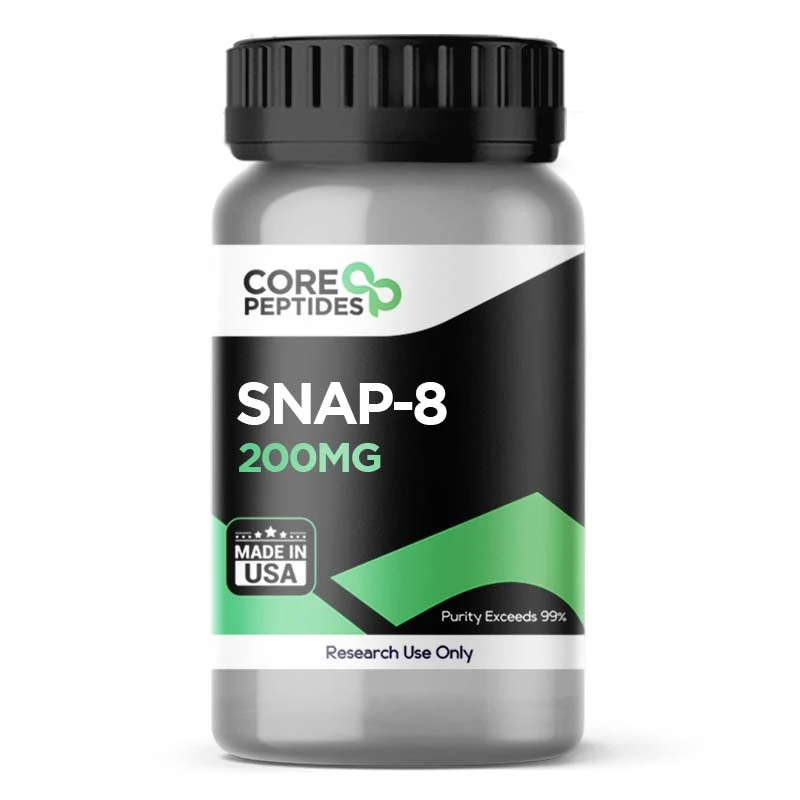
SNAP-8 (200mg) – Acetyl Octapeptide-3 Research Peptide
SNAP-8 (200mg), also known as Acetyl Octapeptide-3, is a synthetic eight-amino-acid peptide studied primarily in cosmetic science and peptide research. It is structurally related to SNAP-25, a protein involved in the SNARE complex responsible for neurotransmitter vesicle fusion.
SNAP-8 has therefore attracted research interest for its proposed ability to interfere with SNARE complex assembly and modulate neurotransmitter release in experimental models. SNAP-8 is particularly associated with research into expression lines, skin appearance and topical cosmetic peptide formulations.
Its proposed mechanism is related to the modulation of the molecular machinery involved in acetylcholine release at neuromuscular junctions. However, the ability of a topically applied peptide to reach neuromuscular junctions at pharmacologically relevant concentrations remains an important area of investigation.
The 200mg format provides researchers with a larger quantity of SNAP-8 for appropriate laboratory, analytical, formulation and in-vitro research applications. This product is intended for research use only and should not be used for human or animal consumption.
What Is SNAP-8 (200mg)?
SNAP-8 is a synthetic octapeptide commonly identified as Acetyl Octapeptide-3. It was developed as an extended peptide analogue of Argireline and is based on a sequence derived from the N-terminal region of SNAP-25.
SNAP-25 is one of the key proteins involved in the SNARE complex, a molecular system that plays an essential role in vesicle docking and neurotransmitter release. By mimicking a portion of SNAP-25, SNAP-8 has been investigated for its ability to compete with endogenous SNAP-25 during SNARE complex formation.
From a research perspective, this makes SNAP-8 particularly relevant to studies involving:
- SNARE complex assembly.
- Neurotransmitter release.
- Acetylcholine signalling.
- Neuromuscular junction biology.
- Cosmetic peptide formulations.
- Expression-line research.
- Peptide stability and analytical chemistry.
- Topical peptide delivery systems.
SNAP-8 (200mg) Product Specifications
| Specification | Details |
|---|---|
| Product Name | SNAP-8 |
| Quantity | 200mg |
| Scientific Name | Acetyl Octapeptide-3 |
| Peptide Type | Synthetic octapeptide |
| Primary Research Area | Cosmetic peptide and skin research |
| Research Target | SNARE complex / SNAP-25-related signalling |
| Form | Research peptide material |
| Intended Use | Laboratory, analytical and research applications |
What Is Acetyl Octapeptide-3?
Acetyl Octapeptide-3 is the scientific name commonly associated with SNAP-8. It is an eight-residue synthetic peptide designed around a sequence derived from the N-terminal region of SNAP-25.
Research references describe the peptide sequence as Ac-Glu-Glu-Met-Gln-Arg-Arg-Ala-Asp-NH2. The extended eight-residue structure distinguishes SNAP-8 from shorter SNAP-25-derived cosmetic peptides such as Argireline.
The molecular design is intended to provide an experimental peptide that can interact with components of the SNARE machinery. This provides researchers with a model for investigating how synthetic peptide fragments can influence protein–protein interactions associated with vesicle fusion.
How Does SNAP-8 Work?
The proposed mechanism of SNAP-8 centres on the SNARE complex. SNARE proteins are fundamental to the process through which neurotransmitter-containing vesicles fuse with the presynaptic membrane.
SNAP-25 normally participates in the formation of a functional SNARE complex together with other proteins, including syntaxin and synaptobrevin/VAMP. This complex facilitates membrane fusion and subsequent neurotransmitter release.
SNAP-8 is designed to mimic part of the SNAP-25 sequence. Experimental research suggests that it can compete with native SNAP-25 for interactions involved in SNARE complex assembly. This provides a molecular basis for investigating whether neurotransmitter vesicle fusion and acetylcholine release can be modulated.
Importantly, this mechanism should be understood as a research model. Molecular activity demonstrated in laboratory systems does not automatically establish the same effect following topical application to human skin.
SNAP-8 and the SNARE Complex
The SNARE complex is a group of proteins responsible for coordinating membrane fusion during neurotransmitter release.
At the neuromuscular junction, neurotransmitter-containing vesicles are transported towards the presynaptic membrane. SNARE proteins participate in bringing the vesicle and cell membranes into close proximity, allowing calcium-dependent fusion and release of neurotransmitters such as acetylcholine.
Because SNAP-25 is an essential component of this machinery, peptides based on its sequence have been investigated as potential modulators of SNARE complex assembly. SNAP-8 represents one such synthetic peptide model.
SNAP-8 and Acetylcholine Research
Acetylcholine is a neurotransmitter involved in communication between motor neurons and skeletal muscle cells. Its release at the neuromuscular junction initiates signalling that contributes to muscle contraction.
Research into SNAP-8 examines whether interference with SNARE complex formation can influence the efficiency of neurotransmitter vesicle release. In laboratory models, this provides a useful framework for investigating the relationship between peptide–protein interactions, vesicle fusion and neurotransmitter signalling.
This mechanism is also the basis for the cosmetic interest surrounding SNAP-8 and other so-called neurotransmitter-inhibiting peptides. Nevertheless, the molecular mechanism and the effectiveness of topical delivery are separate scientific questions.
SNAP-8 for Cosmetic Peptide Research
SNAP-8 has been studied primarily as a topical cosmetic peptide ingredient associated with the appearance of expression lines. Research interest stems from the possibility that modulation of neurotransmitter release could reduce repetitive facial muscle activity involved in dynamic wrinkle formation.
Expression lines commonly occur in areas repeatedly affected by facial movement, including the forehead, glabellar region and areas around the eyes. SNAP-8 has consequently been investigated in relation to cosmetic formulations designed for these areas.
However, topical peptide research involves an important delivery challenge. The skin’s outer barrier can restrict the movement of relatively large and hydrophilic peptide molecules. Independent sources note that whether topically applied SNAP-8 reaches neuromuscular junctions at pharmacologically relevant concentrations remains unresolved.
SNAP-8 vs Argireline
SNAP-8 and Argireline are both synthetic peptides based on portions of SNAP-25 and are frequently discussed together in cosmetic peptide research.
| Feature | SNAP-8 | Argireline |
|---|---|---|
| Scientific Name | Acetyl Octapeptide-3 | Acetyl Hexapeptide-8 / related naming variants |
| Structure | Eight amino acids | Six amino acids |
| Research Basis | SNAP-25-derived peptide | SNAP-25-derived peptide |
| Research Target | SNARE complex | SNARE complex |
| Primary Research Area | Cosmetic and peptide research | Cosmetic and peptide research |
SNAP-8 was developed as an extended analogue of the Argireline concept, incorporating additional residues into the peptide sequence. Some supplier and industry literature proposes stronger SNARE-complex interaction, but independent evidence directly demonstrating superior topical clinical performance remains limited.
Potential Research Applications
Researchers may investigate SNAP-8 (200mg) across a range of laboratory and cosmetic-science applications, including:
- SNARE complex research: Investigation of peptide interactions with SNARE proteins.
- Protein–protein interaction studies: Evaluation of synthetic peptide fragments and protein binding.
- Neurotransmitter release research: Experimental investigation of vesicle fusion and neurotransmitter signalling.
- Cosmetic formulation research: Development and evaluation of topical peptide formulations.
- Skin-delivery research: Investigation of peptide penetration and formulation-dependent delivery.
- Expression-line research: Laboratory investigation of peptides associated with dynamic facial lines.
- Analytical chemistry: Identification, quantification and purity analysis of Acetyl Octapeptide-3.
- Peptide stability studies: Investigation of stability under controlled laboratory conditions.
- Comparative peptide research: Comparison with other SNAP-25-derived cosmetic peptides.
SNAP-8 and Topical Delivery Research
One of the most important considerations when studying SNAP-8 as a topical cosmetic peptide is skin permeability.
The stratum corneum acts as a strong barrier against the penetration of many molecules. Peptides can present additional formulation and delivery challenges because of their molecular size, polarity and physicochemical properties.
Research into related cosmetic peptides has highlighted the importance of formulation technology in determining skin penetration. For SNAP-8 specifically, the question of whether topical application delivers sufficient quantities to deeper neuromuscular targets remains an area requiring further investigation.
This makes SNAP-8 relevant not only to peptide biology but also to research into delivery systems, emulsions, patches and other topical formulation technologies.
Research Evidence for SNAP-8
The evidence surrounding SNAP-8 should be interpreted according to the type of study being considered.
- Molecular research: The proposed interaction with SNAP-25-related SNARE complex assembly provides a defined biochemical research mechanism.
- Laboratory research: In-vitro models can be used to examine peptide interactions and neurotransmitter-related processes.
- Cosmetic studies: Supplier-associated studies have reported changes in wrinkle-depth measurements following topical formulations.
- Independent clinical evidence: Independent, high-quality clinical evidence specifically establishing topical SNAP-8 efficacy remains limited.
- Skin penetration: Delivery of topical SNAP-8 to the neuromuscular junction at pharmacologically relevant concentrations remains unresolved.
Accordingly, claims regarding specific percentages of wrinkle reduction or comparisons with injectable botulinum toxin should be treated as supplier or formulation-specific claims rather than established clinical outcomes.
SNAP-8 in Analytical Research
Analytical research involving SNAP-8 can focus on accurately identifying and quantifying the peptide in raw materials, formulations and experimental delivery systems.
Potential analytical techniques include:
- HPLC: Assessment of chromatographic purity and peptide-related impurities.
- LC-MS/MS: Identification and quantitative analysis of Acetyl Octapeptide-3.
- Mass spectrometry: Molecular-mass confirmation and structural characterisation.
- Peptide stability testing: Evaluation under controlled storage or formulation conditions.
- Extraction studies: Investigation of recovery from cosmetic formulations.
Researchers should use validated analytical methods and consult the relevant batch-specific documentation when evaluating the identity and purity of any research material.
Why Choose SNAP-8 (200mg)?
SNAP-8 (200mg) offers researchers a practical quantity of Acetyl Octapeptide-3 for laboratory and cosmetic-science applications.
- 200mg quantity: Suitable for research programmes requiring a larger quantity of peptide material.
- Defined peptide identity: Supplied as SNAP-8 / Acetyl Octapeptide-3.
- Established research interest: Extensively discussed in cosmetic peptide and SNARE-related research.
- SNAP-25-derived structure: Provides a useful model for investigating peptide–protein interactions.
- Cosmetic formulation relevance: Suitable for research involving topical peptide formulations.
- Analytical applications: Can be incorporated into appropriate identity, purity and stability studies.
- Research-focused use: Intended for qualified laboratory and experimental applications.
Handling and Storage of SNAP-8
SNAP-8 should be handled according to the supplier’s current technical documentation and the laboratory’s established procedures for synthetic peptide materials.
- Keep the material in its original, appropriately labelled container.
- Protect the peptide from unnecessary exposure to moisture.
- Follow the supplier’s recommended storage temperature and conditions.
- Minimise unnecessary temperature fluctuations.
- Use suitable laboratory personal protective equipment.
- Avoid contamination during experimental handling.
- Follow institutional procedures for laboratory waste and disposal.
Specific storage and handling requirements may depend on the formulation, packaging and intended research application. Always refer to the current product documentation and applicable Certificate of Analysis.
Frequently Asked Questions About SNAP-8 (200mg)
What is SNAP-8?
SNAP-8 is a synthetic octapeptide commonly known as Acetyl Octapeptide-3. It is derived from a sequence associated with SNAP-25 and is primarily researched in cosmetic peptide science and SNARE-complex biology.
What is SNAP-8 used for in research?
SNAP-8 can be studied in relation to SNARE complex assembly, neurotransmitter release, peptide–protein interactions, topical cosmetic formulations, skin delivery and expression-line research.
How does SNAP-8 differ from Argireline?
Both are SNAP-25-derived cosmetic peptides, but SNAP-8 contains an eight-amino-acid sequence, while Argireline is a shorter peptide. SNAP-8 was developed as an extended version of the Argireline concept.
Does SNAP-8 work like botulinum toxin?
SNAP-8 and botulinum toxin involve the SNARE/neurotransmitter-release pathway in different ways. SNAP-8 is investigated as a competitive peptide modulator, whereas botulinum toxin is a biological toxin that enzymatically cleaves SNAP-25. They should not be considered equivalent products or treatments.
Can SNAP-8 be used as a cosmetic ingredient?
SNAP-8 is associated with topical cosmetic peptide research. However, this research product should not be presented as an approved medicine or as a treatment for wrinkles or other medical conditions.
Is there clinical evidence for SNAP-8?
There are supplier-associated cosmetic studies reporting changes in wrinkle-depth measurements, but independent clinical evidence specifically establishing the efficacy of topical SNAP-8 remains limited. The question of whether topical SNAP-8 reaches deeper neuromuscular junctions at pharmacologically relevant concentrations also remains unresolved.
What does the 200mg quantity mean?
The 200mg designation refers to the quantity of SNAP-8 research material supplied. It does not represent a recommended human dose or usage instruction.
Is SNAP-8 intended for human consumption?
No. This product is intended for laboratory, analytical and research applications only and should not be consumed or self-administered.
Can SNAP-8 be used for medical treatment?
No. SNAP-8 should not be represented as a medicine or as a treatment for wrinkles, neurological conditions or any other medical condition. Its inclusion on this website is for legitimate research purposes.
SNAP-8 (200mg) Research Summary
SNAP-8 (200mg) is a synthetic cosmetic research peptide also known as Acetyl Octapeptide-3. Based on a sequence derived from SNAP-25, it provides researchers with a model for investigating the molecular interactions involved in SNARE complex formation and neurotransmitter vesicle release.
The peptide has particular relevance to cosmetic-science research because the SNARE complex is involved in acetylcholine release at neuromuscular junctions. SNAP-8 has therefore been investigated in connection with expression-line research and topical cosmetic formulations. However, the molecular mechanism demonstrated in laboratory systems should not be confused with proven clinical efficacy following topical application.
The 200mg format can support research involving analytical testing, peptide characterisation, formulation development, stability assessment, skin-delivery research and controlled in-vitro experiments. Researchers should evaluate the scientific literature critically and distinguish supplier claims from independently replicated evidence.
Research-Use Disclaimer
SNAP-8 (200mg) is intended solely for qualified research, laboratory, analytical and in-vitro experimental purposes. It is not intended for human or veterinary consumption, self-administration, diagnosis, treatment, cure or prevention of any disease.
References to SNARE complex activity, neurotransmitter release, expression lines, wrinkle appearance or other biological mechanisms describe areas of scientific research and should not be interpreted as established medical or therapeutic benefits.
Researchers are responsible for ensuring that all experimental procedures comply with applicable laws, regulations, institutional requirements and laboratory safety protocols. Always review the current product documentation and relevant Certificate of Analysis before using the material in research.
For research use only. Not for human or animal consumption.
Be the first to review “SNAP-8 (200mg)”
Related products
Peptides for Sale
Peptides for Sale
Peptides for Sale
Peptides for Sale
Peptides for Sale
Peptides for Sale
Peptides for Sale
Peptides for Sale
Reviews
There are no reviews yet.