
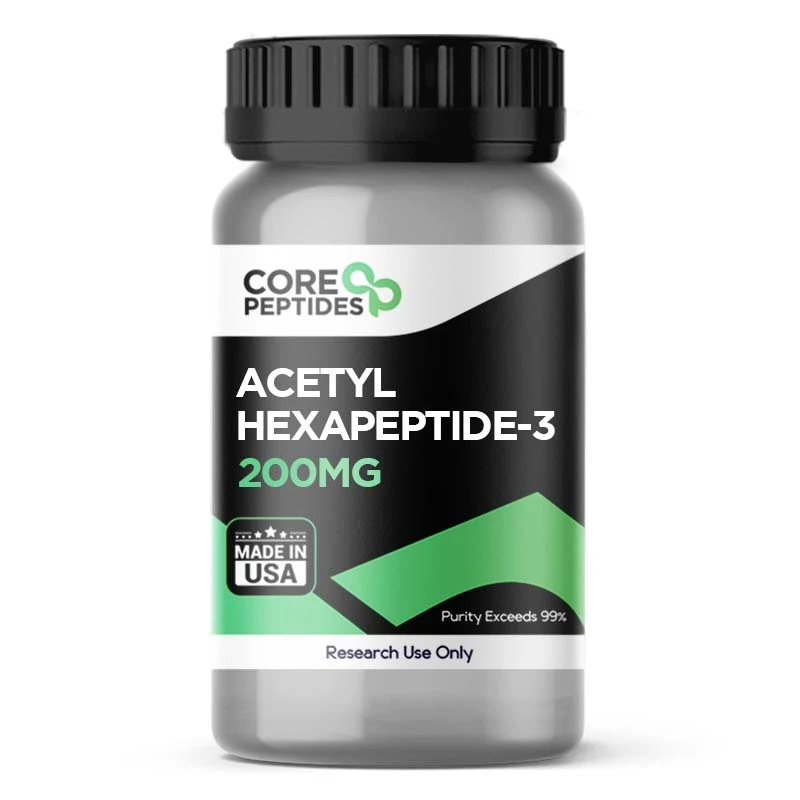
Acetyl Hexapeptide-3 (Argireline) (200mg) – Research-Grade Peptide
Acetyl Hexapeptide-3 (Argireline) (200mg) is a synthetic peptide offered for laboratory and research applications involving skin biology, peptide–protein interactions, cellular signalling and cosmetic science. The Core Peptides product is supplied as a lyophilised powder with a stated purity of >99% and contains 200mg of Acetyl Hexapeptide-3.
Acetyl Hexapeptide-3 is closely associated with the name Argireline in cosmetic and scientific literature. The terminology can be confusing because published literature and commercial sources also commonly refer to Argireline as Acetyl Hexapeptide-8.
The Core Peptides listing itself identifies Acetyl Hexapeptide-3 as having Acetyl Hexapeptide-8 and Argireline among its alternative names. Researchers should therefore verify the exact peptide identity, sequence and analytical documentation supplied with a particular material before beginning an experiment.
Research into Argireline has primarily focused on its proposed interaction with components of the SNARE complex, particularly SNAP-25, and on the potential effects of this mechanism on neurotransmitter release and facial muscle activity. Studies have also investigated its potential relevance to wrinkle appearance, skin hydration, collagen-related processes and other areas of dermatological and cosmetic research.
What Is Acetyl Hexapeptide-3 (Argireline)?
Acetyl Hexapeptide-3 is a synthetic short-chain peptide studied for its biological activity in skin and muscle-related research. It is commonly associated with the cosmetic peptide Argireline, which has been investigated as a topical ingredient because of its proposed effects on processes involved in facial muscle contraction and the appearance of expression lines.
The research rationale behind Argireline is based partly on its structural relationship to a sequence within SNAP-25, a protein that participates in the SNARE complex. The SNARE complex is involved in calcium-dependent exocytosis, a cellular process responsible for the release of signalling molecules from vesicles.
Experimental research has proposed that Argireline may interact competitively with SNAP-25-related processes, potentially affecting the assembly or function of the SNARE complex. This mechanism is one of the principal reasons the peptide has attracted interest in cosmetic and cellular research.
Acetyl Hexapeptide-3 (Argireline) (200mg) Product Highlights
- Product: Acetyl Hexapeptide-3 (Argireline)
- Quantity: 200mg
- Form: Lyophilised powder
- Stated purity: >99%
- SKU: P-ACETYL-HEXAPEPTIDE-3
- Research category: Synthetic peptides
- Research focus: Skin biology, cellular signalling, cosmetic science and peptide research
- Intended application: Laboratory, analytical and in vitro research
The product specifications above reflect the information published on the Core Peptides product page.
Acetyl Hexapeptide-3 and Argireline Nomenclature
One of the most important points for researchers is the naming convention surrounding this peptide. The product is marketed by Core Peptides under the name Acetyl Hexapeptide-3 (Argireline), while the same product page lists Acetyl Hexapeptide-8 and Argireline as alternative titles.
Scientific literature on Argireline frequently uses the designation Acetyl Hexapeptide-8. For example, published studies have examined Acetyl Hexapeptide-8 in relation to wrinkle appearance, skin properties and cosmetic applications.
Because peptide nomenclature can differ between commercial catalogues and scientific publications, laboratories should not rely solely on the product name. The sequence, molecular formula, molecular weight and certificate of analysis are more useful for confirming the identity of a research material.
Chemical Characteristics
| Specification | Details |
|---|---|
| Product name | Acetyl Hexapeptide-3 (Argireline) |
| Quantity | 200mg |
| Physical form | Lyophilised powder |
| Stated purity | >99% |
| Molecular formula listed by supplier | C34H60N14O12S |
| Molecular weight listed by supplier | 888.99 g/mol |
| Alternative titles listed | Acetyl Hexapeptide-8, Argireline |
| SKU | P-ACETYL-HEXAPEPTIDE-3 |
The chemical specifications shown above are based on the supplier’s published product information.
How Does Argireline Work in Research?
The principal research hypothesis surrounding Argireline concerns the SNARE complex and the protein SNAP-25. SNARE proteins participate in vesicle fusion and calcium-dependent exocytosis, allowing cells to release signalling molecules and neurotransmitters.
Argireline has been investigated because its sequence has similarities to a region of SNAP-25. Researchers have proposed that this similarity may allow the synthetic peptide to compete with SNAP-25-related interactions and potentially interfere with efficient SNARE-complex formation.
Since acetylcholine release is involved in communication between nerves and skeletal muscle, this mechanism has been studied as a possible explanation for the peptide’s effects in cosmetic research concerning facial expression lines.
This mechanism remains a subject of scientific investigation, and results obtained with topical formulations cannot automatically be extrapolated to isolated peptide material or other experimental systems.
Acetyl Hexapeptide-3 and Wrinkle Research
One of the best-known areas of Argireline research is the investigation of facial lines and wrinkles. Early research examined a topical emulsion containing the synthetic hexapeptide and reported an apparent reduction in wrinkle depth after 30 days in a small group of participants.
Subsequent studies have investigated combinations containing Acetyl Hexapeptide-3 or Acetyl Hexapeptide-8 and have assessed parameters including skin microtopography, transepidermal water loss and wrinkle appearance. Research cited by the supplier has reported findings consistent with possible improvements in wrinkle appearance and skin hydration.
A further study involving 52 participants examined wrinkle-related outcomes over a 29-day period, with researchers reporting improvements in wrinkle morphology and skin hydration. Another clinical investigation reported an apparent improvement in anti-wrinkle efficacy compared with placebo.
These studies provide research context for the popularity of Argireline in cosmetic science, but study design, formulation, concentration, application method and participant characteristics can all influence results. Consequently, findings from a specific topical formulation should not automatically be attributed to every Acetyl Hexapeptide product.
Argireline and Skin Hydration Research
In addition to wrinkle appearance, researchers have examined the relationship between Argireline-containing formulations and skin hydration. One parameter used in this type of research is transepidermal water loss (TEWL), which provides information about the movement of water through the skin barrier.
Research cited by Core Peptides reports that certain Acetyl Hexapeptide-3 formulations were associated with changes in TEWL and suggested improved water retention or hydration of skin tissues.
These findings are relevant to cosmetic-science research because skin hydration can influence the appearance and mechanical properties of the skin. However, hydration outcomes depend on the complete formulation rather than necessarily on the peptide alone.
Acetyl Hexapeptide-3 and Collagen Research
Argireline has also been investigated in relation to collagen and extracellular-matrix biology. The Core Peptides research summary cites animal-model research in which Acetyl Hexapeptide-3 was associated with changes in the histological structure of aged skin, including an apparent increase in type I collagen fibres and a reduction in type III collagen fibres.
Collagen is an important structural protein in the extracellular matrix, and differences in collagen composition can influence the physical characteristics of skin tissue. Research into these mechanisms may therefore help scientists understand how peptide-based cosmetic ingredients interact with ageing-related changes in skin.
However, collagen-related findings from animal models should not be interpreted as proof of a comparable effect in humans. Additional controlled research is necessary to establish the significance of these observations.
Acetyl Hexapeptide-3 and Muscle-Related Research
Because the proposed mechanism of Argireline involves neurotransmitter release and communication between nerves and muscle, researchers have also investigated the peptide in relation to muscle contraction and involuntary muscle activity.
One pilot clinical study examined Acetyl Hexapeptide-8 in patients receiving botulinum toxin treatment for blepharospasm, a condition involving involuntary eyelid contractions. The study reported a trend towards longer symptom-control periods and improved blepharospasm scores in the active group.
Such findings are useful as a research reference for investigating neuronal exocytosis and neuromuscular signalling, but they do not establish Acetyl Hexapeptide-3 as a treatment for blepharospasm or other medical conditions.
Argireline and Scarring Research
Research has also examined Acetyl Hexapeptide-8 in relation to the appearance and physical properties of scar tissue. A retrospective study cited by Core Peptides investigated changes in skin-tissue parameters and reported an apparent increase in scar-tissue elasticity in certain areas.
The researchers proposed that changes in collagen composition could potentially contribute to these observations. Type III collagen is associated with early tissue repair and scar formation, while type I collagen contributes substantially to mature connective tissue.
These findings provide an additional area of investigation for cosmetic and dermatological research, although the evidence should be regarded as preliminary rather than as proof of a clinical scar-treatment effect.
Acetyl Hexapeptide-3 and Neuronal Exocytosis Research
Beyond cosmetic applications, researchers have investigated derivatives of Acetyl Hexapeptide-3 in cellular and animal models involving neuronal exocytosis. One example is the palmitoylated derivative known as DD04107.
Research into DD04107 has explored whether inhibition of neuronal exocytosis can influence signalling pathways associated with inflammatory and neuropathic pain. Experimental studies have examined mechanisms involving neuromodulator release and TRPV1-associated signalling.
It is important to distinguish this modified derivative from the standard Acetyl Hexapeptide-3 product. Findings obtained using DD04107 or other chemically modified derivatives cannot automatically be applied to unmodified Acetyl Hexapeptide-3.
Potential Research Applications
The defined structure of Acetyl Hexapeptide-3 makes it relevant to several areas of laboratory research. Potential research applications include:
- Cosmetic peptide research: Investigation of synthetic peptides used in topical cosmetic formulations.
- Skin biology: Study of cellular processes associated with skin structure, hydration and ageing.
- Wrinkle research: Investigation of mechanisms potentially influencing expression-line appearance.
- SNARE-complex research: Examination of peptide interactions with proteins involved in vesicle fusion.
- SNAP-25 research: Investigation of competitive peptide interactions with SNAP-25-related pathways.
- Neurotransmission research: Study of calcium-dependent exocytosis and neurotransmitter release.
- Collagen research: Investigation of collagen-related changes in experimental skin models.
- Muscle biology: Examination of mechanisms connecting neuronal signalling and muscle contraction.
- Scar-tissue research: Investigation of collagen composition and skin-tissue elasticity.
- Peptide formulation research: Evaluation of the behaviour of Acetyl Hexapeptide in controlled topical formulations.
Why Research Acetyl Hexapeptide-3 (Argireline)?
Argireline is one of the better-known synthetic peptides in cosmetic-science research because its proposed mechanism connects molecular peptide interactions with processes involved in neurotransmitter release and facial muscle activity.
Unlike approaches that rely on bacterial neurotoxins, Argireline research has focused on a much smaller synthetic peptide and its potential interaction with the molecular machinery involved in exocytosis. This has made it particularly interesting for researchers studying topical cosmetic formulations and non-invasive approaches to the appearance of expression lines.
At the same time, the scientific literature covers multiple formulations, concentrations and experimental models. Researchers should therefore distinguish between evidence concerning a specific finished cosmetic formulation and evidence concerning isolated Acetyl Hexapeptide material.
Acetyl Hexapeptide-3 (Argireline) Research Evidence
The scientific literature provides several lines of investigation surrounding Argireline. Early work published in the International Journal of Cosmetic Science examined a synthetic hexapeptide and reported anti-wrinkle activity in a topical emulsion.
Later research examined combinations containing Acetyl Hexapeptide-3, while additional studies investigated Acetyl Hexapeptide-8 in microneedle patches, topical formulations and other cosmetic applications.
Research has also expanded beyond cosmetic appearance, including experimental work on cellular cytotoxicity, neuronal exocytosis, pain-related signalling and muscle activity. These studies illustrate the broader biological research interest in peptides related to the Argireline sequence.
Acetyl Hexapeptide-3 (200mg) Quality and Specifications
| Attribute | Product Details |
|---|---|
| Product name | Acetyl Hexapeptide-3 (Argireline) |
| Quantity | 200mg |
| Form | Lyophilised powder |
| Purity | >99% |
| Molecular formula | C34H60N14O12S |
| Molecular weight | 888.99 g/mol |
| SKU | P-ACETYL-HEXAPEPTIDE-3 |
| Intended use | Research, laboratory and analytical applications |
The product information and specifications are based on the Core Peptides listing for Acetyl Hexapeptide-3 (Argireline) (200mg).
Frequently Asked Questions About Acetyl Hexapeptide-3 (Argireline)
What is Acetyl Hexapeptide-3?
Acetyl Hexapeptide-3 is a synthetic peptide studied in relation to skin biology, SNARE-complex activity, neuronal exocytosis, wrinkle appearance and other cosmetic-science applications.
Is Acetyl Hexapeptide-3 the same as Argireline?
The terminology requires care. Core Peptides markets the product as Acetyl Hexapeptide-3 (Argireline) and lists Acetyl Hexapeptide-8 and Argireline as alternative titles. Scientific literature commonly uses the term Acetyl Hexapeptide-8 when discussing Argireline. Researchers should verify the exact identity and analytical documentation for the material they purchase.
What is the Argireline peptide studied for?
Research has primarily investigated Argireline in relation to expression lines, skin appearance, hydration, SNAP-25 and SNARE-complex mechanisms. Other studies have examined muscle activity, scarring and neuronal signalling.
How does Argireline potentially affect wrinkles?
The proposed mechanism involves interaction with molecular processes associated with SNAP-25 and the SNARE complex, which participate in neurotransmitter release. Researchers have proposed that modulation of these processes may influence facial muscle activity and consequently the appearance of expression lines. This remains a research mechanism rather than an established medical claim.
What does the 200mg designation mean?
The 200mg designation refers to the quantity of research material supplied in the product format. It is not a recommended dosage or instruction for human use.
What form is Acetyl Hexapeptide-3 supplied in?
The Core Peptides product is supplied as a lyophilised powder with a stated purity greater than 99%.
Is Acetyl Hexapeptide-3 intended for human use?
No. The supplier states that its products are intended for research, laboratory or analytical purposes only and are not for human consumption.
Can Acetyl Hexapeptide-3 be used as a cosmetic ingredient?
The scientific literature has investigated Argireline in topical cosmetic formulations, but the specific Core Peptides product is sold as a research material. Its research designation should not be interpreted as approval or authorisation for use in cosmetic products or direct application to human skin.
Has Argireline been studied clinically?
Yes. Published studies have investigated Argireline or Acetyl Hexapeptide-8 in human participants, including research concerning wrinkle appearance, skin properties and blepharospasm. However, results from a particular formulation or study should not automatically be applied to every research-grade peptide preparation.
What is SNAP-25?
SNAP-25, or synaptosome-associated protein 25 kDa, is a component of the SNARE complex. It plays an important role in vesicle fusion and calcium-dependent exocytosis, including the release of signalling molecules from cells.
Research-Use and Safety Information
Acetyl Hexapeptide-3 (Argireline) (200mg) is supplied for research, laboratory and analytical purposes only. The Core Peptides product is not presented as a medicine, dietary supplement or approved cosmetic product. The supplier specifically states that its products are not intended for human consumption.
The research discussed on this page includes laboratory, animal and human studies involving particular formulations, derivatives or experimental conditions. Such findings should not be interpreted as evidence that the isolated product can diagnose, treat, cure or prevent a disease or medical condition.
Researchers should consult the applicable safety documentation, certificate of analysis, institutional procedures and relevant regulations before working with Acetyl Hexapeptide-3 or related compounds.
Acetyl Hexapeptide-3 (Argireline) (200mg) – Research Summary
Acetyl Hexapeptide-3 (Argireline) (200mg) is a synthetic research peptide associated with the study of skin biology, cosmetic peptide science and molecular mechanisms involving SNAP-25 and the SNARE complex. Research has explored its potential relationship with wrinkle appearance, skin hydration, collagen-related processes, muscle activity and neuronal exocytosis.
The 200mg Core Peptides product is supplied as a lyophilised powder with a stated purity of >99%. Because nomenclature surrounding Argireline can vary, particularly between the terms Acetyl Hexapeptide-3 and Acetyl Hexapeptide-8, researchers should confirm the exact identity of the material through its sequence, specifications and analytical documentation rather than relying on the product name alone.
For qualified laboratories conducting controlled investigations into cosmetic peptides, skin biology, cellular signalling or related molecular pathways, Acetyl Hexapeptide-3 provides a defined synthetic research material for experimental study.
Be the first to review “Acetyl Hexapeptide-3 (Argireline) (200mg)”
Related products
Peptides for Sale
Peptides for Sale
Peptides for Sale
Peptides for Sale
Peptides for Sale
Peptides for Sale
Peptides for Sale
Peptides for Sale
Reviews
There are no reviews yet.