
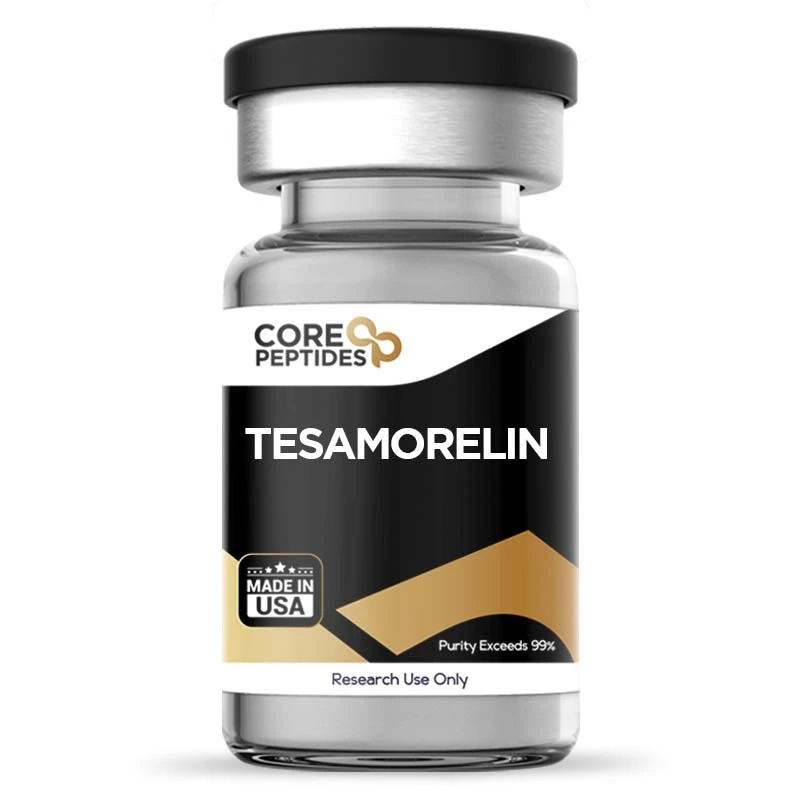
Tesamorelin (5mg / 10mg)
Tesamorelin (5mg / 10mg) is a synthetic peptide and growth hormone-releasing hormone (GHRH) analogue studied extensively in endocrine, metabolic and peptide research.
It is designed to interact with growth hormone-releasing factor receptors and has been investigated for its effects on endogenous growth hormone (GH) secretion and downstream insulin-like growth factor-1 (IGF-1) signalling.
Core Peptides lists Tesamorelin in 5mg and 10mg formats as a lyophilised research peptide with a stated purity of >99%. The supplier identifies the material as being intended for research, laboratory and analytical purposes only.
Tesamorelin is structurally related to human growth hormone-releasing hormone. The FDA-approved pharmaceutical formulation describes tesamorelin as a synthetic analogue containing the 44-amino-acid sequence of human GHRF with an N-terminal modification that contributes to its distinctive molecular structure.
For research, laboratory and analytical use only. Not for human or animal consumption.
What Is Tesamorelin?
Tesamorelin is a synthetic analogue of human growth hormone-releasing factor (GRF), also known as growth hormone-releasing hormone (GHRH). It was developed to interact with GHRH receptors and stimulate the body’s endogenous GH secretion pathway.
Unlike synthetic growth hormone itself, Tesamorelin does not directly supply recombinant human growth hormone. Instead, it is studied for its ability to stimulate the pituitary gland to produce and release endogenous GH. The resulting increase in GH can subsequently influence IGF-1 production in the liver and other tissues.
This makes Tesamorelin an important research compound for laboratories investigating the GHRH–GH–IGF-1 axis, endocrine signalling, metabolic regulation and body-composition biology.
Tesamorelin Product Specifications
| Specification | Details |
|---|---|
| Product Name | Tesamorelin |
| Available Quantities | 5mg / 10mg |
| Peptide Type | GHRH / GRF analogue |
| Form | Lyophilised powder |
| Stated Purity | >99% |
| Peptide Length | 44 amino acids |
| Molecular Weight | Approximately 5,136 Da as free base |
| Primary Research Area | Growth hormone and endocrine signalling |
| Related Research Areas | IGF-1, visceral adiposity, metabolic research and body composition |
| Intended Use | Laboratory, analytical and scientific research |
Core Peptides currently lists Tesamorelin in 5mg and 10mg formats, supplied as a lyophilised powder with a stated purity exceeding 99%.
How Does Tesamorelin Work?
Tesamorelin is primarily studied through its interaction with the growth hormone-releasing hormone receptor. The FDA describes tesamorelin as binding to and stimulating human GRF receptors with potency similar to endogenous GRF.
When GHRH receptors on pituitary somatotroph cells are stimulated, signalling promotes the synthesis and pulsatile secretion of endogenous growth hormone. GH can then act on various tissues and stimulate production of IGF-1, particularly in the liver.
The overall research pathway can therefore be simplified as:
Tesamorelin → GHRH receptor stimulation → increased endogenous GH secretion → increased IGF-1 signalling
Research has demonstrated that Tesamorelin can increase GH secretion and subsequently increase circulating IGF-1 and IGFBP-3 levels.
Tesamorelin and the GHRH–GH–IGF-1 Axis
The GHRH–GH–IGF-1 axis is an interconnected endocrine system involved in growth, metabolism and tissue physiology.
GHRH is produced in the hypothalamus and stimulates the pituitary gland to release growth hormone. GH then interacts with receptors throughout the body and promotes a range of physiological effects, some of which are mediated through IGF-1.
Tesamorelin provides researchers with a synthetic GHRH analogue for investigating this pathway under controlled experimental conditions.
Clinical pharmacology data show that Tesamorelin stimulates GH secretion and subsequently increases IGF-1 and IGFBP-3 concentrations.
Tesamorelin and Growth Hormone Research
One of the defining characteristics of Tesamorelin research is its ability to influence endogenous growth hormone secretion.
In a controlled study involving healthy men, Tesamorelin increased mean overnight GH, GH peak area and basal GH secretion. The same study reported a substantial increase in IGF-1 while measures of insulin-stimulated glucose uptake were not significantly changed.
These findings make Tesamorelin useful for experimental research examining how selective stimulation of the GHRH pathway affects GH pulsatility and downstream endocrine markers.
Because Tesamorelin stimulates endogenous GH rather than directly supplying GH, it can also be used as a research model for studying differences between GHRH-mediated stimulation and direct growth-hormone administration.
Tesamorelin and IGF-1 Research
Insulin-like growth factor-1 (IGF-1) is an important downstream mediator of the growth hormone axis. It is produced primarily by the liver but can also be produced locally by peripheral tissues.
Tesamorelin research consistently demonstrates an increase in circulating IGF-1 following stimulation of the GH pathway. The FDA prescribing information states that Tesamorelin stimulates GH secretion and subsequently increases IGF-1 and IGFBP-3 levels.
For researchers, this makes Tesamorelin relevant to studies investigating:
- GH and IGF-1 signalling.
- Endocrine feedback mechanisms.
- Growth hormone pulsatility.
- IGF-1-dependent cellular responses.
- Metabolic physiology.
- Body-composition research.
Tesamorelin and Visceral Fat Research
Tesamorelin has been extensively investigated in the context of visceral adipose tissue, particularly in people with HIV-associated lipodystrophy.
In a randomised placebo-controlled clinical trial, Tesamorelin treatment produced a significant reduction in visceral adipose tissue compared with placebo after 26 weeks. The study also reported increases in IGF-1 and improvements in selected body-composition and lipid measures.
Another randomised trial reported that Tesamorelin reduced visceral adipose tissue by approximately 10.9% during the initial six-month treatment period, while changes in abdominal subcutaneous fat were not significant.
These findings are important because they demonstrate that Tesamorelin’s research profile is particularly associated with visceral rather than generalised fat loss.
Researchers should nevertheless distinguish between the clinical populations studied and other potential applications. Evidence in HIV-associated lipodystrophy should not automatically be generalised to healthy individuals or other conditions.
Tesamorelin and Body Composition Research
Body composition is another important area of Tesamorelin research. Investigators have examined whether changes in GH and IGF-1 signalling influence fat distribution, lean tissue and muscle-related measurements.
A 2026 meta-analysis of randomised controlled trials in adults with HIV-associated lipodystrophy found that Tesamorelin was associated with reductions in visceral adipose tissue, trunk fat, hepatic fat percentage and waist circumference, alongside an increase in lean body mass. The analysis did not find a significant reduction in BMI or subcutaneous adipose tissue.
These results reinforce the distinction between visceral adiposity and overall body weight. Tesamorelin research has focused more strongly on body-fat distribution than on conventional weight-loss outcomes.
Tesamorelin and Liver Fat Research
The relationship between visceral adiposity and hepatic fat has also contributed to research interest in Tesamorelin.
A randomised, double-blind trial investigated Tesamorelin in people with HIV and non-alcoholic fatty liver disease. The study examined hepatic fat fraction and reported improvements in liver-fat measures among participants receiving Tesamorelin.
More recent evidence also supports continued investigation of Tesamorelin in metabolic and hepatic research. A 2026 meta-analysis reported a significant reduction in hepatic fat percentage across included randomised controlled trials involving HIV-associated lipodystrophy.
These findings make Tesamorelin relevant to experimental research examining the relationship between the GH/IGF-1 axis, visceral adiposity and hepatic metabolism.
Tesamorelin and Metabolic Research
Because growth hormone and IGF-1 participate in lipid and carbohydrate metabolism, Tesamorelin has also been investigated for potential metabolic effects.
Clinical research has examined glucose, insulin sensitivity, triglycerides, cholesterol and other metabolic markers during Tesamorelin treatment.
In one controlled study involving healthy men, Tesamorelin increased GH and IGF-1 without significantly altering fasting glucose or insulin-stimulated glucose uptake.
Research in HIV-associated lipodystrophy has also reported improvements in selected lipid measures alongside reductions in visceral adipose tissue.
These findings illustrate why Tesamorelin is of interest to researchers studying the relationship between endocrine signalling and metabolism.
Tesamorelin and Muscle Research
The GH/IGF-1 axis plays an important role in muscle physiology, making Tesamorelin relevant to body-composition research.
Studies have investigated whether Tesamorelin-associated changes in GH and IGF-1 may influence muscle composition. Research in adults with HIV reported changes in muscle area and reductions in intramuscular fat following Tesamorelin treatment.
These findings provide a basis for further research into the interaction between the GH axis, lean tissue and muscle composition.
However, research findings relating to muscle composition should not be interpreted as evidence that research-grade Tesamorelin is a muscle-building treatment or suitable for athletic performance enhancement.
Tesamorelin and Insulin Sensitivity
The interaction between the GH/IGF-1 axis and glucose metabolism is an important consideration in Tesamorelin research.
Clinical studies have examined whether Tesamorelin influences insulin sensitivity and glycaemic parameters. A randomised placebo-controlled trial in people with type 2 diabetes found no significant reductions in fasting glucose, HbA1c or measures of diabetes control over the study period.
Researchers should therefore avoid describing Tesamorelin as a glucose-lowering peptide. Its principal pharmacological effect is stimulation of the GH axis, and metabolic consequences may vary according to population and experimental context.
Tesamorelin and Endocrine Research
Tesamorelin provides a useful research model for examining selective stimulation of the GH axis.
Its interaction with GHRH receptors makes it particularly relevant to investigations of:
- Hypothalamic-pituitary signalling.
- Growth hormone secretion.
- GH pulse dynamics.
- IGF-1 production.
- IGFBP-3 regulation.
- Endocrine feedback mechanisms.
- Growth hormone-dependent metabolic pathways.
The FDA prescribing information reports that clinically significant changes were not observed in several other pituitary hormones, including TSH, LH, ACTH and prolactin, in clinical trials of the approved formulation.
Tesamorelin Molecular Structure
Tesamorelin is a synthetic analogue based on the 44-amino-acid sequence of human growth hormone-releasing factor.
The molecule contains structural modifications that distinguish it from native GHRH. The FDA describes tesamorelin as incorporating a hexenoyl moiety attached to the N-terminal tyrosine residue. These structural changes are associated with the molecule’s pharmacological properties and stability characteristics.
Core Peptides identifies Tesamorelin using the chemical name N-(trans-3-hexenoyl)-[Tyr1]hGRF(1–44)NH2 acetate.
The molecular weight of tesamorelin free base is approximately 5,135.9 Da, according to the FDA-approved pharmaceutical labelling.
Tesamorelin vs Growth Hormone
| Feature | Tesamorelin | Growth Hormone |
|---|---|---|
| Classification | GHRH/GRF analogue | Growth hormone |
| Primary action | Stimulates endogenous GH secretion | Directly supplies GH |
| Main receptor pathway | GHRH receptor | Growth hormone receptor |
| IGF-1 effect | Increases downstream IGF-1 | Can directly stimulate GH receptor pathways that increase IGF-1 |
| Research relevance | GHRH–GH–IGF-1 axis | GH receptor signalling and downstream physiology |
This distinction is important when designing experiments. Tesamorelin is a secretagogue-type GHRH analogue, whereas recombinant growth hormone directly provides the hormone itself.
Tesamorelin vs Sermorelin
| Feature | Tesamorelin | Sermorelin |
|---|---|---|
| Class | GHRH/GRF analogue | GHRH analogue |
| Relationship to GHRH | Modified 44-amino-acid GHRH-related sequence | Shorter GHRH fragment |
| Research focus | GH secretion, IGF-1 and metabolic/body-composition pathways | GH secretion and endocrine signalling |
| Molecular size | Approximately 5.1 kDa | Smaller peptide |
Both compounds are used in research involving the GHRH pathway, but they are structurally different molecules and should not be treated as interchangeable experimental materials.
Potential Research Applications of Tesamorelin (5mg / 10mg)
Tesamorelin (5mg / 10mg) can be relevant to qualified researchers investigating a broad range of endocrine and metabolic questions.
- Growth hormone research: Study of endogenous GH secretion and pulsatility.
- GHRH receptor research: Investigation of receptor-mediated endocrine signalling.
- IGF-1 research: Examination of downstream IGF-1 responses.
- Body-composition research: Study of visceral adiposity and lean tissue.
- Metabolic research: Investigation of lipid and glucose-related parameters.
- Hepatic research: Study of relationships between visceral fat, hepatic fat and endocrine signalling.
- Endocrine research: Investigation of hypothalamic-pituitary pathways.
- Cellular research: Study of GH/IGF-1-mediated cellular responses.
- Analytical research: Peptide identity, purity and stability assessment.
- Comparative peptide research: Comparison with other GHRH analogues and growth-hormone secretagogues.
Tesamorelin in Analytical Research
Analytical characterisation is an important component of peptide research. Researchers can use validated analytical techniques to confirm molecular identity, assess purity and monitor degradation.
Potential analytical approaches include:
- High-performance liquid chromatography (HPLC): Assessment of chromatographic purity and related substances.
- Liquid chromatography–mass spectrometry (LC-MS): Confirmation of molecular identity and mass.
- Mass spectrometry: Molecular-weight and structural characterisation.
- Peptide mapping: Investigation of sequence-related characteristics where appropriate.
- Stability studies: Monitoring degradation under controlled storage conditions.
- Formulation analysis: Assessment of peptide recovery and stability in experimental systems.
Researchers should rely on validated methods and batch-specific documentation when evaluating the material.
Tesamorelin and Clinical Research
Tesamorelin has a more extensive clinical research history than many experimental peptides. It has been studied particularly in adults with HIV-associated lipodystrophy and excess visceral adipose tissue.
Clinical trials reported reductions in visceral adipose tissue and increases in IGF-1 following Tesamorelin treatment.
A 2026 meta-analysis of five randomised controlled trials similarly found reductions in visceral adipose tissue, trunk fat and hepatic fat, as well as an increase in lean body mass. The analysis also reported adverse events including arthralgia, myalgia, paraesthesia and injection-site reactions.
These clinical findings demonstrate that Tesamorelin is pharmacologically active and should not be treated as an inert laboratory chemical.
Important Safety and Regulatory Considerations
Tesamorelin has been developed as a prescription pharmaceutical in certain jurisdictions and indications. The FDA-approved EGRIFTA formulations are indicated for reducing excess abdominal fat in HIV-infected adults with lipodystrophy; this regulatory indication does not mean that research-grade Tesamorelin sold by a chemical supplier is an approved medicine or appropriate for self-administration.
The FDA prescribing information also identifies important contraindications and warnings associated with pharmaceutical tesamorelin, including active malignancy, disruption of the hypothalamic-pituitary axis, hypersensitivity and glucose intolerance/diabetes-related considerations. It also warns that Tesamorelin can increase IGF-1 and may have effects relevant to neoplasia and fluid retention.
Because the Core Peptides product is supplied as research material, it should not be used as a substitute for an approved pharmaceutical product or medical treatment.
Storage and Handling of Tesamorelin
Researchers should always follow the current product label, Certificate of Analysis and supplier documentation for exact storage conditions.
- Keep the material in its original, correctly labelled container.
- Protect the peptide from unnecessary exposure to moisture.
- Follow the specified temperature and storage conditions provided with the product.
- Minimise repeated temperature fluctuations.
- Use appropriate laboratory handling procedures.
- Prevent contamination of the research material.
- Use suitable personal protective equipment.
- Dispose of research materials according to applicable institutional procedures.
Storage requirements can vary according to formulation, packaging and experimental application. Researchers should therefore rely on batch-specific documentation rather than generic peptide-storage assumptions.
Frequently Asked Questions About Tesamorelin (5mg / 10mg)
What is Tesamorelin?
Tesamorelin is a synthetic analogue of growth hormone-releasing hormone (GHRH/GRF). It is studied for its ability to stimulate endogenous growth hormone secretion and influence downstream IGF-1 signalling.
What does Tesamorelin do in research?
Tesamorelin is primarily investigated for its effects on the GHRH–GH–IGF-1 axis. Research also examines its relationship with visceral adipose tissue, body composition, hepatic fat and metabolic parameters.
How does Tesamorelin affect growth hormone?
Tesamorelin stimulates GHRH receptors and promotes endogenous growth hormone secretion from pituitary somatotroph cells. Clinical pharmacology data demonstrate increased GH secretion following Tesamorelin exposure.
Does Tesamorelin increase IGF-1?
Yes. Tesamorelin stimulates GH secretion and subsequently increases circulating IGF-1 and IGFBP-3 levels.
What is the relationship between Tesamorelin and visceral fat?
Clinical research has investigated Tesamorelin for its effects on visceral adipose tissue, particularly in HIV-associated lipodystrophy. Randomised trials reported significant reductions in visceral adipose tissue compared with placebo.
Is Tesamorelin the same as growth hormone?
No. Tesamorelin is a GHRH analogue that stimulates the body’s endogenous GH secretion, whereas growth hormone is the hormone itself.
Is Tesamorelin the same as Sermorelin?
No. Both are related to the GHRH pathway, but they have different molecular structures and should be considered separate research compounds.
What does 5mg / 10mg mean?
The 5mg / 10mg designation refers to the quantity of research material supplied. It is not a recommended dose or administration instruction.
Is Tesamorelin suitable for laboratory research?
Yes. Core Peptides lists its Tesamorelin material for research, laboratory and analytical purposes. The product is supplied as a lyophilised powder with a stated purity exceeding 99%.
Can research-grade Tesamorelin be used for weight loss?
Research-grade Tesamorelin should not be marketed or used as a general weight-loss product. Clinical research has primarily examined its effect on visceral adiposity in specific populations, particularly HIV-associated lipodystrophy.
Is Tesamorelin intended for human consumption?
No. The Tesamorelin material described on the Core Peptides website is intended for research, laboratory and analytical purposes only and is not intended for human or animal consumption.
Tesamorelin (5mg / 10mg) Research Summary
Tesamorelin (5mg / 10mg) is a synthetic GHRH analogue with a well-established research profile in endocrine and metabolic science. It interacts with GHRH receptors and stimulates endogenous growth hormone secretion, which subsequently increases downstream IGF-1 signalling.
Research has examined Tesamorelin in relation to growth hormone pulsatility, IGF-1, visceral adipose tissue, hepatic fat, body composition, muscle composition and metabolic parameters. Clinical trials have particularly focused on HIV-associated lipodystrophy, where reductions in visceral adipose tissue have been observed.
More recent evidence continues to evaluate its metabolic and body-composition effects. A 2026 meta-analysis reported reductions in visceral adipose tissue, trunk fat and hepatic fat alongside increased lean body mass in the studied HIV-associated lipodystrophy population.
The 5mg and 10mg research formats provide qualified laboratories with defined quantities of Tesamorelin for analytical testing, peptide characterisation, endocrine research, cellular studies and controlled experimental investigations.
Research-Use Disclaimer
Tesamorelin (5mg / 10mg) supplied by Core Peptides is intended solely for qualified research, laboratory and analytical purposes. It is not intended for human or veterinary consumption, self-administration, diagnosis, treatment, cure or prevention of any disease.
References to growth hormone, IGF-1, visceral adipose tissue, body composition, hepatic fat or other biological effects describe areas of scientific research and should not be interpreted as medical advice or a recommendation to use research-grade Tesamorelin therapeutically.
Tesamorelin is pharmacologically active and has prescription-drug status in certain jurisdictions and indications. Researchers should distinguish research material from approved pharmaceutical formulations and comply with all applicable legislation, institutional requirements and laboratory safety procedures.
For research use only. Not for human or animal consumption.
| Please select a size | 5MG, 10MG |
|---|
Be the first to review “Tesamorelin (5mg / 10mg)”
Related products
Peptides for Sale
Peptides for Sale
Peptides for Sale
Peptides for Sale
Peptides for Sale
Peptides for Sale
Peptides for Sale
Peptides for Sale
Reviews
There are no reviews yet.