
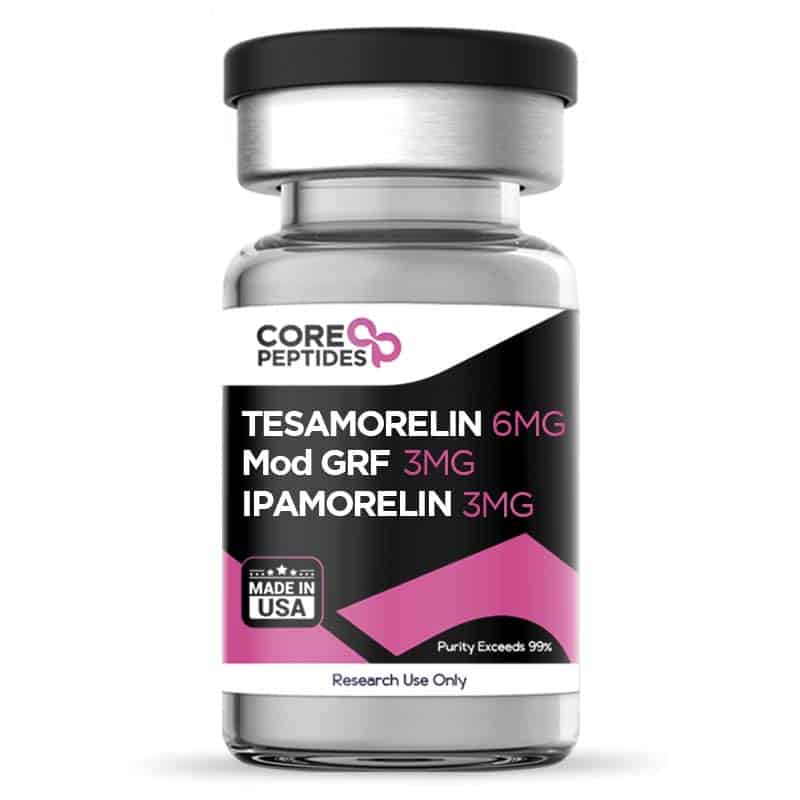
Tesamorelin & CJC-1295 (Mod GRF 1-29) & Ipamorelin Blend (12mg)
Tesamorelin & CJC-1295 (Mod GRF 1-29) & Ipamorelin Blend (12mg) is a multi-peptide research formulation designed for laboratory investigation of growth hormone-releasing pathways and related endocrine signalling. The blend combines three synthetic peptides with distinct but related mechanisms of action: Tesamorelin, CJC-1295 (Mod GRF 1-29) and Ipamorelin.
According to the Core Peptides product specification, each 12mg vial contains 6mg Tesamorelin, 3mg CJC-1295 (Mod GRF 1-29) and 3mg Ipamorelin. The material is supplied as a lyophilised powder with a stated purity of >99% and is intended for research and laboratory purposes only.
This combination is of particular interest to researchers studying the growth hormone-releasing hormone (GHRH), growth hormone secretagogue receptor (GHS-R) and GH–IGF-1 signalling pathways. Each constituent provides a different research model for examining the regulation of endogenous growth hormone secretion.
For research, laboratory and analytical use only. Not for human or animal consumption.
What Is the Tesamorelin & CJC-1295 (Mod GRF 1-29) & Ipamorelin Blend?
This 12mg peptide blend combines three research compounds associated with the regulation of growth hormone secretion. Rather than containing recombinant growth hormone itself, the formulation contains peptides that have been investigated for their ability to interact with signalling systems involved in endogenous GH release.
Tesamorelin is a synthetic analogue of growth hormone-releasing hormone (GHRH) and is studied for its interaction with GHRH receptors. CJC-1295 (Mod GRF 1-29), commonly referred to as modified GRF 1-29 or CJC-1295 without DAC, is a modified fragment of GHRH investigated for GHRH receptor signalling. Ipamorelin is a synthetic peptide studied as a selective growth hormone secretagogue receptor agonist.
The combination therefore provides researchers with a multi-component model for investigating different upstream mechanisms associated with GH secretion.
Product Specifications
| Specification | Details |
|---|---|
| Product Name | Tesamorelin & CJC-1295 (Mod GRF 1-29) & Ipamorelin Blend |
| Total Quantity | 12mg |
| Tesamorelin | 6mg |
| CJC-1295 (Mod GRF 1-29) | 3mg |
| Ipamorelin | 3mg |
| Form | Lyophilised powder |
| Stated Purity | >99% |
| Product Category | Research Peptide Blend |
| Research Focus | GH secretion, GHRH signalling and endocrine research |
| Intended Application | Laboratory, analytical and in-vitro research |
The 12mg formulation is supplied in a defined 6mg/3mg/3mg composition, allowing researchers to work with a consistent combination of the three listed peptides.
Key Components of the 12mg Blend
Tesamorelin
Tesamorelin is a synthetic GHRH analogue consisting of a modified 44-amino-acid sequence related to human growth hormone-releasing factor. It has been studied extensively in endocrine research because of its ability to interact with GHRH receptors and stimulate endogenous growth hormone secretion.
Research involving Tesamorelin has examined the relationship between GHRH receptor activation, GH secretion, IGF-1 signalling and body-composition parameters. It therefore provides an important research component for investigations involving the broader GH–IGF-1 axis.
CJC-1295 (Mod GRF 1-29)
CJC-1295 (Mod GRF 1-29) is a modified analogue of the biologically active N-terminal region of GHRH. It is also commonly described as Mod GRF 1-29 or CJC-1295 without DAC.
The modifications incorporated into Mod GRF 1-29 are intended to alter its resistance to enzymatic degradation and pharmacological characteristics compared with unmodified GRF 1-29. This makes it a useful compound for laboratory research examining GHRH receptor signalling and GH secretion.
Ipamorelin
Ipamorelin is a synthetic pentapeptide investigated as a selective agonist of the growth hormone secretagogue receptor (GHS-R). The receptor is also associated with the physiological actions of ghrelin.
Research has investigated Ipamorelin because of its apparent selectivity for GH secretagogue signalling compared with some earlier growth hormone secretagogues. It provides a complementary research mechanism to GHRH-related peptides such as Tesamorelin and Mod GRF 1-29.
How the Three Peptides Differ
| Peptide | Primary Research Target | Research Classification |
|---|---|---|
| Tesamorelin | GHRH receptor | GHRH analogue |
| CJC-1295 (Mod GRF 1-29) | GHRH receptor | Modified GHRH fragment |
| Ipamorelin | Growth hormone secretagogue receptor (GHS-R) | Growth hormone secretagogue |
The principal scientific interest in this formulation comes from combining two GHRH-related research peptides with a peptide acting through the growth hormone secretagogue receptor. This provides a broader experimental framework for investigating GH-release signalling than studying any one compound in isolation.
Understanding the GHRH–GH–IGF-1 Axis
The GHRH–GH–IGF-1 axis is a complex endocrine signalling system involving the hypothalamus, pituitary gland, liver and peripheral tissues.
Under normal physiological conditions, hypothalamic GHRH contributes to the regulation of growth hormone release from pituitary somatotroph cells. GH subsequently acts on tissues throughout the body and contributes to the production of IGF-1, particularly in the liver.
Tesamorelin and Mod GRF 1-29 are investigated in relation to GHRH receptor signalling, while Ipamorelin is studied in relation to the GHS-R pathway.
For laboratory researchers, the three compounds can therefore provide complementary models for examining different regulatory inputs within the GH secretion pathway.
Why Combine Tesamorelin, Mod GRF 1-29 and Ipamorelin?
The scientific rationale for studying this combination is based on the fact that the three peptides are associated with different upstream signalling mechanisms involved in growth hormone release.
- Tesamorelin provides a GHRH analogue model.
- Mod GRF 1-29 provides a modified GHRH-fragment model.
- Ipamorelin provides a growth hormone secretagogue receptor model.
Studying these compounds together can allow researchers to investigate how distinct signalling mechanisms may influence the same broader endocrine pathway. However, the presence of several peptides in a formulation does not by itself establish a clinically meaningful synergistic effect.
Any claims regarding combined biological activity should be supported by appropriate experimental evidence rather than inferred solely from the individual mechanisms of the components.
Research Areas for the 12mg Peptide Blend
The Tesamorelin, Mod GRF 1-29 and Ipamorelin combination may be relevant to qualified laboratories investigating:
- Growth hormone secretion mechanisms.
- GHRH receptor signalling.
- Growth hormone secretagogue receptor activity.
- GH pulse dynamics.
- GH–IGF-1 pathway regulation.
- Endocrine receptor interactions.
- Peptide-receptor binding.
- Cellular signalling pathways.
- Metabolic and endocrine research.
- Peptide stability and degradation.
- Analytical peptide characterisation.
- Comparative studies involving GHRH analogues and secretagogues.
Tesamorelin Research Profile
Tesamorelin has been studied considerably more extensively in clinical research than many experimental peptide compounds. Research has focused particularly on its effects on the GH axis and visceral adipose tissue in specific clinical populations.
Clinical studies have demonstrated that Tesamorelin can stimulate GH secretion and increase downstream IGF-1 concentrations. Research has also investigated its effects on visceral adipose tissue and related body-composition parameters.
These findings provide useful background for laboratory investigations of the biological pathways associated with Tesamorelin, but results from clinical pharmaceutical formulations should not automatically be attributed to research-grade peptide blends containing multiple compounds.
CJC-1295 (Mod GRF 1-29) Research Profile
Mod GRF 1-29 is a modified fragment of GHRH designed to retain GHRH-related biological activity while incorporating structural changes intended to influence stability.
Research has investigated the peptide’s interaction with GHRH receptors and its ability to influence GH secretion. The Core Peptides research literature describes Mod GRF 1-29 as a modified GHRH analogue containing several amino-acid substitutions that may reduce susceptibility to enzymatic degradation.
These properties make Mod GRF 1-29 relevant to experimental studies involving peptide stability, receptor activation and endocrine signalling.
Ipamorelin Research Profile
Ipamorelin is a synthetic pentapeptide that has been studied as a selective growth hormone secretagogue. Its primary research interest is its interaction with GHS-R, the receptor through which ghrelin can stimulate growth hormone secretion.
Experimental research has investigated whether Ipamorelin can stimulate GH secretion while exhibiting comparatively selective activity across other pituitary hormone pathways. These observations have contributed to continued interest in Ipamorelin as a laboratory research compound.
Chemical Composition
| Compound | Molecular Formula | Approx. Molecular Weight |
|---|---|---|
| Tesamorelin | C221H366N72O67S | 5,136 g/mol |
| CJC-1295 (Mod GRF 1-29) | C152H252N44O42 | 3,367.9 g/mol |
| Ipamorelin | C38H49N9O5 | 711.8 g/mol |
The molecular information above corresponds to the individual peptide components listed for the formulation.
Lyophilised Peptide Format
The Tesamorelin & CJC-1295 (Mod GRF 1-29) & Ipamorelin Blend is supplied as a lyophilised powder. Lyophilisation, also known as freeze-drying, is widely used for peptide materials because removing water can help provide a stable format for storage and subsequent laboratory handling.
Researchers should always follow the product-specific documentation and Certificate of Analysis for storage, handling and analytical requirements. Conditions can vary according to the formulation and packaging.
Analytical Research and Quality Assessment
High-quality peptide research depends on appropriate analytical characterisation. For multi-component formulations such as this 12mg blend, researchers may be interested in confirming the identity and purity of the individual constituents as well as assessing the overall material.
Common analytical approaches for peptide research can include:
- Reverse-phase HPLC: Used to evaluate chromatographic purity and related impurities.
- Mass spectrometry: Used to investigate molecular mass and confirm peptide identity.
- LC-MS: Combines chromatographic separation with mass-based identification.
- Stability analysis: Used to monitor degradation over controlled storage periods.
- Peptide mapping: Used where appropriate to investigate structural characteristics.
For research applications, a current batch-specific Certificate of Analysis should be reviewed before experimental use.
Research Applications of a Multi-Peptide GH Blend
Researchers studying endocrine signalling may use multi-peptide formulations to compare distinct receptor pathways under controlled laboratory conditions.
The Tesamorelin/Mod GRF 1-29/Ipamorelin combination can be particularly relevant to research questions such as:
- How different GH-releasing pathways interact at the receptor level.
- How GHRH-related signalling influences pituitary GH secretion.
- How GHS-R activation differs from GHRH receptor activation.
- How peptide structure affects receptor interaction.
- How peptide modifications influence stability.
- How endocrine signalling affects downstream IGF-1 pathways.
- How individual peptides compare with multi-component formulations.
Tesamorelin vs CJC-1295 (Mod GRF 1-29) vs Ipamorelin
| Feature | Tesamorelin | Mod GRF 1-29 | Ipamorelin |
|---|---|---|---|
| General classification | GHRH analogue | Modified GHRH fragment | Growth hormone secretagogue |
| Primary research receptor | GHRH receptor | GHRH receptor | GHS-R |
| Relationship to GHRH | Modified 44-amino-acid analogue | Modified 29-amino-acid fragment | Not a GHRH analogue |
| Research focus | GH secretion and endocrine signalling | GH secretion and GHRH signalling | GH secretagogue signalling |
| Quantity in blend | 6mg | 3mg | 3mg |
Frequently Asked Questions
What is Tesamorelin & CJC-1295 (Mod GRF 1-29) & Ipamorelin Blend?
It is a 12mg research peptide formulation containing 6mg Tesamorelin, 3mg CJC-1295 (Mod GRF 1-29) and 3mg Ipamorelin. The three compounds are studied in relation to growth hormone secretion and endocrine signalling.
What is included in the 12mg blend?
The formulation contains 6mg Tesamorelin, 3mg CJC-1295 (Mod GRF 1-29) and 3mg Ipamorelin, for a total peptide content of 12mg.
What is Mod GRF 1-29?
Mod GRF 1-29 is a modified fragment of growth hormone-releasing hormone. It is also commonly referred to as CJC-1295 without DAC and is studied for its interaction with GHRH receptors and its effects on GH secretion.
What is Ipamorelin?
Ipamorelin is a synthetic pentapeptide investigated as a selective growth hormone secretagogue receptor agonist. Its research profile centres on GHS-R signalling and the regulation of GH release.
What is Tesamorelin?
Tesamorelin is a synthetic GHRH analogue studied for its interaction with GHRH receptors and its ability to stimulate endogenous growth hormone secretion.
Is this blend growth hormone?
No. The product does not contain recombinant human growth hormone. It contains three synthetic peptides that are researched in connection with signalling pathways involved in endogenous GH secretion.
Why are three peptides combined?
The three components provide different research models: Tesamorelin and Mod GRF 1-29 are associated with GHRH receptor signalling, while Ipamorelin is associated with GHS-R signalling. The combination can therefore be studied when investigating different regulatory mechanisms within the GH-release pathway.
What does 12mg mean?
The 12mg designation refers to the total quantity of peptide material in the formulation. It consists of 6mg Tesamorelin, 3mg Mod GRF 1-29 and 3mg Ipamorelin. It should not be interpreted as a dosage recommendation.
What form is the peptide blend supplied in?
The Core Peptides listing specifies a lyophilised powder with a stated purity of >99%.
What research areas are relevant to this blend?
The formulation may be relevant to laboratory studies involving growth hormone secretion, GHRH receptor signalling, GHS-R signalling, endocrine pathways, peptide stability, receptor biology and the GH–IGF-1 axis.
Is this product intended for human use?
No. The product is listed for research and laboratory purposes only. It is not intended for human or animal consumption, self-administration, diagnosis, treatment or prevention of disease.
Does the blend have an established clinical indication?
The three peptides have different research and clinical histories, but this specific three-peptide research formulation should not be represented as an approved medicine or as having a clinical indication.
Research-Only Product Information
The Tesamorelin & CJC-1295 (Mod GRF 1-29) & Ipamorelin Blend (12mg) is intended to provide qualified researchers with a defined multi-peptide material for controlled laboratory investigation.
With a composition of 6mg Tesamorelin, 3mg CJC-1295 (Mod GRF 1-29) and 3mg Ipamorelin, the formulation brings together three compounds associated with different mechanisms within the growth hormone-release pathway. The product is supplied as lyophilised powder with a stated purity of >99%.
Its research value lies in the opportunity to investigate GHRH-related and GHS-R-related signalling within a defined multi-component formulation. Appropriate experimental design, validated analytical procedures and batch-specific documentation remain essential when working with peptide research materials.
Storage and Laboratory Handling
Researchers should consult the current product documentation and Certificate of Analysis for specific storage and handling requirements.
- Keep the material in its original labelled container.
- Protect the lyophilised peptide from unnecessary moisture and environmental exposure.
- Follow the supplier’s specified storage conditions.
- Minimise unnecessary temperature fluctuations.
- Use appropriate laboratory protective equipment.
- Prevent contamination during laboratory handling.
- Maintain appropriate records for batch identification and experimental use.
- Dispose of research materials according to applicable institutional procedures.
Research institutions should establish their own validated handling and storage procedures in accordance with applicable regulations and laboratory standards.
Important Research Disclaimer
Tesamorelin & CJC-1295 (Mod GRF 1-29) & Ipamorelin Blend (12mg) is supplied for research, laboratory and analytical purposes only.
This product is not intended for human or veterinary consumption, self-administration, diagnosis, treatment, cure or prevention of any disease. Information regarding biological pathways and published research is provided for scientific and educational context and should not be interpreted as medical advice or a recommendation for therapeutic use.
The presence of three research peptides in one formulation does not establish that the combination is clinically effective, safe or approved for any particular purpose. Researchers should comply with all applicable laws, institutional requirements and laboratory safety procedures.
For research use only. Not for human or animal consumption.
Be the first to review “Tesamorelin & CJC-1295 (Mod GRF 1-29) & Ipamorelin Blend (12mg)”
Related products
Peptides for Sale
Peptides for Sale
Peptides for Sale
Peptides for Sale
Peptides for Sale
Peptides for Sale
Peptides for Sale
Peptide Blends for Sale
Reviews
There are no reviews yet.