
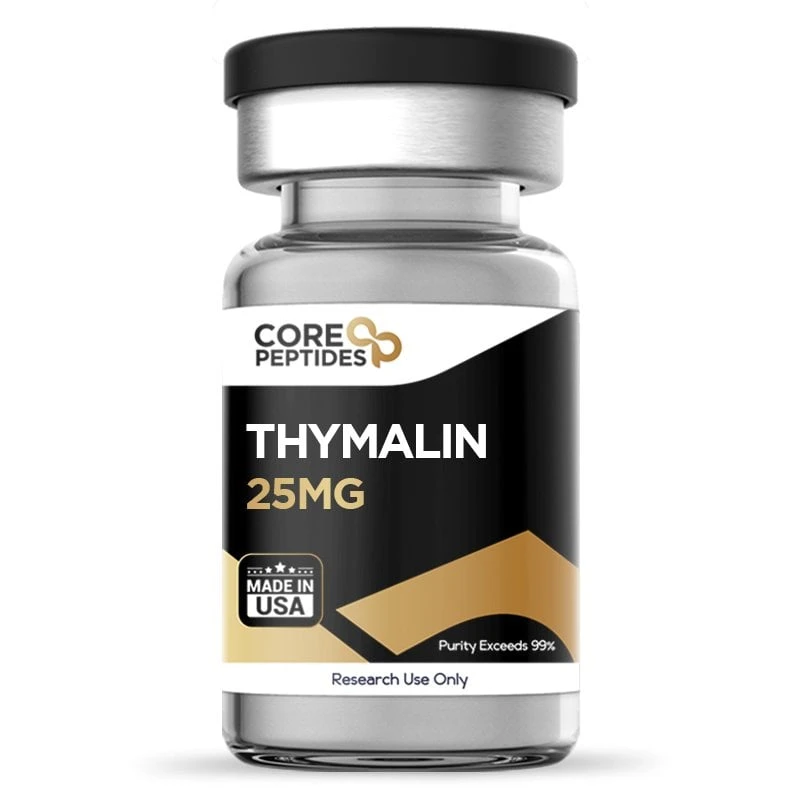
Thymalin (25mg) – Research Peptide
Thymalin (25mg) is a research peptide associated with the study of thymic biology, immune-cell signalling and cellular regulation. Thymalin is a naturally derived thymic peptide preparation that has been investigated extensively in experimental research concerning T-cell differentiation, immune responses, cytokine signalling and age-related changes in thymic function.
The Core Peptides product is supplied as a 25mg lyophilised powder with a stated purity of >99%. The product listing identifies a molecular formula of C33H54N12O15 and a molecular weight of approximately 858.864 g/mol.
Thymalin has been the subject of laboratory and clinical research investigating its relationship with immune function, thymic activity, cytokine responses, cellular differentiation, oxidative stress and age-associated biological changes. These research findings provide scientific context for the compound but should not be interpreted as evidence of an approved medical use.
For research, laboratory and analytical purposes only. Not for human or animal consumption.
What Is Thymalin?
Thymalin is a thymic peptide preparation associated with research into the biological functions of the thymus. The thymus is an important lymphoid organ involved in the development and maturation of T lymphocytes, making thymic peptides an area of interest within immunology and cellular biology.
Research cited by Core Peptides describes Thymalin as a polypeptide associated with the thymus and notes that levels of thymic peptide material may change with age.
Researchers have investigated Thymalin and related peptides to better understand potential relationships between thymic function, immune-cell differentiation and cellular signalling.
Thymalin should be distinguished from Thymulin, a separate zinc-dependent nonapeptide hormone. Although both are associated with thymic biology, they are chemically distinct research subjects.
Thymalin (25mg) Product Specifications
| Specification | Details |
|---|---|
| Product Name | Thymalin |
| Quantity | 25mg |
| Form | Lyophilised powder |
| Stated Purity | >99% |
| Molecular Formula | C33H54N12O15 |
| Molecular Weight | 858.864 g/mol |
| Research Category | Thymic and peptide research |
| Research Areas | Immune signalling, T-cell biology, cellular differentiation and ageing research |
| Intended Use | Laboratory, analytical and in-vitro research |
The specifications above are based on the Core Peptides product listing for Thymalin 25mg.
Thymalin and Thymic Biology
The thymus plays a central role in the development of T lymphocytes. These immune cells are essential components of adaptive immunity and help the body recognise and respond to foreign antigens.
Thymic tissue and its associated peptide signalling systems have therefore attracted significant research interest. Studies involving Thymalin have explored whether thymic peptides may influence T-cell differentiation, immune-cell activity and cytokine production.
Research cited by Core Peptides includes investigations into Thymalin and the differentiation of human haematopoietic stem cells. Such studies contribute to the broader understanding of how thymic peptide signalling may interact with cellular differentiation pathways.
Thymalin and T-Cell Research
T cells are lymphocytes that play an important role in adaptive immune responses. Their development involves several stages, including maturation within the thymus.
Experimental research into Thymalin has examined potential changes in T-cell differentiation and immune-cell function. Research cited by Core Peptides describes observations involving T-cell-related immune responses and changes in cellular signalling following exposure to thymic peptides.
These studies are relevant to laboratories investigating the relationship between peptide signalling and immune-cell biology. Experimental results should, however, be assessed according to the specific model, study design and biological conditions involved.
Thymalin and Immune Signalling
Immune cells communicate through complex networks involving cytokines, receptors, intracellular messengers and other signalling molecules. Research into thymic peptides has explored whether these compounds may influence aspects of this communication.
Studies cited on the Thymalin product page have investigated changes in cytokine-associated responses and lymphocyte activity. Research has also considered potential relationships between thymic peptides and immune exhaustion markers such as PD-1 and PD-L1.
These observations provide research hypotheses for further investigation but do not establish Thymalin as a clinically proven immunomodulatory treatment.
Thymalin and Cytokine Research
Cytokines are signalling proteins involved in communication between immune cells. They can participate in inflammatory responses, immune-cell differentiation and host defence.
Research involving thymic peptides has examined cytokines including IFN-γ and IL-2, as well as other immune-related markers. One study referenced by Core Peptides investigated thymic peptides in subjects with reactivated human alphaherpesvirus 1 infection and reported changes in selected cytokine levels and immune exhaustion markers.
Because cytokine responses depend heavily on experimental conditions and individual biological systems, these findings require careful interpretation and further validation.
Thymalin and Cellular Differentiation
Cellular differentiation describes the process through which less specialised cells develop into cells with specific biological functions.
Thymalin has been studied in relation to the differentiation of haematopoietic cells and immune-cell development. Research cited by Core Peptides includes a 2020 publication investigating Thymalin and the differentiation of human haematopoietic stem cells.
This area of research is relevant to laboratories studying stem-cell biology, immune-cell development and the molecular mechanisms involved in cellular differentiation.
Thymalin and Oxidative Stress Research
Oxidative stress occurs when reactive oxygen species and antioxidant defence systems become imbalanced. It is a major area of investigation in ageing, cellular biology and inflammatory research.
Research cited by Core Peptides suggests that naturally occurring thymic peptide preparations may differ from synthetic thymic peptide analogues in their reported effects on antioxidant responses. These observations have contributed to research interest in the relationship between thymic peptides, oxidative balance and cellular protection.
Further research is required to clarify the molecular mechanisms involved and to determine the reproducibility and significance of these observations across different models.
Thymalin and Ageing Research
The thymus undergoes significant age-associated changes. Research has investigated whether thymic peptide signalling may be associated with changes in immune function and other biological processes during ageing.
Long-term experimental research cited by Core Peptides investigated Thymalin and Epithalamin in mature subjects over several years. The studies reported observations involving cardiovascular, neurological, immunological and metabolic parameters, as well as changes associated with systemic inflammation and thymic function.
These findings form part of the historical research surrounding thymic peptides and ageing. They should not be interpreted as proof that Thymalin reverses ageing or provides an established anti-ageing treatment.
Thymalin and Carcinogenesis Research
Thymalin has also been investigated in experimental models involving carcinogenesis.
One study referenced by Core Peptides investigated the effects of the synthetic dipeptide L-Glu-L-Trp in rats exposed to experimental conditions associated with spontaneous carcinogenesis. The research reported differences in tumour incidence and lifespan between experimental groups.
Such animal research can be useful for investigating biological mechanisms and generating hypotheses. However, observations from animal models cannot be assumed to demonstrate cancer prevention or treatment in humans.
Thymalin and Viral Infection Research
Thymic peptides have been studied in experimental and clinical research involving immune responses to viral infection.
The Core Peptides reference material cites research involving patients with reactivated human alphaherpesvirus 1 infections. The study investigated immune exhaustion markers and cytokine responses following exposure to thymic peptides, reporting changes in selected immune parameters.
This research may be relevant to investigators studying immune exhaustion, T-cell function and cytokine signalling. It should not be interpreted as evidence that research-grade Thymalin is an antiviral treatment.
Thymalin and Experimental Thyroid Research
The interaction between immune function and endocrine biology is another area in which thymic peptides have been investigated.
A study referenced by Core Peptides examined Thymalin in subjects with diffuse toxic goitre and investigated parameters including medium-molecular-weight peptides and lipid peroxidation. The study reported observations following combined experimental interventions involving Thymalin.
These findings are part of historical research and should not be considered evidence of an established treatment for thyroid disease.
Thymalin and Lymphoid Leukaemia Research
Research has also explored thymic peptide preparations in experimental and clinical settings involving lymphoid malignancies.
The Core Peptides product page cites a study examining Thymalin alongside plasmapheresis in subjects with chronic lymphocytic leukaemia. The research investigated changes in physiological and immune-related parameters in the context of combined treatment.
These historical findings do not establish Thymalin as a cancer therapy and should not be used as a substitute for evidence-based medical treatment.
Thymalin vs Thymagen
Thymalin and Thymagen are both associated with thymic peptide research, but they are distinct materials.
| Feature | Thymalin | Thymagen |
|---|---|---|
| General description | Thymic polypeptide preparation | Defined synthetic dipeptide |
| Structure | Complex peptide composition | Glu-Trp dipeptide |
| Research focus | Thymic biology and immune regulation | Short-peptide and immune-signalling research |
| Research category | Thymic peptide research | Thymic peptide research |
These compounds should not be treated as interchangeable. Researchers should select the appropriate peptide according to the specific experimental question and verified product specifications.
Thymalin vs Thymulin
Although their names are similar, Thymalin and Thymulin are not the same compound.
Thymalin is described in the supplied product literature as a thymic polypeptide preparation, whereas Thymulin is a zinc-dependent nonapeptide hormone associated with thymic function.
Researchers should therefore verify the exact peptide identity, sequence, molecular characteristics and product documentation before designing experiments involving either compound.
Thymalin (25mg) Research Applications
Qualified laboratories may investigate Thymalin in a range of research areas, including:
- Thymic biology.
- T-cell differentiation.
- Immune-cell signalling.
- Cytokine research.
- Haematopoietic stem-cell differentiation.
- Immune exhaustion research.
- Oxidative-stress research.
- Age-related changes in immune function.
- Cellular signalling.
- Experimental carcinogenesis research.
- Viral and host-response research.
- Endocrine and immune-system interactions.
- Peptide characterisation and analytical research.
These are areas of scientific investigation rather than approved indications or recommendations for use.
Thymalin Chemical Profile
The Core Peptides product listing provides the following chemical information for Thymalin:
| Property | Value |
|---|---|
| Molecular Formula | C33H54N12O15 |
| Molecular Weight | 858.864 g/mol |
| Product Quantity | 25mg |
| Physical Form | Lyophilised powder |
| Stated Purity | >99% |
These specifications are taken from the product information published by Core Peptides.
Lyophilised Thymalin Powder
Thymalin (25mg) is supplied as a lyophilised powder. Lyophilisation, also known as freeze-drying, is commonly used for research materials because removing water under controlled conditions can support the storage and handling of sensitive compounds.
Researchers should follow the current product documentation and batch-specific Certificate of Analysis for storage, handling and any applicable laboratory preparation requirements. Product-specific instructions should always take precedence over generic peptide-handling guidance.
Analytical Testing of Thymalin
Laboratory research involving peptide materials often requires appropriate analytical verification. Depending on the research objective, investigators may use techniques such as:
- High-performance liquid chromatography (HPLC): For chromatographic assessment and purity analysis.
- Mass spectrometry: For molecular-mass determination and compound identification.
- LC-MS: For combined chromatographic and mass-based analysis.
- Stability testing: For monitoring changes under defined storage or experimental conditions.
- Biochemical assays: For studying peptide-associated biological activity in controlled experimental systems.
Researchers should review the applicable Certificate of Analysis before using a research material in an experimental protocol.
Thymalin (25mg) Research Summary
| Research Characteristic | Information |
|---|---|
| Compound | Thymalin |
| Quantity | 25mg |
| Form | Lyophilised powder |
| Stated Purity | >99% |
| Molecular Formula | C33H54N12O15 |
| Molecular Weight | 858.864 g/mol |
| Primary Research Areas | Thymic biology, immune signalling, T-cell differentiation and cellular research |
| Intended Use | Laboratory, analytical and in-vitro research |
Frequently Asked Questions About Thymalin (25mg)
What is Thymalin?
Thymalin is a thymic peptide preparation that has been investigated in research concerning thymic function, T-cell differentiation, immune signalling and cellular regulation.
How much Thymalin is in this product?
This product contains 25mg of Thymalin. The stated quantity refers to the amount of research material supplied and should not be interpreted as a dosage recommendation.
What form is Thymalin supplied in?
Core Peptides lists Thymalin (25mg) as a lyophilised powder.
What is the stated purity of Thymalin?
The product listing states a purity of >99%. Researchers should consult the applicable batch-specific Certificate of Analysis for detailed quality information.
What is the molecular weight of Thymalin?
The molecular weight listed for Thymalin is approximately 858.864 g/mol.
What is the molecular formula of Thymalin?
The Core Peptides listing gives the molecular formula as C33H54N12O15.
What is Thymalin studied for?
Research has investigated Thymalin in areas including thymic biology, T-cell differentiation, immune signalling, cytokine responses, oxidative stress, cellular differentiation and age-associated biological changes.
Is Thymalin the same as Thymagen?
No. Thymalin is described as a thymic polypeptide preparation, while Thymagen is a defined synthetic dipeptide. Although both are associated with thymic peptide research, they are distinct research materials.
Is Thymalin the same as Thymulin?
No. Thymalin and Thymulin are different compounds. Thymulin is a zinc-dependent nonapeptide hormone, while Thymalin is associated with a thymic polypeptide preparation.
Is Thymalin approved for medical use?
This research-grade product should not be represented as an approved medicinal product. Core Peptides states that its products are sold for research, laboratory or analytical purposes only and are not intended for human consumption.
Can Thymalin be used for self-administration?
No. The product is intended for laboratory and research purposes only and is not intended for human or animal consumption or self-administration.
Storage and Laboratory Handling
Researchers should consult the current product documentation and Certificate of Analysis for product-specific storage and handling requirements.
- Keep the product in its original labelled container.
- Protect the lyophilised material from unnecessary moisture exposure.
- Follow the supplier’s specified storage conditions.
- Minimise unnecessary temperature fluctuations.
- Use appropriate laboratory protective equipment.
- Prevent contamination during research handling.
- Maintain appropriate batch and experimental records.
- Dispose of research materials in accordance with applicable laboratory and institutional procedures.
Why Choose Thymalin (25mg) for Research?
Thymalin (25mg) provides researchers with a defined, high-purity research material for investigating thymic peptide biology and related cellular processes. The product is supplied as a 25mg lyophilised powder with a stated purity of >99%, providing a documented research format for suitable laboratory applications.
Its extensive research history makes Thymalin particularly relevant to laboratories studying T-cell biology, immune signalling, cellular differentiation, cytokine pathways and age-associated changes in thymic function.
Important Research Disclaimer
Thymalin (25mg) is supplied strictly for research, laboratory and analytical purposes.
This product is not intended for human or animal consumption, self-administration, diagnosis, treatment, cure or prevention of any disease. References to immune function, cancer, viral infections, ageing, thyroid conditions or other biological effects describe areas of scientific research and should not be interpreted as medical advice or therapeutic claims.
Some research cited in connection with Thymalin involves animal models, historical studies or specific clinical populations. Findings from these studies should not automatically be extrapolated to other populations or interpreted as proof of efficacy for this research-grade material.
Researchers are responsible for complying with applicable laws, institutional requirements, laboratory safety procedures and appropriate handling protocols when working with Thymalin.
For research use only. Not for human or animal consumption.
Be the first to review “Thymalin (25mg)”
Related products
Peptides for Sale
Peptides for Sale
Peptides for Sale
Peptides for Sale
Peptide Blends for Sale
Peptides for Sale
Peptides for Sale
Peptides for Sale
Reviews
There are no reviews yet.