
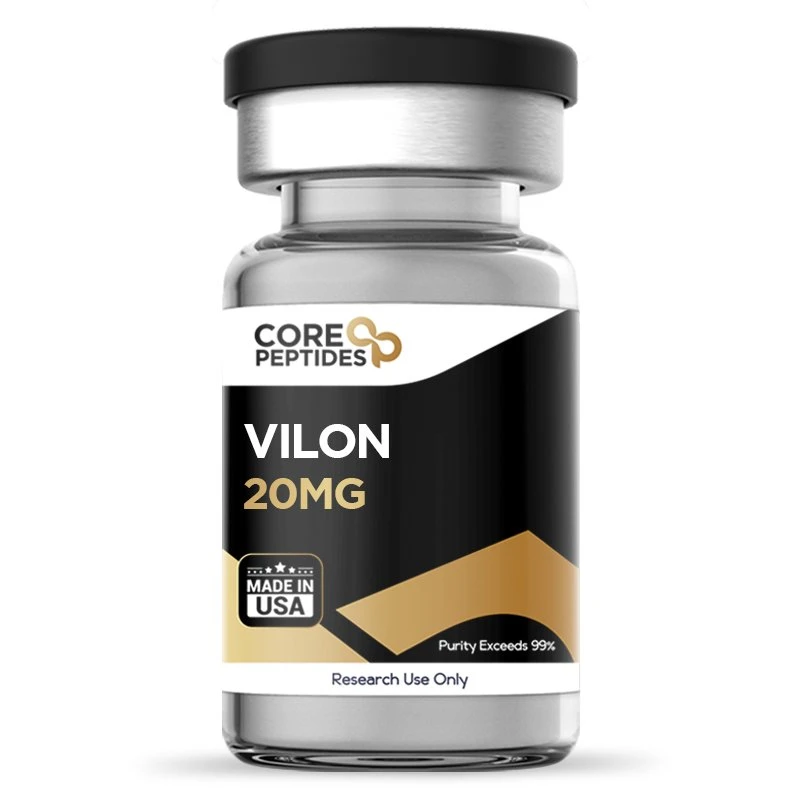

Vilon (20mg) – Lys-Glu Dipeptide Research Peptide
Vilon (20mg) is a synthetic short-chain peptide consisting of the amino-acid sequence Lys-Glu (KE). Also known as the Lys-Glu dipeptide or lysylglutamic acid, Vilon belongs to the group of short peptide bioregulators associated with the Khavinson research programme.
Because of its exceptionally short two-residue structure, Vilon is of interest to researchers investigating how small peptide sequences interact with biological systems.
Published experimental research has examined Vilon in animal models and cellular systems, including studies involving digestive enzyme activity, intestinal tissue, chromatin organisation and age-associated biological processes.
Core Peptides supplies Vilon (20mg) as research material intended for laboratory, analytical and scientific applications. This product is for research use only and is not intended for human or animal consumption.
What Is Vilon?
Vilon is a synthetic dipeptide formed from two amino-acid residues: L-lysine and L-glutamic acid. Its sequence is written as Lys-Glu or abbreviated as KE.
Unlike longer peptides containing numerous amino acids, Vilon consists of only two residues. This simple molecular structure makes it an interesting compound for research into short-peptide structure, peptide–cell interactions and proposed peptide-mediated regulation of biological processes.
Vilon is associated with the broader family of short peptide bioregulators developed and investigated by Vladimir Khavinson and colleagues. Much of the published literature concerns experimental rather than clinical research, meaning that observations from laboratory or animal models should not automatically be extrapolated to humans.
Vilon (20mg) Product Overview
| Specification | Details |
|---|---|
| Product Name | Vilon |
| Quantity | 20mg |
| Alternative Name | Lys-Glu / KE Dipeptide / Lysylglutamic Acid |
| Sequence | Lys-Glu |
| Sequence Abbreviation | KE |
| Peptide Type | Synthetic dipeptide |
| Molecular Formula | C11H21N3O5 |
| Molecular Weight | 275.30 g/mol |
| Physical Form | Lyophilised research material |
| Research Areas | Short-peptide, cellular, ageing and biological research |
| Intended Use | Laboratory, analytical and in-vitro research |
The chemical identity of Lys-Glu as Vilon, including its C11H21N3O5 formula and approximately 275.30 g/mol molecular weight, is documented in PubChem.
Vilon Peptide Sequence: Lys-Glu (KE)
The defining characteristic of Vilon is its Lys-Glu sequence. Lysine is a basic amino acid, while glutamic acid is an acidic amino acid. Together, they form a compact dipeptide that can be investigated as a discrete molecular structure.
The two-residue sequence also provides a useful model for researchers interested in comparing very short peptides with longer peptide bioregulators. Differences in amino-acid sequence, peptide length and molecular structure can affect how compounds behave in experimental biological systems.
Vilon should therefore be distinguished from other short peptides such as Thymogen, Epithalon, Livagen and Thymalin, which have different amino-acid sequences and molecular structures.
Vilon and Short Peptide Bioregulator Research
Vilon is part of a broader area of research involving naturally derived and synthetic short peptides sometimes described as peptide bioregulators.
The underlying research concept proposes that very short peptide sequences may interact with cellular regulatory systems. Experimental studies have investigated various short peptides in relation to cellular differentiation, gene expression, chromatin organisation and tissue-specific biological processes.
For Vilon specifically, the published evidence includes animal studies and laboratory research. The proposed biological mechanisms remain an area of scientific investigation rather than established clinical pharmacology.
Vilon and Ageing Research
One area of interest surrounding Vilon is research into biological changes associated with ageing. Experimental studies have investigated the peptide in ageing animal models and examined outcomes such as enzyme activity, biological markers and lifespan-related measures.
A study published in Biogerontology investigated Vilon in senescence-accelerated mice and reported changes in lifespan and gene-expression-related measurements.
Such findings provide experimental evidence for further investigation, but results obtained in mice cannot be assumed to demonstrate equivalent effects in humans.
Other research has examined Vilon in aged animal models, including studies investigating digestive enzyme activity and tissue-specific responses.
Vilon and Cellular Research
Short peptides can be studied using controlled cellular models to investigate their interaction with cells and measurable biological responses.
Research involving Vilon has included studies of cellular and tissue-related processes. Investigators have examined changes in enzyme activity and other biological markers following experimental exposure to the dipeptide.
These models can provide useful information about potential biological activity, but they are not substitutes for controlled human clinical research.
Vilon and Chromatin Research
Chromatin is the complex structure formed by DNA and associated proteins inside cells. Its organisation influences how genetic information is packaged and made accessible for transcription.
Vilon has been investigated in experimental research concerning chromatin organisation. Published work involving cultured lymphocytes from older individuals reported changes in chromatin characteristics following exposure to Vilon.
These observations have contributed to hypotheses concerning the relationship between short peptides and gene-regulatory processes. However, proposed mechanisms should be regarded as experimental and require independent validation.
Vilon and Gene Expression Research
Gene-expression research examines how cells regulate the activity of particular genes. Short peptide bioregulators have been investigated as potential modulators of gene-expression-related processes in experimental systems.
Research involving Vilon has explored changes in gene activity in animal and cellular models. The Khavinson research programme has proposed that short peptide sequences may interact with regulatory regions associated with specific genes.
Such findings are hypothesis-generating rather than evidence of an established mechanism in humans. Further independent studies are required to determine the reproducibility and biological significance of these observations.
Vilon and Digestive Enzyme Research
Vilon has also been investigated in experimental studies involving the digestive system. One published study examined the effects of the Lys-Glu dipeptide on digestive enzyme activity in rats of different ages.
The researchers reported changes in the activity of several digestive enzymes, including invertase, maltase, alkaline phosphatase and amino- and dipeptidases. The effects were reported to be more pronounced in older animals.
A separate study investigated Vilon and Epithalon in aged rats and reported changes in enzyme activity within the epithelial and subepithelial layers of the small intestine.
These results are relevant to experimental gastrointestinal research but should not be interpreted as evidence that Vilon treats digestive disorders in humans.
Vilon and Intestinal Research
The intestinal epithelium provides an important model for studying cellular turnover, enzyme activity and barrier-related processes.
Experimental research has investigated Vilon in aged rats and measured changes in enzyme activity in different regions and layers of the gastrointestinal tract. These studies have been used to explore possible relationships between short peptide exposure, tissue biology and age-associated changes.
Because these studies were performed in animal models, their findings require further investigation before any conclusions about human biology can be drawn.
Vilon and Immune-Related Research
Vilon is also associated with research into immune and thymus-related biology because of its origin within the broader thymic peptide research programme.
Experimental studies have investigated Vilon in relation to thymocyte and immune-cell processes. These studies form part of the wider scientific interest in whether short peptide sequences can influence cellular differentiation or signalling.
However, experimental immune-related observations should not be interpreted as proof that Vilon restores immune function or treats immune disorders in humans.
Vilon and Animal Research
A substantial portion of the published Vilon literature consists of animal studies. Researchers have used mice and rats to investigate different biological endpoints, including ageing-related characteristics, enzyme activity, tissue responses and tumour-related outcomes.
One PubMed-indexed study reported that synthetic Vilon inhibited spontaneous tumour growth and increased lifespan in mice.
Animal research can provide useful information for generating hypotheses and designing subsequent studies. However, findings in rodents do not establish human efficacy, safety or an appropriate clinical dose.
Vilon and Tumour Research
Vilon has been investigated in experimental cancer-related models. A 2000 study reported that L-Lys-L-Glu was associated with inhibition of spontaneous tumour growth and increased lifespan in mice.
Such findings are part of the historical preclinical literature surrounding Vilon. They should not be interpreted as evidence that Vilon is an anticancer treatment or as a substitute for established medical care.
Research involving tumour models is particularly dependent on experimental design, animal strain, tumour model and treatment conditions, so conclusions should remain limited to the specific study context.
Vilon and Stress-Response Research
Another experimental area has involved the response of animals to emotional stress. A PubMed-indexed study investigated Vilon in male Wistar rats and examined behavioural measures, c-Fos expression and changes in stress-sensitive organs.
The study reported changes in behavioural and physiological markers following experimental Vilon administration.
These observations provide another example of the breadth of Vilon research, but they remain animal-model findings and should not be interpreted as evidence for a stress-related treatment in humans.
Vilon Research Applications
Qualified laboratories may consider Vilon (20mg) for exploratory research involving:
- Short-peptide structure and function.
- Lys-Glu peptide biology.
- Cellular ageing models.
- Gene-expression research.
- Chromatin and epigenetic studies.
- Immune-cell research.
- Thymus-related cellular research.
- Digestive enzyme studies.
- Intestinal tissue models.
- Animal ageing research.
- Comparative peptide studies.
- Analytical characterisation of synthetic dipeptides.
These represent areas of scientific investigation and are not medical indications or recommendations for personal use.
Vilon Chemical Profile
| Property | Information |
|---|---|
| Compound | Vilon |
| Alternative Names | Lys-Glu, KE Dipeptide, Lysylglutamic Acid |
| Sequence | Lys-Glu |
| Sequence Code | KE |
| Peptide Length | 2 amino-acid residues |
| Molecular Formula | C11H21N3O5 |
| Molecular Weight | 275.30 g/mol |
| CAS Number | 45234-02-4 |
| PubChem CID | 7010502 |
| Product Quantity | 20mg |
PubChem identifies Vilon as lysylglutamic acid, lists the Lys-Glu sequence and reports a molecular weight of 275.30 g/mol.
Vilon Compared With Other Short Peptides
| Compound | Sequence | Peptide Length | General Research Context |
|---|---|---|---|
| Vilon | Lys-Glu (KE) | 2 residues | Cellular, ageing and bioregulator research |
| Thymogen | Glu-Trp (EW) | 2 residues | Immune and peptide research |
| Vesilut | Glu-Asp (ED) | 2 residues | Short-peptide and cellular research |
| Epithalon | Ala-Glu-Asp-Gly | 4 residues | Ageing and cellular research |
| Livagen | Lys-Glu-Asp-Ala | 4 residues | Short-peptide bioregulator research |
Although some short peptides contain overlapping amino acids, their sequences and structures are different. They should therefore be treated as separate research compounds rather than interchangeable products.
Why Research Vilon?
Vilon provides researchers with an exceptionally simple Lys-Glu dipeptide model for investigating the biological properties of short peptide sequences.
Its small molecular structure makes it particularly interesting for comparative studies examining whether two-residue peptides can produce measurable effects in controlled experimental systems.
The existing literature includes animal studies involving ageing, digestive enzymes, intestinal tissue, stress responses and tumour-related models, alongside cellular research concerning chromatin and gene-expression processes.
At the same time, the evidence remains predominantly preclinical. Researchers should therefore distinguish clearly between published experimental findings and established human clinical evidence.
Vilon (20mg) for Analytical Research
Analytical characterisation is an important component of synthetic peptide research. Laboratories may use validated methods to confirm molecular identity, assess purity and monitor sample characteristics.
- HPLC: Can be used to evaluate chromatographic purity and identify related substances.
- Mass spectrometry: Can support molecular-mass confirmation and compound identification.
- LC-MS: Can combine chromatographic separation with mass-based detection.
- In-vitro assays: Can be used to investigate cellular responses under controlled conditions.
- Gene-expression analysis: Can evaluate changes in selected molecular markers.
- Cellular imaging: Can support studies of cellular or chromatin-associated changes.
Researchers should use validated laboratory methods and consult current batch-specific documentation when characterising Vilon.
Vilon (20mg) Research Summary
| Research Characteristic | Information |
|---|---|
| Product | Vilon (20mg) |
| Sequence | Lys-Glu |
| Abbreviation | KE |
| Peptide Length | 2 amino-acid residues |
| Molecular Formula | C11H21N3O5 |
| Molecular Weight | 275.30 g/mol |
| Primary Research Areas | Short-peptide, cellular and ageing research |
| Additional Research Areas | Digestive enzyme, intestinal, chromatin and animal-model studies |
| Product Form | Research-grade peptide material |
| Intended Use | Laboratory, analytical and in-vitro research |
Frequently Asked Questions About Vilon (20mg)
What is Vilon?
Vilon is a synthetic dipeptide composed of Lys-Glu, also written as KE. It is associated with the short peptide bioregulator research programme and has been investigated in experimental biological models.
What is the sequence of Vilon?
The sequence of Vilon is Lys-Glu (KE), consisting of lysine followed by glutamic acid.
What is the molecular weight of Vilon?
Vilon has a molecular weight of approximately 275.30 g/mol, according to PubChem.
What is Vilon studied for?
Research has investigated Vilon in relation to cellular ageing, digestive enzyme activity, intestinal tissue, chromatin and other biological processes. Much of the available evidence comes from animal and laboratory studies.
Is Vilon the same as Thymalin?
No. Vilon is a defined Lys-Glu dipeptide, whereas Thymalin refers to a different peptide preparation. Their composition and research profiles should not be treated as identical.
Is Vilon the same as Epithalon?
No. Vilon contains two amino-acid residues, Lys-Glu, while Epithalon is a four-residue peptide with the sequence Ala-Glu-Asp-Gly.
Has Vilon been studied in animals?
Yes. Published research has investigated Vilon in rats and mice, including studies involving digestive enzyme activity, intestinal biology, stress responses, lifespan and tumour-related outcomes.
Has Vilon been studied in human cells?
Experimental research has included work using cultured human cells, including studies examining chromatin-related effects. These are laboratory observations and should not be interpreted as evidence of a clinical effect in people.
Does Vilon have established anti-ageing effects?
Vilon has been investigated in animal and cellular ageing models, but experimental findings do not establish an anti-ageing treatment effect in humans. Human clinical evidence is insufficient to make such a claim.
Is Vilon an approved medicine?
Vilon should be treated as a research compound rather than an authorised medicinal product. It is not supplied by Core Peptides as a medicine or as a treatment for any medical condition.
Is Vilon intended for human use?
No. Vilon (20mg) is intended for research, laboratory and analytical applications only and is not intended for human or animal consumption.
Storage and Laboratory Handling
Researchers should follow the current supplier documentation and applicable batch-specific Certificate of Analysis for exact storage and handling requirements.
- Keep Vilon in its original labelled container.
- Follow the storage conditions specified in the applicable product documentation.
- Protect the material from unnecessary exposure to moisture and environmental contaminants.
- Minimise unnecessary temperature fluctuations.
- Use appropriate laboratory protective equipment when handling the material.
- Prevent contamination during sample preparation.
- Maintain appropriate batch and experimental records.
- Dispose of unused material according to applicable laboratory procedures and local requirements.
No dosing, administration or self-use instructions are provided because Vilon is intended exclusively for laboratory research.
Important Research Disclaimer
Vilon (20mg) is supplied strictly for research, laboratory and analytical purposes.
This product is not intended for human or animal consumption, self-administration, diagnosis, treatment, cure or prevention of any disease. References to ageing, immune processes, digestive enzymes, chromatin, gene expression, tumour models or other biological processes describe areas of scientific investigation and should not be interpreted as therapeutic claims.
Published studies have reported experimental findings involving Vilon, including animal research into digestive enzymes, intestinal biology and tumour-related outcomes. These findings do not establish clinical efficacy or safety in humans.
Researchers are responsible for complying with applicable legislation, institutional requirements, laboratory safety procedures and appropriate handling protocols when working with this material.
For research use only. Not for human or animal consumption.
Be the first to review “Vilon – 20MG”
Related products
Peptides for Sale
Peptides for Sale
Peptides for Sale
Peptides for Sale
Peptides for Sale
Peptides for Sale
Peptides for Sale
Peptide Blends for Sale
Reviews
There are no reviews yet.