
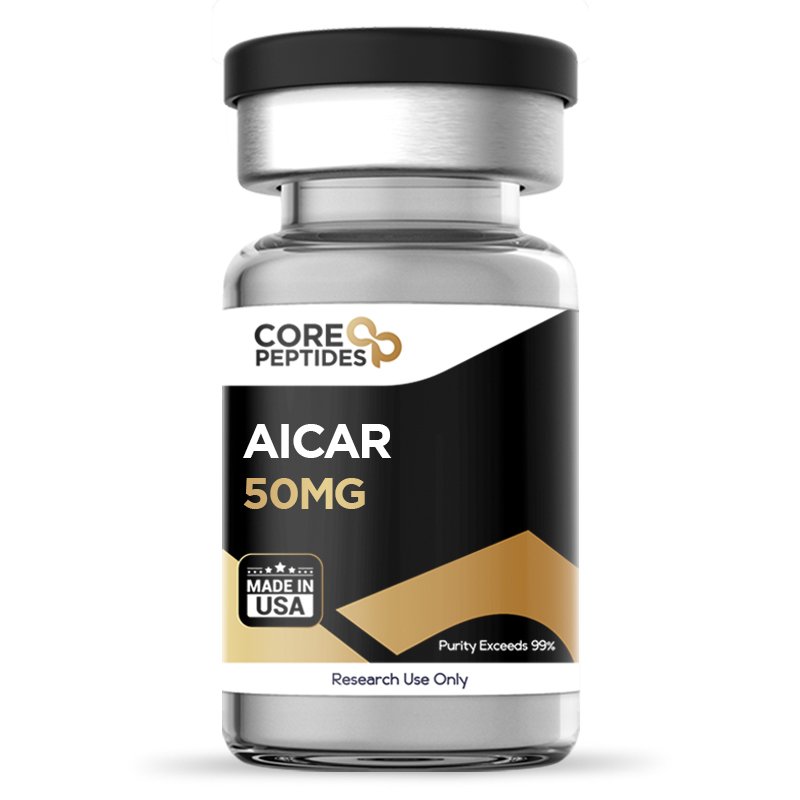

AICAR (50mg) – Research-Grade AMPK Activator & Metabolic Research Compound
AICAR (50mg), also known as 5-Aminoimidazole-4-carboxamide ribonucleotide, AICAr or acadesine, is an experimental metabolic research compound widely used in laboratory studies investigating AMP-activated protein kinase (AMPK), cellular energy regulation, glucose metabolism, fatty-acid oxidation and exercise-related signalling.
Although AICAR is frequently grouped with research peptides in commercial catalogues, it is important to note that AICAR is not a conventional peptide. It is a synthetic nucleoside analogue that can enter cells and be metabolised to ZMP, an AMP analogue that interacts with AMPK and other cellular pathways.
Because of its ability to influence cellular energy-sensing pathways, AICAR has become an important experimental tool for studying metabolic regulation. Research has examined its effects in models involving glucose utilisation, lipid metabolism, mitochondrial function, exercise physiology, inflammation, cellular stress and other biological processes.
The 50mg format is intended as a defined research quantity for appropriately equipped laboratories conducting controlled experimental work. AICAR should not be regarded as an approved medicine, nutritional supplement, performance-enhancing treatment or established therapy for metabolic conditions.
What Is AICAR?
AICAR stands for 5-Aminoimidazole-4-carboxamide ribonucleotide. The compound is also commonly referred to as AICAr and acadesine.
AICAR is structurally related to an intermediate involved in purine nucleotide metabolism. Inside cells, AICAR can be converted into ZMP, which resembles AMP and can influence AMP-sensitive signalling pathways.
One of the principal reasons researchers use AICAR is its ability to activate or modulate AMP-activated protein kinase (AMPK), an important cellular energy sensor. AMPK helps cells respond to changes in energy availability by coordinating pathways involved in glucose utilisation, fatty-acid metabolism and energy production.
AICAR has therefore become a widely used pharmacological research tool for investigating AMPK biology. However, scientific reviews emphasise that AICAR can produce effects that are independent of AMPK, meaning experimental findings should be interpreted carefully rather than automatically attributing every observed effect to AMPK activation.
AICAR (50mg) Product Highlights
- Product name: AICAR
- Quantity: 50mg
- Full name: 5-Aminoimidazole-4-carboxamide ribonucleotide
- Common abbreviation: AICAr
- Alternative name: Acadesine
- Compound category: Nucleoside analogue / metabolic research compound
- Primary research target: AMP-activated protein kinase (AMPK)
- Research areas: Cellular energy metabolism, glucose metabolism, lipid metabolism and exercise-related signalling
- Research format: Laboratory research material
- Intended purpose: Controlled research and experimental applications
How Does AICAR Work?
AICAR is commonly used as a pharmacological tool for studying AMPK signalling. Following cellular uptake, AICAR can be metabolised to ZMP, which resembles AMP and can interact with AMPK-associated regulatory mechanisms.
AMPK functions as a cellular energy sensor. When cellular energy availability falls, AMPK signalling can increase processes that generate energy while reducing certain energy-consuming anabolic processes. These responses help cells adapt to changing metabolic conditions.
Research has therefore used AICAR to experimentally manipulate AMPK-related pathways and investigate how changes in cellular energy signalling affect metabolism.
However, AICAR should not be considered a perfectly selective AMPK activator. A systematic review of AICAr research concluded that several effects historically attributed solely to AMPK activation may involve AMPK-independent mechanisms. This is an important consideration when designing experiments or interpreting AICAR-related findings.
AICAR and AMPK Research
AMP-activated protein kinase (AMPK) is a central regulator of cellular energy homeostasis. It responds to changes in the cellular energy state and coordinates metabolic pathways according to energy demand and availability.
When AMPK signalling increases, cells can enhance certain catabolic processes involved in energy production while suppressing selected anabolic pathways that consume substantial amounts of cellular energy.
AICAR has become one of the most frequently used pharmacological tools for experimentally manipulating this pathway. Researchers have used AICAR in cell cultures, animal models and biochemical experiments to examine the consequences of AMPK activation.
For this reason, AICAR is particularly useful in research focused on the relationship between energy status, metabolism and intracellular signalling.
AICAR and Cellular Energy Metabolism
Cells continuously balance energy production and energy consumption. ATP serves as a primary cellular energy currency, while AMP and ADP can provide information about changes in energy availability.
AMPK acts as part of this energy-sensing system. When cellular energy demand rises or ATP availability falls, AMPK signalling can help shift metabolism towards pathways capable of generating additional energy.
By producing ZMP, AICAR can experimentally mimic aspects of the intracellular signalling environment associated with increased AMP availability. This makes the compound useful for researchers studying how cells respond to metabolic stress.
Research involving AICAR can therefore provide insight into mechanisms connecting energy availability, nutrient utilisation and cellular adaptation.
AICAR and Glucose Metabolism
AMPK signalling is closely connected with glucose metabolism. Activation of AMPK can influence glucose uptake and utilisation in certain tissues, particularly skeletal muscle.
AICAR has consequently been widely investigated in experimental models of glucose metabolism. Researchers have used the compound to examine how AMPK-related signalling affects glucose handling independently of changes in circulating hormones or food intake.
These studies are relevant to basic research into metabolic flexibility and energy regulation. However, experimental effects observed in cells or animals should not be interpreted as evidence that AICAR is an established treatment for diabetes, insulin resistance or other metabolic disorders.
AICAR and Fatty-Acid Oxidation
AMPK participates in the regulation of lipid metabolism and can promote cellular pathways associated with fatty-acid utilisation under appropriate metabolic conditions.
AICAR has therefore been used as an experimental AMPK-modulating compound in research investigating fatty-acid oxidation, lipid utilisation and energy production.
These investigations can help researchers understand how energy-sensing pathways alter the balance between carbohydrate and lipid metabolism.
It is important to distinguish laboratory investigation of fatty-acid oxidation from consumer-facing claims about fat loss or weight management. AICAR is not an approved weight-management product.
AICAR and Exercise Research
AICAR has attracted considerable scientific interest because AMPK is also involved in metabolic responses to physical activity.
Exercise increases energy demand in skeletal muscle and can activate AMPK signalling. Researchers have therefore used AICAR as a pharmacological tool to investigate certain pathways that are also responsive to exercise.
This has led to AICAR sometimes being described informally as an “exercise mimetic”. Such terminology should be treated cautiously. AICAR does not reproduce every physiological process associated with exercise, and the biological response to a pharmacological compound is not equivalent to the complex systemic response produced by physical activity.
Experimental studies have nevertheless made AICAR valuable for investigating the relationship between AMPK signalling, muscle metabolism and exercise physiology.
AICAR and Mitochondrial Research
Mitochondria are responsible for producing much of the ATP required by cells. Their activity is therefore closely connected with cellular energy status and metabolic adaptation.
AMPK signalling can influence pathways associated with mitochondrial function and energy production. AICAR has consequently been used in laboratory research examining how pharmacological AMPK activation affects mitochondrial-related processes.
Such studies may investigate mitochondrial metabolism, oxidative capacity, cellular energy production and adaptations to metabolic stress.
Results depend heavily on the experimental model, cell type, exposure conditions and biological endpoint being measured.
AICAR and Metabolic Flexibility
Metabolic flexibility describes the ability of cells and organisms to adjust fuel utilisation according to energy requirements and nutrient availability.
AMPK is an important component of the cellular signalling network involved in this process. By manipulating AMPK-associated pathways, researchers can examine how cells alter glucose and lipid utilisation in response to changing energy conditions.
AICAR is therefore relevant to research investigating how metabolic pathways respond to energetic stress, exercise-related demands and alterations in nutrient availability.
AICAR and Adipose-Tissue Research
Research has also investigated AICAR in relation to adipose tissue and fat metabolism. AMPK participates in signalling pathways that regulate lipid storage, lipid utilisation and cellular energy balance.
In animal research, AICAR has been investigated for its effects on adipose-tissue biology and changes in body-fat accumulation. One study found that AICAR prevented gains in body fat in rats following the transition from voluntary physical activity to inactivity, with effects comparable in that experimental setting to continued physical activity.
Such findings provide a useful experimental model for studying the relationship between AMPK signalling and adipose-tissue regulation. They should not, however, be interpreted as evidence that AICAR is a clinically established fat-loss treatment.
AICAR and Muscle Research
Skeletal muscle has a high demand for energy, particularly during physical activity. AMPK is an important signalling component involved in adapting muscle metabolism to increased energy requirements.
AICAR has been widely used in muscle-cell and animal research to investigate AMPK-dependent changes in glucose handling, lipid metabolism and energy production.
Researchers can use AICAR as an experimental stimulus to help distinguish the effects of AMPK signalling from other pathways activated during exercise.
This makes the compound particularly relevant to research in exercise physiology, muscle metabolism and cellular energy regulation.
AICAR and Inflammation Research
AMPK signalling interacts with several pathways involved in inflammation and cellular stress. Researchers have therefore investigated AICAR in experimental models involving inflammatory signalling and tissue stress.
For example, experimental work has examined whether AICAR-mediated AMPK activation influences inflammatory processes associated with muscle wasting and other forms of cellular stress.
These findings are useful for understanding molecular pathways but do not establish AICAR as a treatment for inflammatory diseases or muscle-wasting conditions.
AICAR and Cellular Stress Research
Cells can experience metabolic stress when energy demand exceeds available resources. Conditions such as nutrient deprivation, hypoxia or increased energy demand can alter AMPK activity.
AICAR provides researchers with a pharmacological means of experimentally modifying energy-sensing pathways and studying how cells adapt to these conditions.
This makes AICAR relevant to research involving:
- Cellular energy balance
- Metabolic stress
- AMPK signalling
- Mitochondrial function
- Glucose utilisation
- Lipid metabolism
- Cellular adaptation
- Exercise-associated metabolic pathways
AICAR Research Applications
AICAR may be relevant to controlled laboratory studies investigating:
- AMPK signalling: Experimental modulation of the AMP-activated protein kinase pathway.
- Cellular energy metabolism: Investigation of intracellular energy sensing and metabolic adaptation.
- Glucose metabolism: Research into glucose uptake, utilisation and metabolic regulation.
- Fatty-acid oxidation: Study of pathways involved in lipid utilisation.
- Exercise physiology: Investigation of molecular pathways associated with exercise-related metabolic responses.
- Skeletal-muscle research: Study of AMPK-dependent metabolic changes in muscle cells and animal models.
- Mitochondrial research: Investigation of cellular energy production and mitochondrial signalling.
- Adipose biology: Research into AMPK signalling and adipose-tissue metabolism.
- Metabolic flexibility: Study of how cells switch between energy substrates.
- Inflammation research: Investigation of interactions between AMPK and inflammatory signalling.
- Cellular stress: Examination of metabolic responses to energetic or environmental stress.
AICAR (50mg) Research Specifications
| Specification | Details |
|---|---|
| Product name | AICAR |
| Quantity | 50mg |
| Full chemical name | 5-Aminoimidazole-4-carboxamide ribonucleotide |
| Alternative designation | AICAr |
| Alternative name | Acadesine |
| Compound class | Nucleoside analogue / metabolic research compound |
| Primary research pathway | AMP-activated protein kinase (AMPK) |
| Research focus | Cellular energy and metabolic signalling |
| Research applications | AMPK, glucose, lipid, muscle, mitochondrial and exercise research |
| Intended application | Laboratory and research use |
AICAR vs AMPK
AICAR and AMPK are related but are not the same substance.
| Feature | AICAR | AMPK |
|---|---|---|
| What is it? | Experimental metabolic compound | Cellular energy-sensing protein kinase |
| Full name | 5-Aminoimidazole-4-carboxamide ribonucleotide | AMP-activated protein kinase |
| Role | Pharmacological research tool | Regulates cellular energy metabolism |
| Relationship | Can influence AMPK signalling through intracellular metabolism | Acts as a metabolic signalling hub |
| Research use | Used to experimentally manipulate metabolic pathways | Studied to understand cellular energy regulation |
AICAR and ZMP
A key part of AICAR biology involves its conversion into ZMP, an intracellular metabolite that resembles AMP.
Because AMP is an important signal of cellular energy status, ZMP can interact with AMP-sensitive pathways. This is one of the primary reasons AICAR has been used experimentally to influence AMPK signalling.
However, AICAR-derived ZMP can affect more than a single signalling protein. Research has identified effects involving additional metabolic pathways, which is why AICAR experiments require careful controls when researchers are attempting to attribute a particular biological outcome specifically to AMPK.
Important Consideration: AICAR Is Not a Selective AMPK Tool
Although AICAR is widely recognised as an AMPK activator, modern research has highlighted limitations to this simplified description.
A systematic review concluded that AICAr can produce both AMPK-dependent and AMPK-independent effects. Some biological changes previously interpreted as consequences of AMPK activation may involve other metabolic pathways.
Researchers should therefore consider appropriate controls, complementary AMPK-modulating compounds and genetic approaches when attempting to determine whether an observed effect is genuinely mediated by AMPK.
This distinction is particularly important for studies involving metabolism, cancer biology, exercise, nucleotide synthesis and cellular stress.
AICAR in Metabolic Research
AICAR has been used extensively in experimental metabolic research because of its ability to manipulate pathways associated with cellular energy availability.
Studies have investigated the compound in relation to glucose metabolism, fatty-acid utilisation, energy production and adipose-tissue regulation. Animal research has also examined its effects following changes in physical activity.
For example, an experimental study in rats reported that AICAR prevented the increase in body fat normally observed after voluntary exercise was discontinued. The researchers concluded that AICAR and continued physical activity produced similar effects in that particular experimental context.
These findings are useful for understanding AMPK-associated metabolic signalling but cannot be directly extrapolated into human weight-management recommendations.
AICAR and Exercise-Mimetic Research
The phrase exercise mimetic is sometimes associated with AICAR because of its ability to experimentally influence AMPK-related metabolic pathways that are also responsive to exercise.
However, exercise is a complex physiological stimulus involving the cardiovascular, muscular, endocrine, nervous and metabolic systems. AICAR influences selected molecular pathways and therefore cannot reproduce the complete physiological response to physical activity.
For researchers, this distinction is useful: AICAR can serve as a pharmacological tool for studying particular exercise-responsive signalling pathways without representing exercise itself.
AICAR and Mitochondrial Biogenesis Research
AMPK signalling is connected with cellular adaptations that influence mitochondrial capacity and oxidative metabolism. Consequently, AICAR has been investigated in research exploring mitochondrial-related adaptations.
Researchers may examine markers of mitochondrial function, oxidative metabolism and energy production following experimental AMPK stimulation.
Because mitochondrial responses are influenced by many pathways, AICAR-related findings should be interpreted alongside other experimental measurements rather than being attributed automatically to a single mechanism.
AICAR and Cancer Research
AICAR has also been used as an experimental compound in cancer and cell-cycle research. AMPK plays an important role in cellular energy regulation, and its relationship with growth and metabolic pathways has made it relevant to cancer biology.
Research has examined AICAr in different cancer and cellular models, including studies involving metabolism, cell-cycle regulation and nucleotide synthesis.
These studies are experimental and do not establish AICAR as an anticancer treatment. The compound’s biological effects can vary considerably depending on cell type, metabolic state and experimental conditions.
Why Researchers Study AICAR
AICAR remains valuable in laboratory research because it provides a well-established experimental method for manipulating energy-sensing pathways.
Its research value comes from several characteristics:
- It can influence AMPK-related signalling.
- It provides a pharmacological model of increased AMP-like signalling.
- It can be used to investigate glucose and lipid metabolism.
- It has been studied extensively in muscle and exercise models.
- It can help researchers investigate metabolic adaptation.
- It provides a useful model for examining interactions between energy sensing and other cellular pathways.
- Its AMPK-independent effects encourage the use of more sophisticated experimental controls.
Frequently Asked Questions About AICAR (50mg)
What is AICAR?
AICAR is the abbreviation for 5-Aminoimidazole-4-carboxamide ribonucleotide, also known as AICAr or acadesine. It is an experimental metabolic research compound commonly used to investigate AMPK and cellular energy signalling.
Is AICAR a peptide?
No. Despite sometimes being listed alongside research peptides, AICAR is not a conventional peptide. It is a nucleoside analogue that can be converted intracellularly to ZMP.
What does AICAR stand for?
AICAR stands for 5-Aminoimidazole-4-carboxamide ribonucleotide.
What is AICAr?
AICAr is another abbreviation used for AICAR. The compound is also known as acadesine.
What is AICAR used for in research?
AICAR is primarily used as an experimental metabolic compound for investigating AMPK signalling, cellular energy metabolism, glucose utilisation, fatty-acid metabolism, exercise-related pathways and other biological processes.
How does AICAR affect AMPK?
AICAR can be metabolised to ZMP, an AMP analogue that can influence AMPK signalling. However, AICAR also has AMPK-independent effects, so not every biological response to AICAR can be attributed exclusively to AMPK.
What is AMPK?
AMPK, or AMP-activated protein kinase, is a cellular energy sensor that helps coordinate metabolic responses to changes in energy availability.
What is ZMP?
ZMP is an intracellular metabolite generated from AICAR. It resembles AMP and can interact with AMP-sensitive signalling pathways, including AMPK-associated mechanisms.
Is AICAR an exercise mimetic?
AICAR is sometimes described as an experimental exercise mimetic because it can influence AMPK-related pathways associated with exercise. However, it does not reproduce the complete physiological effects of physical activity.
Has AICAR been studied in animals?
Yes. AICAR has been extensively investigated in animal models. Research has examined its effects on metabolism, adipose tissue, skeletal muscle, exercise-related signalling and other physiological processes.
Has AICAR been studied in human research?
AICAR has a history of clinical and pharmacological investigation, but the research context should be distinguished from the use of AICAR as an approved treatment or consumer metabolic product.
Is AICAR approved as a weight-loss treatment?
No. Experimental findings involving AICAR and body composition should not be interpreted as establishing it as an approved weight-loss medicine.
What does the 50mg designation mean?
The 50mg designation refers to the quantity of AICAR in the listed research product. It is a product specification and should not be interpreted as a recommended human dose.
Why is AICAR important in metabolic research?
AICAR provides researchers with a well-established pharmacological tool for investigating cellular energy sensing and AMPK-associated metabolic pathways.
Research-Use Disclaimer
AICAR (50mg) is intended for laboratory and research applications only. It is not a conventional peptide, food product, dietary supplement or approved treatment for weight management, diabetes, metabolic disease, exercise performance or any other medical condition.
The information presented here describes experimental scientific research. Findings obtained from cell cultures, isolated tissues or animal models cannot automatically be translated into clinical outcomes in humans.
AICAR has complex biological effects, including effects that may occur independently of AMPK. Researchers should therefore use appropriate experimental controls and consult relevant scientific literature, product documentation, safety information and institutional procedures before undertaking laboratory work.
AICAR (50mg) – Research Summary
AICAR (50mg) is a research-grade preparation of 5-Aminoimidazole-4-carboxamide ribonucleotide, a metabolic research compound widely used to investigate AMPK and cellular energy signalling.
Following intracellular conversion to ZMP, AICAR can influence AMP-sensitive signalling pathways and has been extensively used to study glucose metabolism, fatty-acid oxidation, muscle metabolism, mitochondrial biology, exercise-related signalling and metabolic adaptation.
Its research profile is particularly valuable because AICAR provides a pharmacological means of manipulating AMPK-associated pathways in controlled experimental systems. At the same time, scientific reviews have demonstrated that AICAR has important AMPK-independent effects, making careful experimental design essential.
Animal studies have produced interesting findings involving adipose tissue, metabolic regulation and exercise-related adaptations, but such preclinical observations should not be presented as proof of therapeutic efficacy in humans.
For appropriately equipped research laboratories, AICAR (50mg) provides a specialised experimental compound for investigating the molecular relationship between cellular energy status, AMPK signalling and metabolic regulation.
Be the first to review “AICAR (50mg)”
Related products
Peptides for Sale

Peptides for Sale
Peptides for Sale
Peptides for Sale
Peptides for Sale
Peptides for Sale

Peptides for Sale
Peptides for Sale
Reviews
There are no reviews yet.