
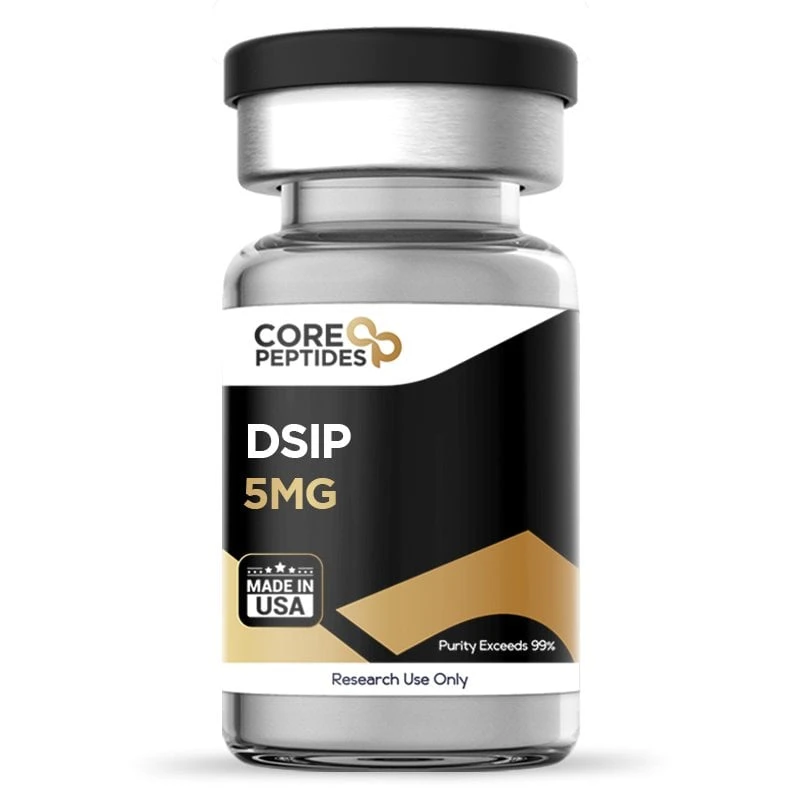
DSIP (5mg) – Delta Sleep-Inducing Peptide
DSIP (5mg), short for Delta Sleep-Inducing Peptide, is a synthetic nonapeptide that has been investigated extensively in experimental research concerning sleep regulation, brain activity, stress responses and neurophysiology. The peptide consists of nine amino acids and was originally identified in research investigating factors associated with sleep and slow-wave brain activity.
The referenced product is supplied as 5mg of lyophilised DSIP powder with a stated purity of >99%. It is presented as a research peptide for laboratory and scientific applications.
DSIP has attracted particular scientific interest because early experimental studies associated it with delta-wave and slow-wave sleep. Subsequent research has investigated its potential effects on sleep architecture, electrophysiological activity, neurotransmitter systems, circadian patterns and other physiological processes.
What Is DSIP?
Delta Sleep-Inducing Peptide (DSIP) is a naturally occurring neuropeptide that was originally isolated during experiments involving electrically induced sleep in animal models. Researchers subsequently characterised the compound as a nine-amino-acid peptide and investigated its relationship with slow-wave sleep and central nervous system activity.
The peptide’s name comes from its early association with delta-frequency EEG activity, which is characteristic of slow-wave sleep. Research has since expanded beyond sleep alone, examining DSIP in relation to neurochemical, electrophysiological and behavioural processes.
Although DSIP is often described as a sleep-related peptide, its biological activity is considerably more complex than simply acting as a conventional sedative. Historical research has explored effects involving sleep patterns, neurotransmitter levels, circadian rhythms, hormonal activity and responses to stress. }
DSIP (5mg) Product Highlights
- Product name: DSIP
- Full name: Delta Sleep-Inducing Peptide
- Quantity: 5mg
- Peptide classification: Synthetic nonapeptide
- Peptide length: 9 amino acids
- Physical form: Lyophilised powder
- Stated purity: >99%
- Primary research area: Sleep and neurophysiology
- Additional research areas: Electrophysiology, neurotransmitter research, circadian biology and stress-response research
- Intended application: Laboratory and research use
The 5mg quantity, lyophilised format and stated purity correspond to the referenced Core Peptides product listing.
DSIP Peptide Sequence
DSIP is a nonapeptide, meaning that it contains nine amino acids. The sequence identified in the original structural research is:
Trp-Ala-Gly-Gly-Asp-Ala-Ser-Gly-Glu
Scientific work published in 1978 described the amino-acid analysis, sequence determination and synthesis of the DSIP nonapeptide.
| Property | Details |
|---|---|
| Peptide | Delta Sleep-Inducing Peptide |
| Abbreviation | DSIP |
| Peptide type | Nonapeptide |
| Number of amino acids | 9 |
| Sequence | Trp-Ala-Gly-Gly-Asp-Ala-Ser-Gly-Glu |
| Quantity | 5mg |
| Physical form | Lyophilised powder |
| Stated purity | >99% |
| Research focus | Sleep and neurophysiology |
History of DSIP Research
DSIP has a relatively long history within peptide and neurophysiological research. Its isolation and characterisation took place during research conducted from the 1960s and 1970s, with subsequent studies investigating its relationship with sleep and other biological processes.
The peptide was initially identified from material associated with experimental sleep induction. Researchers subsequently isolated and characterised the active peptide and established its nine-amino-acid sequence.
During the 1980s, DSIP became the subject of numerous experimental studies investigating possible effects on sleep, pain, withdrawal phenomena, neurotransmitter activity and other physiological processes. A contemporary scientific review noted the rapidly expanding literature surrounding the peptide during that period.
DSIP and Slow-Wave Sleep Research
One of the principal reasons DSIP remains scientifically interesting is its association with slow-wave sleep.
Slow-wave sleep is characterised by high-amplitude, low-frequency delta activity on electroencephalography (EEG). It represents an important component of normal sleep architecture and is associated with a range of physiological processes.
Early animal research reported that DSIP could influence delta-frequency EEG activity. Reviews subsequently described sleep-related effects in several animal species and humans, although the observed responses varied between experimental models.
Consequently, DSIP is generally studied as a compound relevant to the regulation and modulation of sleep processes rather than simply as a conventional sleep-inducing drug.
DSIP and Sleep Architecture
Sleep architecture refers to the organisation and distribution of different sleep stages throughout a sleep period.
Historical research into DSIP examined whether the peptide could influence the distribution and characteristics of sleep stages. Studies in different experimental models reported changes involving slow-wave or non-REM sleep, while effects were not necessarily uniform across species or experimental conditions.
This makes DSIP particularly useful for research investigating how endogenous peptides may participate in the physiological regulation of sleep.
DSIP and Human Sleep Research
DSIP has also been investigated experimentally in humans. An early double-blind crossover study involving six healthy volunteers examined synthetic DSIP and reported changes in sleep behaviour following intravenous administration. The researchers observed increased sleep during the observation period and changes in subsequent night-time sleep parameters.
Another clinical investigation examined DSIP in people with insomnia and reported improvements in certain sleep measurements following experimental administration.
These studies are historically important but relatively old and limited in scale. They should therefore be interpreted as part of the experimental literature rather than as contemporary evidence establishing DSIP as an approved treatment for insomnia or other sleep disorders.
DSIP and Neurophysiology
DSIP research extends beyond sleep duration. Scientists have investigated the peptide’s potential relationship with electrophysiological activity in the brain.
Electrophysiological research examines electrical activity generated by neurons and neural networks. Because DSIP was originally identified through experiments involving EEG changes, electrophysiological effects remain an important area of investigation.
Research reviews have described DSIP-related effects involving EEG activity and other measures of central nervous system function.
DSIP and Neurotransmitter Research
Another area of interest is the relationship between DSIP and neurotransmitter systems.
Historical reviews have reported that DSIP may influence neurotransmitter levels within the brain, providing a potential explanation for some of its observed effects on sleep and neurophysiological activity.
However, the precise molecular mechanism responsible for DSIP’s reported biological effects remains incompletely established. Researchers continue to distinguish between observed experimental effects and the mechanisms responsible for those effects.
DSIP and Circadian Research
The circadian system regulates approximately 24-hour biological rhythms, including sleep-wake cycles, hormone release, body temperature and other physiological functions.
Historical DSIP research has examined possible effects on circadian and locomotor patterns. This makes the peptide relevant to experimental investigations exploring interactions between neuropeptides and biological timing mechanisms.
Importantly, evidence of an experimental influence on circadian patterns does not establish DSIP as a clinically validated treatment for circadian rhythm disorders.
DSIP and Stress Research
DSIP has also been investigated in relation to stress and physiological responses to stressful conditions.
Some experimental studies examined whether DSIP could influence sleep disturbances associated with stressful conditions. Research in animal models reported changes in sleep patterns following experimentally induced stress.
These findings have contributed to broader interest in DSIP as a neuropeptide potentially involved in the interaction between sleep regulation and stress physiology.
DSIP and Experimental Pain Research
Historical reviews have identified pain as another area in which DSIP was investigated experimentally. Researchers explored whether the peptide could influence pain-related responses in animal and human studies.
These investigations form part of DSIP’s wider research history but do not establish the 5mg research material as an analgesic or approved treatment for pain.
DSIP and Withdrawal Research
DSIP was also investigated in experimental models of drug withdrawal.
Research included animal experiments examining behavioural responses associated with withdrawal from opioids and other pharmacological substances. Some studies reported changes in withdrawal-related behaviours following experimental DSIP administration.
This area remains part of the historical research literature surrounding DSIP and should not be interpreted as evidence for clinical treatment of substance dependence.
Potential Research Applications of DSIP
Because DSIP has been investigated across several areas of neurobiology, researchers may study the peptide in relation to:
- Sleep physiology: Investigation of slow-wave and non-REM sleep.
- EEG research: Study of delta-frequency and other electrophysiological patterns.
- Neurotransmitter research: Examination of peptide-related changes in brain neurochemistry.
- Circadian biology: Investigation of sleep-wake and locomotor rhythms.
- Stress research: Study of sleep and neurophysiological responses under stressful conditions.
- Pain research: Experimental investigation of peptide-related effects on pain pathways.
- Withdrawal models: Research into behavioural and neurochemical responses during experimental withdrawal.
- Neuropeptide biology: Investigation of endogenous peptide signalling and regulation.
DSIP and the Central Nervous System
DSIP is particularly relevant to research involving the central nervous system (CNS). Historical studies have identified DSIP-like material in the brain and peripheral tissues, contributing to research into its potential physiological role.
Because sleep regulation involves complex interactions between the hypothalamus, brainstem, thalamus, cortex and multiple neurotransmitter systems, researchers continue to investigate how endogenous peptides may participate in these networks.
DSIP provides a defined peptide model for exploring these questions under controlled experimental conditions.
Research Evidence for DSIP
The evidence base for DSIP includes decades of experimental work, although much of the foundational literature dates from the 1970s and 1980s.
| Research area | Examples of scientific interest |
|---|---|
| Sleep | Slow-wave sleep and sleep architecture |
| EEG activity | Delta-frequency and electrophysiological patterns |
| Neurotransmitters | Changes in brain neurochemical activity |
| Circadian biology | Sleep-wake and locomotor rhythms |
| Stress | Sleep responses to experimentally induced stress |
| Pain | Experimental investigation of pain-related effects |
| Withdrawal | Animal models of withdrawal-related behaviour |
Scientific reviews have documented the broad historical research programme surrounding DSIP, including investigations into sleep, pain, withdrawal and other physiological processes.
Why Researchers Study DSIP
DSIP is unusual because it was identified through research into a physiological phenomenon rather than being designed initially as a conventional pharmaceutical compound.
Its research value comes from several characteristics:
- It is a clearly characterised nine-amino-acid peptide.
- It has a long history of experimental investigation.
- It has been studied in both animal and human research.
- It has been investigated in relation to sleep architecture and EEG activity.
- Its potential neurochemical effects have been examined.
- It provides a model for studying endogenous peptide regulation of physiological processes.
DSIP (5mg) Research Specifications
| Specification | Details |
|---|---|
| Product | DSIP |
| Full name | Delta Sleep-Inducing Peptide |
| Quantity | 5mg |
| Classification | Synthetic nonapeptide |
| Sequence | Trp-Ala-Gly-Gly-Asp-Ala-Ser-Gly-Glu |
| Number of amino acids | 9 |
| Form | Lyophilised powder |
| Stated purity | >99% |
| Primary research field | Sleep and neurophysiology |
| Additional research fields | EEG, neurotransmitters, circadian biology and stress research |
The quantity, physical form and stated purity are based on the referenced Core Peptides listing. :contentReference[oaicite:22]{index=22}
Lyophilised DSIP Powder
The referenced DSIP product is supplied as a lyophilised powder. Lyophilisation, also known as freeze-drying, is commonly used for laboratory peptide materials because removing water can provide a stable dry format suitable for storage and subsequent laboratory analysis.
Researchers should always consult the relevant product documentation and batch-specific analytical information when establishing appropriate storage and handling procedures.
This product description does not provide instructions for reconstitution, dosing or human administration.
Purity and Analytical Characterisation
Analytical characterisation is an important part of peptide research. Researchers commonly use techniques such as high-performance liquid chromatography (HPLC) and mass spectrometry (MS) to assess peptide purity and identity.
The referenced Core Peptides listing states a DSIP purity of >99%.
For experimental work, researchers should rely on the batch-specific Certificate of Analysis and accompanying analytical documentation where available rather than assuming that a general product specification applies to every lot.
DSIP Compared with Conventional Sleep Research Compounds
DSIP is scientifically distinct from conventional pharmaceutical hypnotics. Its research history centres on the modulation of sleep-related physiological processes rather than a simple sedative mechanism.
Early research described DSIP-related changes in slow-wave sleep and electrophysiological activity, while human studies investigated effects on sleep behaviour.
Consequently, DSIP is better considered a research neuropeptide associated with sleep physiology than a conventional sleeping medication.
Limitations of Current DSIP Research
Despite its long history, DSIP research has several important limitations.
- Much of the foundational literature is old: A significant proportion of DSIP research was published during the 1970s and 1980s.
- Small human studies: Some early human investigations involved relatively small numbers of participants.
- Variable experimental findings: Effects can differ depending on species, experimental conditions and study design.
- Mechanistic uncertainty: The complete molecular mechanism of DSIP remains incompletely understood.
- Limited modern clinical evidence: Historical findings should not be treated as equivalent to modern clinical evidence supporting an approved therapy.
- Formulation differences: Research involving one preparation or administration method cannot automatically be applied to another product.
Scientific reviews from the 1980s document substantial interest in DSIP while also reflecting the exploratory nature of the research programme.
Frequently Asked Questions About DSIP (5mg)
What does DSIP stand for?
DSIP stands for Delta Sleep-Inducing Peptide, a nine-amino-acid neuropeptide originally studied in connection with sleep and delta-wave EEG activity.
What type of peptide is DSIP?
DSIP is a nonapeptide, meaning that it consists of nine amino acids. Its characterised sequence is Trp-Ala-Gly-Gly-Asp-Ala-Ser-Gly-Glu.
What does the 5mg specification mean?
The 5mg specification refers to the amount of DSIP research material contained in the referenced product. It is not a recommended human dose.
What is DSIP researched for?
DSIP has been studied primarily in relation to sleep regulation and slow-wave sleep, as well as EEG activity, neurotransmitter levels, circadian patterns, stress responses, pain and experimental withdrawal models.
Does DSIP act like a conventional sleeping tablet?
DSIP has been investigated for its relationship with sleep physiology, but its proposed biological activity is distinct from that of conventional hypnotic medicines. Experimental studies have examined changes in sleep architecture and EEG activity rather than simply treating the peptide as a conventional sedative.
Has DSIP been studied in humans?
Yes. Historical clinical studies investigated synthetic DSIP in healthy volunteers and in people with insomnia. These studies reported changes in sleep-related measurements, although they were relatively small and are several decades old.
Has DSIP been studied in animals?
Yes. Animal research has investigated DSIP extensively, including studies examining sleep, electrophysiological activity and responses to experimentally disturbed sleep. :contentReference[oaicite:30]{index=30}
What is the DSIP peptide sequence?
The sequence identified in structural research is Trp-Ala-Gly-Gly-Asp-Ala-Ser-Gly-Glu.
What form is DSIP (5mg) supplied in?
The referenced product is supplied as a lyophilised powder.
What is the stated purity of DSIP (5mg)?
The Core Peptides listing states a purity of >99%. Researchers should consult the relevant batch documentation for product-specific analytical information.
Is DSIP an approved medicine?
The referenced product is presented as a research peptide rather than an approved medicinal product. Historical studies of DSIP should not be interpreted as establishing the product as an approved treatment for insomnia, pain, stress or another medical condition.
Is DSIP intended for human consumption?
No. The product should be treated as a laboratory research material and not as a food, dietary supplement or self-administered medicine.
DSIP (5mg) Research Summary
DSIP (5mg) is a synthetic nine-amino-acid neuropeptide known as Delta Sleep-Inducing Peptide. Originally identified during research into sleep-associated factors, DSIP has subsequently been studied for its relationship with slow-wave sleep, delta-frequency EEG activity and broader neurophysiological processes.
Historical research has investigated DSIP in animal models and humans, with research areas including sleep architecture, electrophysiology, neurotransmitter activity, circadian patterns, stress responses, pain and withdrawal.
Human studies have reported sleep-related effects, but the clinical evidence is limited and largely historical. Accordingly, DSIP remains best understood as an experimental research peptide rather than an established therapeutic compound.
For researchers investigating sleep physiology, neuropeptide biology, EEG activity, slow-wave sleep and central nervous system regulation, DSIP provides a defined peptide model for controlled laboratory research.
Research-Use Disclaimer
DSIP (5mg) is intended for laboratory and scientific research purposes only. It is not a medicine, dietary supplement, food product or approved therapeutic treatment.
The information provided in this product description is intended for scientific and educational purposes. Experimental findings concerning DSIP should not be interpreted as evidence that this research material can diagnose, treat, cure or prevent any disease or medical condition.
Results obtained from historical animal or human studies should not automatically be attributed to the specific 5mg research material, as outcomes can depend on peptide preparation, formulation, experimental design and administration conditions.
This description does not provide instructions for human administration, dosing, injection, reconstitution for human use or self-experimentation. Researchers should consult relevant scientific literature, batch-specific analytical documentation, institutional laboratory procedures and applicable laws and regulations when working with experimental peptide materials.
Be the first to review “DSIP (5mg)”
Related products
Peptides for Sale

Peptide Blends for Sale
Peptides for Sale
Peptides for Sale

Peptides for Sale
Peptides for Sale
Peptides for Sale

Peptides for Sale
Reviews
There are no reviews yet.