
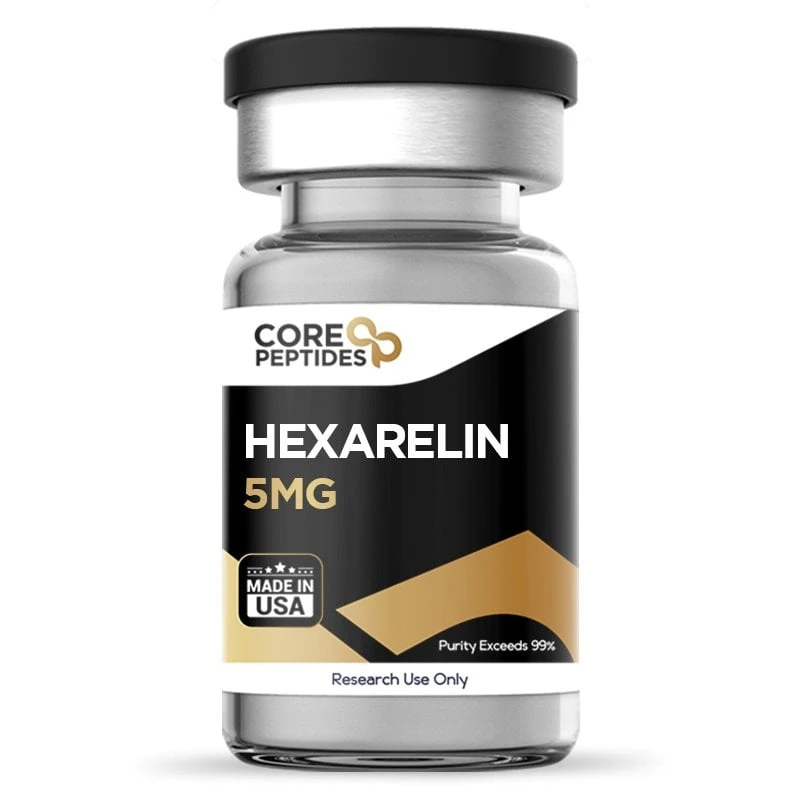


Hexarelin (5mg) – Growth Hormone-Releasing Peptide Research Material
Hexarelin (5mg) is a synthetic hexapeptide belonging to the growth hormone secretagogue (GHS) family. It has been extensively investigated for its ability to stimulate growth hormone (GH) secretion and for its interaction with the growth hormone secretagogue receptor (GHS-R).
Scientific studies have examined Hexarelin in human, cellular and endocrine research models, making it a relevant compound for investigating growth hormone physiology and receptor signalling.
Hexarelin is particularly associated with research into the growth hormone axis, pituitary function, GHS-R signalling, endocrine regulation and interactions between growth hormone-releasing peptides and growth hormone-releasing hormone (GHRH).
The referenced product contains 5mg of Hexarelin and is intended as a research material. It should not be presented as an approved medicine, dietary supplement or product for self-administration.
What Is Hexarelin?
Hexarelin is a synthetic hexapeptide developed as a growth hormone secretagogue. Its peptide sequence is His-D-2-methyl-Trp-Ala-Trp-D-Phe-Lys-NH2.
Research has demonstrated that Hexarelin can stimulate growth hormone release in experimental models and in human studies. Early dose-response research described Hexarelin as a potent GH-releasing peptide and investigated its activity following controlled exposure in healthy volunteers.
Unlike recombinant growth hormone, Hexarelin is not growth hormone itself. It is studied for its ability to influence endogenous GH secretion through growth hormone secretagogue-related signalling.
Hexarelin (5mg) – Product Highlights
- Product name: Hexarelin
- Quantity: 5mg
- Peptide type: Synthetic hexapeptide
- Research classification: Growth hormone secretagogue
- Primary research focus: Growth hormone secretion
- Receptor system: Growth hormone secretagogue receptor (GHS-R)
- Additional research areas: Pituitary endocrinology, receptor pharmacology and hormone signalling
- Research format: Peptide research material
- Intended use: Laboratory and scientific research
Researchers should consult the applicable supplier documentation and batch-specific analytical information for current specifications, purity, storage conditions and quality-control data.
Hexarelin and Growth Hormone Research
One of the principal areas of scientific interest surrounding Hexarelin is its effect on growth hormone secretion.
Human dose-response research has demonstrated that Hexarelin can produce measurable increases in circulating growth hormone under controlled experimental conditions. In one double-blind, placebo-controlled study involving healthy adult men, increasing experimental doses of Hexarelin produced dose-related GH responses.
These findings have made Hexarelin a useful research compound for examining the mechanisms that regulate GH release and the pharmacological characteristics of synthetic growth hormone secretagogues.
Hexarelin and the Growth Hormone Secretagogue Receptor
Hexarelin belongs to the wider group of compounds associated with the growth hormone secretagogue receptor (GHS-R).
GHS-R is a G-protein-coupled receptor involved in the signalling system through which ghrelin and synthetic growth hormone secretagogues influence endocrine activity. Research has demonstrated that GHS-R is expressed in the pituitary and hypothalamus as well as in several peripheral tissues.
This receptor system is an important subject in endocrinology and pharmacology because it provides a molecular link between peptide signalling and growth hormone secretion.
Hexarelin and Pituitary Research
The pituitary gland is a major source of circulating growth hormone and therefore an important target for research involving growth hormone secretagogues.
Experimental studies have examined the direct effects of Hexarelin on pituitary cells and tissues. Research using cultured human pituitary somatotroph tumour cells found that Hexarelin could strongly stimulate GH secretion and investigated intracellular signalling mechanisms associated with this response.
These studies provide a useful basis for examining how synthetic peptide secretagogues interact with pituitary cells and how receptor activation is translated into hormone secretion.
Hexarelin and GHRH Research
Growth hormone-releasing hormone (GHRH) is another major regulator of pituitary GH secretion. Hexarelin has been investigated alongside GHRH to better understand how different signalling pathways influence growth hormone release.
Research has found that Hexarelin can interact functionally with the GHRH system. Experimental studies involving human pituitary cells have investigated whether Hexarelin and GHRH produce complementary effects on GH secretion.
This makes Hexarelin particularly relevant to research examining the coordinated regulation of the growth hormone axis.
Hexarelin and Growth Hormone Feedback
Growth hormone secretion is regulated by multiple feedback mechanisms. Research has investigated whether circulating growth hormone influences the response to growth hormone secretagogues such as Hexarelin.
Human experimental research has reported that administration of recombinant human growth hormone before Hexarelin exposure reduced the subsequent GH response to Hexarelin. This provides evidence that the response to Hexarelin is subject to feedback regulation within the endocrine system.
Such findings are relevant to research into hormonal feedback loops and the mechanisms controlling GH secretion.
Hexarelin and GHS-R Signalling
Research into Hexarelin extends beyond its effect on circulating GH concentrations. Researchers have also investigated how the peptide influences the expression and activity of the growth hormone secretagogue receptor.
Experimental research has examined GHS-R type 1a messenger RNA in hypothalamic and pituitary tissues following exposure to Hexarelin. These studies contribute to a broader understanding of how growth hormone secretagogues may interact with the receptor system at both functional and molecular levels.
This makes Hexarelin relevant to laboratory investigations involving receptor expression, receptor regulation and endocrine signal transduction.
Hexarelin and Cellular Signalling
Cellular research has examined the mechanisms through which Hexarelin stimulates GH secretion.
Studies using cultured human pituitary somatotroph cells have investigated signalling pathways involving protein kinase C and phosphatidylinositol-related mechanisms. Experimental findings suggest that Hexarelin can stimulate GH secretion through intracellular pathways that differ in important respects from classical GHRH signalling.
These findings make Hexarelin useful for researchers investigating the molecular mechanisms behind growth hormone secretagogue activity.
Hexarelin and Endocrine Research
Hexarelin provides a research model for studying several interconnected components of endocrine physiology.
Research applications can include:
- Investigation of growth hormone secretion.
- Study of pituitary somatotroph activity.
- Research into growth hormone secretagogue receptor signalling.
- Investigation of GHRH and secretagogue interactions.
- Study of endocrine feedback mechanisms.
- Analysis of peptide-receptor interactions.
- Investigation of intracellular signalling pathways.
- Research into hypothalamic-pituitary endocrine regulation.
Hexarelin Research Applications
Hexarelin may be relevant to a range of laboratory and scientific research disciplines, including:
- Endocrinology: Investigation of growth hormone regulation and pituitary physiology.
- Receptor pharmacology: Study of GHS-R activation and signalling.
- Cell biology: Investigation of intracellular pathways involved in GH secretion.
- Pituitary research: Examination of somatotroph responsiveness.
- Hormone research: Study of growth hormone release and endocrine feedback.
- Hypothalamic research: Investigation of interactions between hypothalamic signalling and pituitary secretion.
- Peptide research: Evaluation of synthetic growth hormone secretagogues.
- Analytical science: Identification and characterisation of synthetic peptide materials.
Hexarelin Compared with GHRP-6
Hexarelin and GHRP-6 are related synthetic growth hormone secretagogues, but they are distinct peptides.
| Characteristic | Hexarelin | GHRP-6 |
|---|---|---|
| Peptide type | Synthetic hexapeptide | Synthetic growth hormone-releasing peptide |
| Research classification | Growth hormone secretagogue | Growth hormone secretagogue |
| Primary research area | GH secretion and GHS-R signalling | GH secretion and GHS-R/ghrelin signalling |
| Research relevance | Pituitary, endocrine and receptor studies | Pituitary, endocrine and ghrelin-related studies |
Although both compounds belong to the same broad research category, their molecular structures and pharmacological characteristics are not identical. Experimental protocols should therefore identify the precise peptide being studied.
Hexarelin Compared with GHRP-2
Hexarelin and GHRP-2 are both synthetic growth hormone secretagogues, but they represent different peptide structures.
| Research Material | General Classification | Primary Research Interest |
|---|---|---|
| Hexarelin | Growth hormone secretagogue | GH secretion and GHS-R signalling |
| GHRP-2 | Growth hormone secretagogue | GH secretion and ghrelin/GHS-R signalling |
| GHRP-6 | Growth hormone secretagogue | GH secretion and ghrelin receptor research |
These compounds should not be considered interchangeable. Differences in peptide structure and receptor pharmacology can affect experimental results.
Hexarelin and Human Research
Hexarelin has been investigated in controlled human studies, particularly in relation to growth hormone secretion.
Early clinical pharmacology research evaluated Hexarelin following different experimental routes of exposure and observed measurable GH responses in healthy volunteers. Another dose-response study investigated increasing experimental exposures and reported a dose-related increase in GH release.
Human research has also examined Hexarelin responses in individuals with growth hormone deficiency and investigated the influence of exogenous growth hormone on the subsequent GH response.
Although these studies provide valuable information about the biological activity of Hexarelin, experimental human findings should not be interpreted as evidence of suitability for self-administration or as a general therapeutic recommendation.
Hexarelin and Receptor Expression
The growth hormone secretagogue receptor is expressed in multiple tissues, including the pituitary and hypothalamus.
Research has examined whether exposure to synthetic secretagogues such as Hexarelin can influence the expression of GHS-R messenger RNA in hypothalamic and pituitary tissues.
This line of research is useful for understanding the dynamic relationship between a peptide ligand and the receptor system through which it exerts its endocrine effects.
Hexarelin and Pituitary Cell Studies
Cell-based studies provide an opportunity to investigate Hexarelin at the molecular level without relying exclusively on whole-organism models.
Research using cultured human pituitary somatotroph cells has investigated Hexarelin-induced GH secretion and its relationship with GHRH. Experimental findings indicate that Hexarelin can directly stimulate GH secretion in these cell models and can modify responses to GHRH.
Such research is useful for studying the cellular mechanisms responsible for growth hormone secretagogue activity.
Hexarelin Product Quantity
The referenced product is supplied as 5mg of Hexarelin.
| Product Option | Research Material |
|---|---|
| 5mg | Hexarelin research peptide |
The stated quantity refers to the amount of research material supplied. It should not be interpreted as a human dose, treatment amount or recommended administration schedule.
Hexarelin Product Specifications
| Specification | Details |
|---|---|
| Product name | Hexarelin |
| Quantity | 5mg |
| Peptide classification | Synthetic growth hormone secretagogue |
| Peptide type | Hexapeptide |
| Primary research target | Growth hormone secretagogue receptor |
| Primary research area | Growth hormone secretion |
| Additional research areas | Pituitary endocrinology, GHRH interaction and cellular signalling |
| Intended application | Laboratory and scientific research |
Why Researchers Study Hexarelin
Hexarelin has attracted scientific interest because it provides a well-defined synthetic peptide model for investigating growth hormone secretagogue activity.
Key areas of research interest include:
- Potent stimulation of growth hormone secretion in experimental models.
- Investigation of GHS-R-mediated signalling.
- Research into pituitary somatotroph responses.
- Study of interactions between Hexarelin and GHRH.
- Investigation of hormonal feedback mechanisms.
- Study of GHS-R expression in hypothalamic and pituitary tissues.
- Investigation of intracellular pathways involved in GH secretion.
These characteristics make Hexarelin a relevant research material for laboratories studying endocrine physiology and peptide-receptor pharmacology.
Frequently Asked Questions About Hexarelin
What is Hexarelin?
Hexarelin is a synthetic hexapeptide belonging to the growth hormone secretagogue family. It has been studied extensively for its ability to stimulate growth hormone secretion.
What does Hexarelin research focus on?
Research commonly focuses on growth hormone secretion, GHS-R signalling, pituitary endocrinology, GHRH interactions and intracellular mechanisms involved in endocrine signalling.
Is Hexarelin growth hormone?
No. Hexarelin is a synthetic growth hormone secretagogue. It is studied for its ability to influence endogenous growth hormone secretion rather than functioning as growth hormone itself.
Has Hexarelin been studied in humans?
Yes. Published human studies have investigated Hexarelin and its effects on growth hormone secretion under controlled experimental conditions.
Does Hexarelin interact with the growth hormone secretagogue receptor?
Hexarelin belongs to the class of synthetic growth hormone secretagogues associated with GHS-R signalling. Research has examined the receptor system and its expression in pituitary and hypothalamic tissues.
What is the difference between Hexarelin and GHRP-6?
Both are synthetic growth hormone secretagogues, but they are different peptide compounds with distinct structures and pharmacological characteristics. Researchers should use the exact compound specified by their experimental protocol.
What quantity is supplied?
The referenced product is supplied in a 5mg quantity.
Can Hexarelin research results be interpreted as medical advice?
No. Scientific findings should be interpreted according to the specific experimental model and conditions in which they were obtained. Research information does not establish suitability for self-administration or treatment of a medical condition.
Is Hexarelin intended for laboratory research?
The product should be treated as a research material intended for appropriate laboratory and scientific applications rather than as a general-purpose medicine or dietary supplement.
Research Summary
Hexarelin (5mg) is a synthetic hexapeptide that has been extensively investigated as a growth hormone secretagogue. Human research has demonstrated measurable GH-releasing activity, including dose-related responses under controlled experimental conditions.
Research has also examined Hexarelin in relation to the growth hormone secretagogue receptor, pituitary somatotroph cells, GHRH signalling and endocrine feedback mechanisms. Cellular studies have provided additional insight into the intracellular pathways associated with Hexarelin-induced GH secretion.
Its established research history makes Hexarelin relevant to scientific investigations involving growth hormone physiology, pituitary endocrinology, receptor pharmacology, peptide signalling and the regulation of the GH axis.
Research-Use Disclaimer
Hexarelin (5mg) is intended for laboratory and scientific research purposes only. It is not a food product, dietary supplement or general-purpose therapeutic product.
The information provided on this page is for scientific and educational purposes and does not constitute medical advice. It should not be interpreted as evidence that Hexarelin can diagnose, treat, cure or prevent any disease or medical condition.
Research findings from biochemical, cellular, animal and human studies should be interpreted within the specific context in which they were obtained. Experimental findings do not automatically establish clinical safety, efficacy or an appropriate therapeutic application.
This content does not provide instructions for human administration, dosing, injection, reconstitution for human use or self-experimentation. Researchers should follow appropriate laboratory protocols, supplier documentation, institutional requirements and all applicable laws and regulations when working with research peptides.
Be the first to review “Hexarelin (5mg)”
Related products
Peptides for Sale
Peptides for Sale
Peptides for Sale
Peptides for Sale
Peptides for Sale
Peptides for Sale

Peptides for Sale
Peptides for Sale
Reviews
There are no reviews yet.