
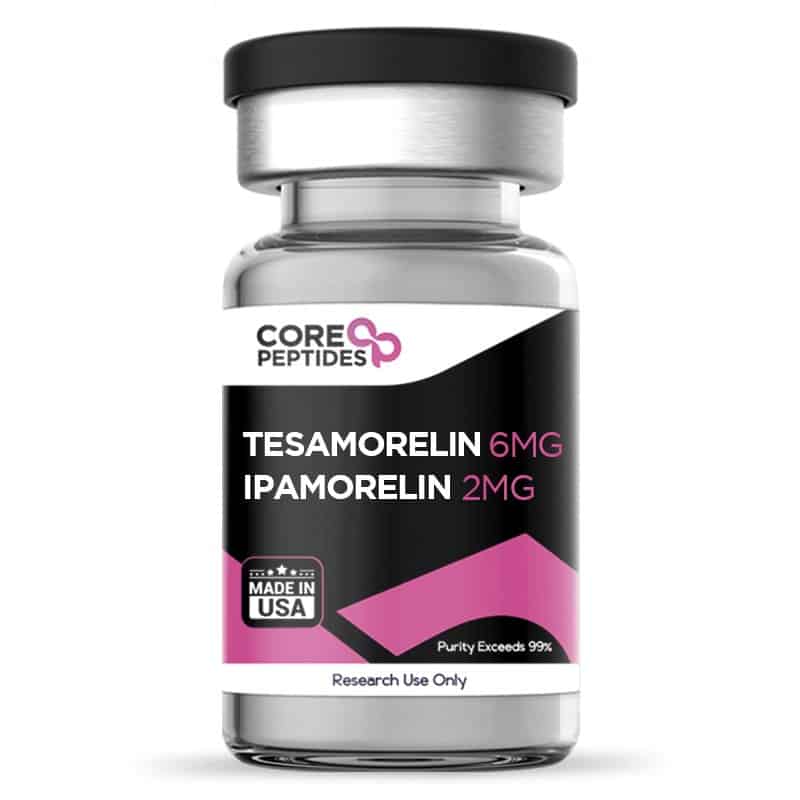
Tesamorelin & Ipamorelin Blend (8MG)
Tesamorelin & Ipamorelin Blend (8MG) is a two-peptide research formulation combining Tesamorelin, a synthetic growth hormone-releasing hormone (GHRH) analogue, with Ipamorelin, a selective growth hormone secretagogue research peptide.
The combination provides researchers with two distinct experimental approaches for investigating signalling within the growth hormone (GH) axis.
According to the Core Peptides product listing, this formulation contains 6mg of Tesamorelin and 2mg of Ipamorelin, giving a total peptide content of 8mg. It is supplied as a lyophilised powder with a stated purity of >99%.
Tesamorelin is primarily associated with GHRH receptor signalling, whereas Ipamorelin has been characterised as a growth hormone secretagogue that acts through the GHS receptor pathway.
Research into these different mechanisms makes the combination relevant to laboratory studies of pituitary GH secretion, endocrine signalling and the broader GH–IGF-1 axis.
For research, laboratory and analytical use only. Not for human or animal consumption.
What Is Tesamorelin & Ipamorelin Blend?
The Tesamorelin & Ipamorelin Blend brings together two synthetic peptides that have been investigated for their relationship with endogenous growth hormone release.
Tesamorelin is a synthetic analogue of growth hormone-releasing hormone. It is studied for its interaction with GHRH receptors on pituitary somatotroph cells and its ability to stimulate endogenous GH secretion. Ipamorelin is a synthetic pentapeptide investigated as a selective growth hormone secretagogue receptor agonist.
By combining these compounds in a single research formulation, laboratories can investigate two different upstream signalling mechanisms associated with GH release. This makes the blend relevant to comparative peptide research, receptor studies and investigations into endocrine signalling.
Product Specifications
| Specification | Details |
|---|---|
| Product Name | Tesamorelin & Ipamorelin Blend |
| Total Peptide Content | 8mg |
| Tesamorelin | 6mg |
| Ipamorelin | 2mg |
| Form | Lyophilised powder |
| Stated Purity | >99% |
| Product Category | Research Peptide Blend |
| Primary Research Area | Growth hormone and endocrine signalling |
| Research Application | Laboratory, analytical and in-vitro research |
| SKU | TESA-IPA-8MG |
The formulation contains a defined 6mg:2mg ratio of Tesamorelin to Ipamorelin. The total listed quantity is 8mg per product.
Key Components of the Blend
Tesamorelin
Tesamorelin is a synthetic analogue related to human growth hormone-releasing hormone (GHRH). It is studied primarily for its interaction with GHRH receptors and its influence on endogenous growth hormone secretion.
The peptide is based on the 44-amino-acid sequence of human GHRH with structural modifications. Research has examined Tesamorelin in connection with GH secretion, IGF-1 signalling, visceral adipose tissue and body-composition parameters.
Ipamorelin
Ipamorelin is a synthetic pentapeptide with the sequence Aib-His-D-2-Nal-D-Phe-Lys-NH2. It was identified as a selective growth hormone secretagogue and has been studied for its interaction with the growth hormone secretagogue receptor (GHS-R).
Early pharmacological research demonstrated that Ipamorelin can stimulate GH release through a GHRP-like receptor pathway. Its relative selectivity for GH release was one of the characteristics that generated scientific interest in the compound.
How Do Tesamorelin and Ipamorelin Differ?
| Feature | Tesamorelin | Ipamorelin |
|---|---|---|
| General classification | GHRH analogue | Growth hormone secretagogue |
| Primary research pathway | GHRH receptor | Growth hormone secretagogue receptor |
| Research role | Investigation of GHRH-mediated GH release | Investigation of GHS receptor-mediated GH release |
| Quantity in blend | 6mg | 2mg |
| Molecular weight | Approximately 5,136 g/mol | Approximately 711.8 g/mol |
The two compounds therefore provide different experimental models for examining regulation of the growth hormone axis.
Understanding the Growth Hormone Axis
The growth hormone axis is an interconnected endocrine pathway involving hypothalamic signalling, pituitary GH secretion and downstream IGF-1 activity.
GHRH released by the hypothalamus contributes to the stimulation of GH secretion from pituitary somatotroph cells. Growth hormone subsequently acts on peripheral tissues and contributes to IGF-1 production, particularly in the liver.
Tesamorelin provides a research model for GHRH-mediated signalling, while Ipamorelin provides a model for investigating growth hormone secretagogue receptor signalling. The combination therefore allows researchers to examine different regulatory inputs affecting the same broader endocrine system.
Why Study Tesamorelin and Ipamorelin Together?
The scientific interest in this blend comes from the distinct mechanisms associated with its two constituents.
- Tesamorelin: Investigated as a GHRH receptor agonist and GH-releasing peptide.
- Ipamorelin: Investigated as a selective growth hormone secretagogue receptor agonist.
- Combined research model: Allows comparison of GHRH-related and GHS receptor-related signalling within one defined formulation.
Core Peptides describes the combination as potentially complementary because the two compounds act through different components of the growth hormone axis. However, proposed synergy should be treated as a research hypothesis rather than an established clinical outcome.
Tesamorelin & Ipamorelin and Growth Hormone Research
Growth hormone secretion is regulated by multiple interacting signals rather than a single receptor or peptide. Studying compounds that act through different pathways can therefore help researchers investigate how endocrine signals converge on pituitary somatotroph cells.
Research has demonstrated that Tesamorelin can stimulate endogenous GH secretion, while early pharmacological studies of Ipamorelin demonstrated potent GH-releasing activity through a GHRP-like receptor.
The two peptides consequently provide complementary tools for investigating:
- GH receptor signalling.
- GHRH receptor activity.
- Growth hormone secretagogue receptor activity.
- Pituitary somatotroph signalling.
- GH secretion and pulsatility.
- Downstream IGF-1 pathways.
- Endocrine feedback mechanisms.
Tesamorelin and IGF-1 Research
One of the principal downstream pathways associated with GH signalling involves insulin-like growth factor-1 (IGF-1).
Tesamorelin research has demonstrated stimulation of GH secretion followed by increases in IGF-1. This provides a useful experimental model for investigating relationships between GHRH receptor activation, pituitary GH secretion and downstream IGF-1 signalling.
Research involving the blend should nevertheless distinguish between the established pharmacology of individual constituents and any proposed effects arising specifically from their combination.
Ipamorelin and Growth Hormone Secretagogue Research
Ipamorelin has a distinct research profile from Tesamorelin. It is a pentapeptide investigated as an agonist of the growth hormone secretagogue receptor.
In early experimental work, Ipamorelin demonstrated GH-releasing activity in pituitary cells and animal models. The study characterised Ipamorelin as a selective GHRP-receptor agonist with GH-releasing properties similar to GHRH in terms of selectivity.
This makes Ipamorelin particularly relevant to laboratory research examining how secretagogue receptor activation influences GH release independently of direct GHRH receptor stimulation.
Tesamorelin & Ipamorelin and Body-Composition Research
Tesamorelin has been investigated extensively in relation to body composition, particularly visceral adipose tissue in specific clinical populations. A 2026 meta-analysis of randomised controlled trials in adults with HIV-associated lipodystrophy reported reductions in visceral adipose tissue, trunk fat and hepatic fat, alongside an increase in lean body mass.
These findings are relevant to research into the relationship between GH signalling and body-fat distribution. They should not, however, be interpreted as evidence that a research-grade Tesamorelin and Ipamorelin blend is an approved body-composition treatment.
Research involving Ipamorelin has also explored adipose and metabolic biology, although results can vary according to the experimental model. For example, an animal study reported increases in relative fat-pad weight following Ipamorelin exposure, illustrating why biological effects should not be assumed to be uniformly beneficial.
Metabolic Research
The GH axis is closely connected to lipid and carbohydrate metabolism, making Tesamorelin and Ipamorelin relevant to metabolic research.
Researchers may investigate the relationship between GH-axis stimulation and:
- Lipid metabolism.
- Visceral adipose tissue.
- Insulin signalling.
- Glucose metabolism.
- IGF-1 concentrations.
- Body-composition markers.
- Hepatic fat.
However, findings from individual peptides, animal models or specific clinical populations should not be extrapolated automatically to the combined research formulation.
Research into Pituitary Signalling
The pituitary gland plays a central role in the regulation of GH secretion. Tesamorelin and Ipamorelin are of interest because they provide different approaches to studying signalling in pituitary somatotroph cells.
Tesamorelin is associated with activation of the GHRH receptor, while Ipamorelin acts through the growth hormone secretagogue receptor pathway. Core Peptides describes these mechanisms as potentially complementary in pituitary-cell research.
This makes the blend relevant to controlled experiments investigating receptor activation, intracellular signalling and GH release.
Potential Research Applications
Tesamorelin & Ipamorelin Blend (8MG) may be relevant to qualified laboratories investigating a range of peptide and endocrine research questions.
- Endocrine research: Investigation of the GH axis and related signalling.
- Receptor research: Study of GHRH and growth hormone secretagogue receptors.
- Pituitary research: Investigation of somatotroph cell signalling.
- IGF-1 research: Examination of downstream GH-mediated pathways.
- Metabolic research: Investigation of relationships between endocrine signalling and metabolism.
- Body-composition research: Study of visceral adiposity and lean tissue.
- Peptide research: Comparative evaluation of different GH-axis peptides.
- Analytical research: Assessment of peptide identity, purity and stability.
- Cellular research: Investigation of receptor-mediated intracellular pathways.
Chemical Composition
| Compound | Molecular Formula | Approx. Molecular Weight |
|---|---|---|
| Tesamorelin | C221H366N72O67S | 5,136 g/mol |
| Ipamorelin | C38H49N9O5 | 711.8 g/mol |
Core Peptides lists the molecular formulae and molecular weights for the two individual constituents in the blend.
Peptide Sequences
Tesamorelin
Core Peptides identifies Tesamorelin as a modified 44-amino-acid GHRH analogue. Its listed sequence begins with the modified N-terminal structure followed by the human GHRH-related sequence.
Ipamorelin
Ipamorelin is a pentapeptide with the sequence:
H-Aib-His-D-2Nal-D-Phe-Lys-NH2
This sequence is consistent with the peptide sequence reported in early pharmacological research.
Lyophilised Powder Format
The Tesamorelin & Ipamorelin Blend is supplied in lyophilised powder form. Lyophilisation, commonly referred to as freeze-drying, is widely used for laboratory peptide materials because removing water provides a dry format that can be handled and stored according to appropriate research protocols.
Researchers should always follow the product-specific documentation and Certificate of Analysis for storage requirements. Storage conditions should not be inferred solely from general peptide-handling practices.
Analytical Research and Quality Control
Multi-component peptide formulations require careful analytical consideration because researchers may need to verify the identity and purity of each constituent as well as the overall preparation.
Common analytical techniques used in peptide research include:
- Reverse-phase HPLC: Assessment of chromatographic purity and related substances.
- LC-MS: Separation and mass-based identification of peptide components.
- Mass spectrometry: Determination of molecular mass and peptide identity.
- Peptide mapping: Investigation of structural characteristics where appropriate.
- Stability testing: Monitoring changes in peptide composition over time.
For experimental work, researchers should review the relevant batch-specific Certificate of Analysis and use validated analytical methods appropriate to their study.
Tesamorelin & Ipamorelin Blend vs Individual Peptides
| Characteristic | Blend | Tesamorelin Alone | Ipamorelin Alone |
|---|---|---|---|
| Composition | 6mg Tesamorelin + 2mg Ipamorelin | Tesamorelin | Ipamorelin |
| Total product quantity | 8mg | Varies by product | Varies by product |
| GHRH-related signalling | Yes | Yes | No |
| GHS receptor-related signalling | Yes | No | Yes |
| Research focus | Combined GH-axis signalling | GHRH-mediated signalling | Secretagogue receptor signalling |
Research Considerations
Although Tesamorelin and Ipamorelin have different mechanisms associated with GH release, it is important to distinguish mechanistic complementarity from demonstrated clinical synergy.
Laboratory studies may investigate whether simultaneous exposure produces additive, synergistic or otherwise distinct responses compared with individual peptide exposure. Such conclusions require appropriate controls, validated assays and statistically robust experimental design.
The presence of two GH-axis peptides in a single formulation should not be interpreted as proof of enhanced efficacy, safety or therapeutic benefit.
Frequently Asked Questions
What is Tesamorelin & Ipamorelin Blend (8MG)?
It is a research peptide formulation containing 6mg Tesamorelin and 2mg Ipamorelin, supplied as lyophilised powder with a stated purity of >99%.
What does the 8MG specification mean?
The 8mg designation refers to the total peptide content in the formulation: 6mg Tesamorelin plus 2mg Ipamorelin. It is a product quantity and should not be interpreted as a dosage recommendation.
What is Tesamorelin?
Tesamorelin is a synthetic GHRH analogue studied for its interaction with GHRH receptors and its effects on endogenous growth hormone secretion.
What is Ipamorelin?
Ipamorelin is a synthetic pentapeptide studied as a selective growth hormone secretagogue receptor agonist. Early research demonstrated potent GH-releasing activity in experimental models.
How are Tesamorelin and Ipamorelin different?
Tesamorelin is primarily associated with GHRH receptor signalling, while Ipamorelin is associated with growth hormone secretagogue receptor signalling. They therefore provide different experimental approaches to studying GH release.
Why are Tesamorelin and Ipamorelin combined?
The combination allows researchers to investigate two distinct signalling pathways associated with growth hormone release within a defined research formulation. Core Peptides describes the mechanisms as potentially complementary, although the degree of any synergy must be established experimentally.
Does the blend contain human growth hormone?
No. The product contains synthetic Tesamorelin and Ipamorelin. It does not contain recombinant human growth hormone.
Is the product supplied as a liquid?
No. Core Peptides lists the product as a lyophilised powder.
What is the stated purity?
The product listing states a purity of >99%. Researchers should consult the current batch-specific Certificate of Analysis for detailed analytical information.
What research areas are relevant to this blend?
The formulation may be relevant to research involving growth hormone secretion, GHRH receptor signalling, GHS receptor signalling, pituitary biology, IGF-1 pathways, metabolic research, peptide stability and analytical characterisation.
Is this product intended for human use?
No. Core Peptides identifies the product as being intended for research, laboratory and analytical purposes only. It is not intended for human or animal consumption.
Is the Tesamorelin & Ipamorelin combination an approved medicine?
This specific 8mg research blend should not be represented as an approved medicinal product or as having an established clinical indication. Research findings involving individual constituents or pharmaceutical formulations should not automatically be applied to this research formulation.
Storage and Laboratory Handling
Researchers should consult the current product documentation and Certificate of Analysis for exact storage and handling requirements.
- Keep the material in its original, correctly labelled container.
- Protect the lyophilised powder from unnecessary exposure to moisture.
- Follow supplier-specified storage conditions.
- Minimise unnecessary temperature fluctuations.
- Use appropriate laboratory protective equipment.
- Prevent contamination during handling.
- Maintain batch and experimental records.
- Dispose of research materials according to applicable institutional procedures.
Storage and handling requirements may vary according to experimental conditions, packaging and formulation. Product-specific documentation should therefore take precedence over general guidance.
Tesamorelin & Ipamorelin Blend (8MG) Research Summary
Tesamorelin & Ipamorelin Blend (8MG) provides researchers with a defined combination of two peptides associated with different aspects of growth hormone regulation. The formulation contains 6mg Tesamorelin and 2mg Ipamorelin in a lyophilised powder format with a stated purity of >99%.
Tesamorelin is studied as a GHRH analogue, while Ipamorelin is studied as a selective growth hormone secretagogue. Early research supports the distinct receptor mechanisms associated with these compounds, making their combination relevant to investigations of pituitary signalling and the broader GH–IGF-1 axis.
Research involving Tesamorelin has also examined visceral adipose tissue, hepatic fat and body composition in specific populations, while Ipamorelin research has explored GH secretion and related biological pathways. These findings provide scientific context but should not be interpreted as evidence that this research-grade blend is a therapeutic product.
For qualified laboratories, the blend offers a defined two-peptide research material for studies involving growth hormone signalling, receptor biology, endocrine pathways, peptide characterisation and controlled in-vitro or analytical research.
Important Research Disclaimer
Tesamorelin & Ipamorelin Blend (8MG) is supplied solely for research, laboratory and analytical purposes.
This product is not intended for human or veterinary consumption, self-administration, diagnosis, treatment, cure or prevention of any disease. References to growth hormone, IGF-1, metabolism, body composition, cognition or other biological processes describe areas of scientific research and should not be interpreted as medical advice or therapeutic claims.
Research findings involving individual peptides, animal models or approved pharmaceutical formulations should not automatically be extrapolated to this specific research blend. Any proposed synergistic effects of Tesamorelin and Ipamorelin require appropriate experimental validation.
Researchers are responsible for complying with all applicable laws, institutional requirements and laboratory safety procedures when handling research peptides.
For research use only. Not for human or animal consumption.
Be the first to review “Tesamorelin & Ipamorelin Blend (8MG)”
Related products
Peptides for Sale
Peptides for Sale
Peptides for Sale
Peptides for Sale
Peptides for Sale
Peptides for Sale
Peptide Blends for Sale
Peptides for Sale
Reviews
There are no reviews yet.