
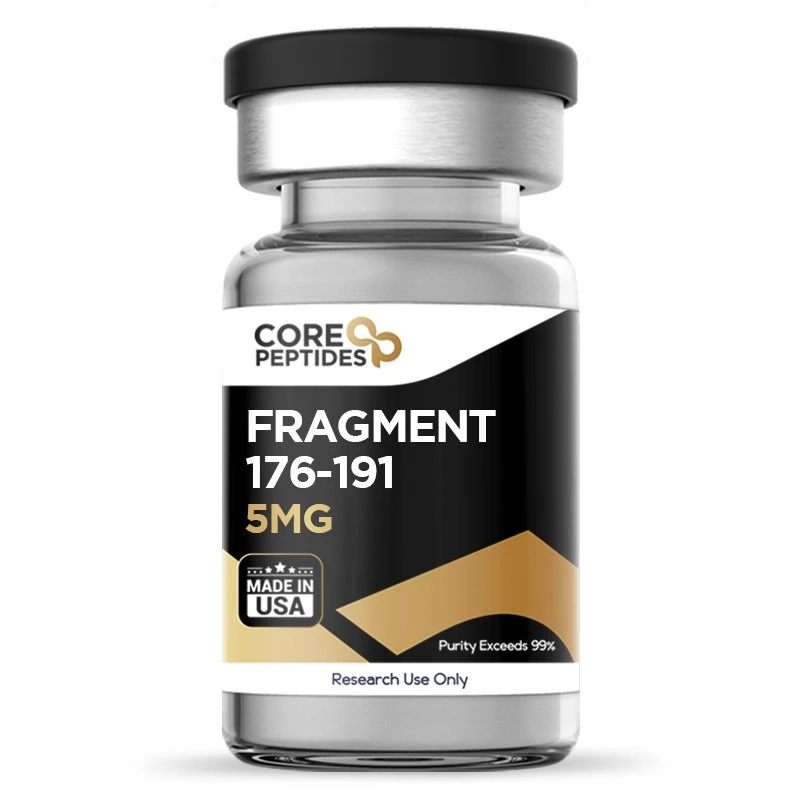

Fragment 176-191 (5mg) – Research Peptide for Lipolysis & Adipose Tissue Studies
Fragment 176-191 (5mg), commonly referred to as HGH Fragment 176-191, is a synthetic peptide corresponding to the C-terminal region of human growth hormone (hGH).
This short peptide has attracted scientific interest because research has associated the 176-191 region of growth hormone with processes involved in lipolysis, lipid metabolism and adipose-tissue biology.
The referenced Fragment 176-191 (5mg) product is supplied as a lyophilised powder and is listed with a stated purity of >99%. The material is intended for laboratory and scientific research rather than human or veterinary use.
Research into HGH Fragment 176-191 forms part of a broader effort to understand whether specific regions of larger hormones can reproduce selected biological activities without reproducing the full range of effects associated with the parent molecule. Experimental studies have therefore examined this fragment in relation to adipocyte metabolism, fatty-acid mobilisation and energy regulation.
What Is Fragment 176-191?
Fragment 176-191 is a peptide derived from the C-terminal portion of the 191-amino-acid human growth hormone molecule. It represents the terminal region of hGH that has been investigated for its relationship with lipid metabolism.
The peptide is sometimes described as the lipolytic fragment of human growth hormone because early experimental research suggested that this region could reproduce certain lipid-mobilising properties associated with growth hormone.
It is important to distinguish the native HGH Fragment 176-191 sequence from modified analogues such as AOD-9604. AOD-9604 is related to the 176-191 region but incorporates a structural modification and should not automatically be treated as chemically identical to the unmodified research fragment.
Fragment 176-191 (5mg) Product Highlights
- Product: Fragment 176-191
- Common name: HGH Fragment 176-191
- Quantity: 5mg
- Form: Lyophilised powder
- Stated purity: >99%
- Origin: Synthetic fragment based on human growth hormone
- Primary research area: Lipid and adipose-tissue metabolism
- Additional research areas: Lipolysis, lipogenesis, fatty-acid metabolism and metabolic signalling
- Research status: Experimental
- Intended use: Laboratory and scientific research only
The product quantity, lyophilised form and stated purity are based on the referenced product listing. Researchers should consult the batch-specific Certificate of Analysis for applicable analytical information.
Fragment 176-191 and Human Growth Hormone
Human growth hormone, commonly abbreviated as hGH, is a naturally occurring peptide hormone consisting of 191 amino acids. It has diverse biological functions involving growth, metabolism and tissue regulation.
Researchers have investigated individual sections of the hGH molecule to determine whether particular biological functions can be associated with specific amino-acid sequences.
Fragment 176-191 is particularly interesting because the C-terminal region has been investigated for its potential involvement in lipid metabolism. This research has contributed to the hypothesis that some metabolic effects attributed to growth hormone may be mediated through regions of the hormone that are distinct from its classical growth-promoting signalling.
This makes Fragment 176-191 useful as an experimental molecule for investigating the relationship between peptide structure and metabolic activity.
Fragment 176-191 and Lipolysis Research
Lipolysis refers to the enzymatic breakdown of stored triglycerides in adipose tissue, releasing fatty acids and glycerol.
Experimental research has investigated whether the 176-191 region of growth hormone can influence pathways involved in lipid mobilisation. Studies in animal models have reported changes in adipose tissue and body-weight parameters following exposure to related peptides.
Some experimental work has proposed involvement of beta-3 adrenergic signalling, while other findings indicate that the biological mechanism may involve additional pathways. The available evidence therefore does not support reducing the activity of Fragment 176-191 to a single molecular mechanism.
Fragment 176-191 and Adipose Tissue Research
Adipose tissue is an important endocrine and metabolic organ involved in energy storage, lipid mobilisation and signalling.
Researchers studying Fragment 176-191 have examined its effects in experimental adipocyte and animal models. Particular areas of interest include:
- Breakdown of stored triglycerides.
- Fatty-acid mobilisation.
- Lipid oxidation.
- Regulation of adipose tissue.
- Adipocyte signalling.
- Interactions with adrenergic pathways.
- Changes in lipogenic activity.
These studies are useful for understanding the biological activity of the peptide but should not be interpreted as evidence that Fragment 176-191 is an established treatment for obesity or body-weight disorders.
Fragment 176-191 and Lipogenesis
In addition to studying lipolysis, researchers have investigated whether the C-terminal growth hormone fragment influences lipogenesis, the process through which fatty acids and other substrates can contribute to lipid storage.
The balance between lipolysis and lipogenesis is an important determinant of adipose-tissue lipid storage.
Experimental studies of Fragment 176-191 have therefore examined whether the peptide can alter metabolic pathways associated with both the mobilisation and storage of lipids.
Research findings vary according to the experimental model, and additional investigation is required to establish the precise molecular pathways responsible for the observed effects.
Fragment 176-191 and Beta-3 Adrenergic Receptors
One proposed mechanism investigated in connection with Fragment 176-191 involves beta-3 adrenergic receptors (β3-AR).
Beta-3 adrenergic receptors are expressed in adipose tissue and are involved in signalling pathways associated with lipid mobilisation and energy metabolism.
Research in obese animal models has reported changes in beta-3 adrenergic receptor expression following exposure to the peptide. However, other experimental observations suggest that beta-3 adrenergic signalling alone may not fully explain the observed biological effects.
This makes the beta-3 adrenergic pathway an important research area rather than a definitive explanation of Fragment 176-191 activity.
Fragment 176-191 and Energy Metabolism
Another area of investigation concerns the relationship between Fragment 176-191 and energy expenditure.
Researchers have proposed that changes in lipid utilisation could influence the availability of fatty acids as an energy substrate. Experimental models have therefore examined whether the peptide affects pathways involved in energy balance and substrate utilisation.
These mechanisms remain subjects of scientific investigation, and findings from animal models cannot automatically be extrapolated to human metabolic outcomes.
Fragment 176-191 and Growth Hormone Signalling
Although Fragment 176-191 originates from human growth hormone, it should not be considered equivalent to full-length hGH.
Full-length growth hormone interacts with the growth hormone receptor and participates in several signalling pathways, including pathways associated with IGF-1 production and growth-related processes.
Fragment 176-191 has instead been studied because researchers believe that selected metabolic properties of hGH may reside within its C-terminal region.
This distinction is important when interpreting research: studying an isolated hormone fragment allows researchers to investigate a particular structural region without assuming that it reproduces every biological function of the complete hormone.
Fragment 176-191 vs AOD-9604
Fragment 176-191 and AOD-9604 are closely related research peptides, but they should not be treated as interchangeable names for exactly the same chemical material.
| Feature | Fragment 176-191 | AOD-9604 |
|---|---|---|
| Relationship to hGH | C-terminal region of hGH | Modified peptide based on the hGH 176-191 region |
| Research focus | Lipid metabolism and lipolysis | Lipid metabolism and related metabolic research |
| Structural status | Research fragment | Modified analogue |
| Research models | Primarily preclinical research | Preclinical and clinical-development research |
The distinction is relevant because even relatively small sequence or structural modifications can affect peptide stability, receptor interactions and biological activity.
Fragment 176-191 Molecular Characteristics
Fragment 176-191 is a short peptide derived from the terminal region of human growth hormone. The referenced product information lists the following chemical characteristics:
| Property | Research Information |
|---|---|
| Peptide name | Fragment 176-191 |
| Alternative name | hGH Fragment 176-191 |
| Quantity | 5mg |
| Physical form | Lyophilised powder |
| Stated purity | >99% |
| Molecular formula listed by supplier | C78H125N23O23S2 |
| Molecular weight listed by supplier | 1817.12 g/mol |
| Primary research field | Lipid and adipose-tissue metabolism |
Researchers should verify molecular and analytical information against the current product documentation and applicable Certificate of Analysis for the relevant batch.
Fragment 176-191 Research Applications
Fragment 176-191 may be investigated in a variety of laboratory research contexts, including:
- Adipocyte biology: Investigation of metabolic behaviour in fat cells.
- Lipolysis research: Study of triglyceride breakdown and fatty-acid mobilisation.
- Lipid metabolism: Investigation of pathways controlling lipid storage and utilisation.
- Beta-3 adrenergic research: Examination of β3-AR-related signalling.
- Energy metabolism: Study of substrate utilisation and metabolic signalling.
- Growth hormone research: Investigation of specific functional regions of hGH.
- Peptide structure-function studies: Examination of biological activity associated with specific amino-acid sequences.
- Metabolic disease models: Experimental investigation in obesity and related animal models.
Fragment 176-191 and Animal Research
Some of the most frequently cited research involving Fragment 176-191 has been conducted using animal models.
Studies have investigated changes in body weight, adipose tissue and lipid metabolism in obese rodents exposed to growth-hormone-derived fragments. Some findings suggested reductions in adiposity and changes in pathways associated with lipolysis.
Other research has examined metabolic effects involving glycogen metabolism and blood glucose-related parameters. The referenced Core Peptides material notes experimental observations involving slight changes in glucose and lactate levels and alterations in glycogen-synthase activity in animal models.
Animal findings can help identify biological mechanisms, but they do not establish clinical efficacy or safety in humans.
Fragment 176-191 and Glucose Metabolism Research
Although much of the interest surrounding Fragment 176-191 concerns lipid metabolism, researchers have also investigated its relationship with glucose and glycogen metabolism.
Experimental work has examined synthetic growth-hormone peptides in animal models to determine whether they influence glycogen-related enzymes in muscle, adipose tissue and liver.
The reported findings included modest changes in blood glucose and lactate together with changes in the activity of glycogen synthase. These observations demonstrate why metabolic peptides should be evaluated across multiple biochemical pathways rather than solely through their proposed effects on adipose tissue.
Fragment 176-191 and Peptide Stability
Peptide stability is an important consideration in laboratory research.
The structure of a peptide can influence its susceptibility to enzymatic degradation, aggregation and environmental conditions. Researchers have therefore examined modifications to growth-hormone-derived peptides that could alter their stability.
Fragment 176-191 is also discussed in relation to structural characteristics of the parent growth hormone molecule. However, researchers should distinguish theoretical stability considerations from experimentally validated stability under a particular laboratory condition.
For analytical or experimental work, researchers should follow the supplier’s batch-specific documentation and validated laboratory procedures.
Fragment 176-191 Purity and Quality Considerations
The referenced Fragment 176-191 (5mg) listing states a purity of >99%. :contentReference[oaicite:7]{index=7}
For research applications, purity is only one component of overall material quality. Researchers may also need to evaluate:
- Peptide identity.
- Molecular mass.
- Sequence fidelity.
- Aggregation or degradation products.
- Residual synthesis-related impurities.
- Batch-to-batch consistency.
- Biological activity where applicable.
Analytical techniques such as HPLC and mass spectrometry are commonly used in peptide characterisation. Researchers should review the relevant Certificate of Analysis rather than relying solely on a general product-page specification.
Why Researchers Study Fragment 176-191
Fragment 176-191 is scientifically interesting because it provides a model for studying how a small region of a larger hormone can contribute to specific biological effects.
The peptide allows researchers to investigate questions such as:
- Which regions of growth hormone contribute to lipid metabolism?
- Can selected metabolic activities be separated from other hormone functions?
- How does the C-terminal region influence adipocyte signalling?
- Which pathways contribute to changes in lipolysis?
- What role do beta-3 adrenergic receptors play?
- How do growth-hormone-derived peptides influence lipid and glucose metabolism?
These questions are relevant to peptide pharmacology, metabolic biology and structure-function research.
Fragment 176-191 and Structure-Function Research
Structure-function analysis is an important technique in molecular biology. Researchers can examine specific regions of a larger protein to determine which sequences contribute to particular biological activities.
The investigation of the growth hormone 176-191 region is an example of this approach. Rather than studying the entire 191-amino-acid hormone, researchers can examine the biological properties of a selected C-terminal segment.
This type of research can help identify functional domains and provide insights into how peptide structure influences biological signalling.
Fragment 176-191 Research Limitations
Despite longstanding scientific interest, important limitations should be considered when evaluating Fragment 176-191 research.
- Limited human evidence: Much of the research specific to the native fragment is preclinical.
- Animal-model dependence: Results observed in rodents may not translate directly to humans.
- Mechanistic uncertainty: Multiple pathways may contribute to observed metabolic effects.
- Distinction from AOD-9604: Research involving modified analogues should not automatically be attributed to the unmodified fragment.
- Product variability: Research findings depend on peptide identity, purity, formulation and experimental conditions.
- No established therapeutic indication: Fragment 176-191 should not be presented as an approved treatment for obesity, weight management or metabolic disease.
Frequently Asked Questions About Fragment 176-191 (5mg)
What is Fragment 176-191?
Fragment 176-191 is a synthetic peptide corresponding to the C-terminal region of human growth hormone. It is primarily studied in relation to lipid metabolism, adipose tissue and lipolytic pathways.
Why is Fragment 176-191 called a growth hormone fragment?
The peptide is derived from the terminal region of the 191-amino-acid human growth hormone molecule, which is why it is commonly referred to as HGH Fragment 176-191.
What is Fragment 176-191 researched for?
Research has investigated the peptide in relation to lipolysis, adipocyte metabolism, lipid oxidation, lipogenesis, beta-3 adrenergic signalling and metabolic pathways.
Is Fragment 176-191 the same as AOD-9604?
No. They are closely related growth-hormone-derived research peptides, but AOD-9604 is a modified analogue of the 176-191 region. Structural differences should be taken into account when comparing research results.
Does Fragment 176-191 work like full-length growth hormone?
No. Fragment 176-191 represents only a small region of the growth hormone molecule and is researched for selected metabolic properties rather than the complete range of biological activities associated with full-length hGH.
What is lipolysis?
Lipolysis is the biological process through which stored triglycerides are broken down into fatty acids and glycerol. Fragment 176-191 has been investigated for potential effects on pathways involved in this process.
What does the 5mg specification mean?
The 5mg specification refers to the quantity of research material supplied. It should not be interpreted as a recommended human dose.
What form is Fragment 176-191 supplied in?
The referenced product is supplied as a lyophilised powder.
What purity is listed for Fragment 176-191?
The referenced Core Peptides product listing states a purity of >99%. Researchers should verify the relevant batch through its Certificate of Analysis.
Has Fragment 176-191 been studied in animals?
Yes. Experimental research has investigated growth-hormone-derived fragments in animal models, including studies examining adipose tissue, body weight and metabolic pathways. These findings remain preclinical.
Is Fragment 176-191 an approved medicine?
No. The referenced product is presented as a research material and should not be represented as an approved medicine or therapeutic treatment.
Fragment 176-191 (5mg) Research Summary
Fragment 176-191 (5mg) is a synthetic C-terminal fragment of human growth hormone investigated primarily for its relationship with lipolysis, adipose-tissue biology and lipid metabolism.
Research has explored how this specific region of hGH may influence fat-cell metabolism, beta-3 adrenergic signalling, lipid mobilisation and related metabolic pathways. Experimental studies have also examined glucose and glycogen metabolism, highlighting the importance of evaluating the peptide across multiple biological systems.
The product is listed as a lyophilised powder with a stated purity of >99% and a quantity of 5mg. It is intended for laboratory research only.
While Fragment 176-191 remains an interesting experimental model for investigating the metabolic functions of the growth-hormone C-terminal region, available evidence should be interpreted within the limitations of preclinical research. Findings involving related compounds such as AOD-9604 should likewise be distinguished from evidence specific to the native Fragment 176-191 sequence.
Research-Use Disclaimer
Fragment 176-191 (5mg) is intended strictly for laboratory and scientific research purposes. It is not a medicine, dietary supplement, food product or approved therapeutic treatment.
The information provided on this page is intended for scientific and educational purposes and does not constitute medical advice. It should not be interpreted as evidence that Fragment 176-191 can diagnose, treat, cure or prevent any disease or medical condition.
Findings from cell and animal studies should not automatically be extrapolated to humans. In particular, research involving related growth-hormone analogues or modified peptides should not be assumed to demonstrate equivalent activity for Fragment 176-191.
This content does not provide instructions for human administration, dosing, injection, reconstitution for human use or self-experimentation. Researchers should follow appropriate laboratory procedures, supplier documentation, institutional requirements and applicable laws and regulations when handling research materials.
Be the first to review “Fragment 176-191 (5mg)”
Related products
Peptides for Sale

Peptides for Sale
Peptides for Sale
Peptides for Sale
Peptides for Sale
Peptides for Sale
Peptides for Sale
Peptides for Sale
Reviews
There are no reviews yet.