
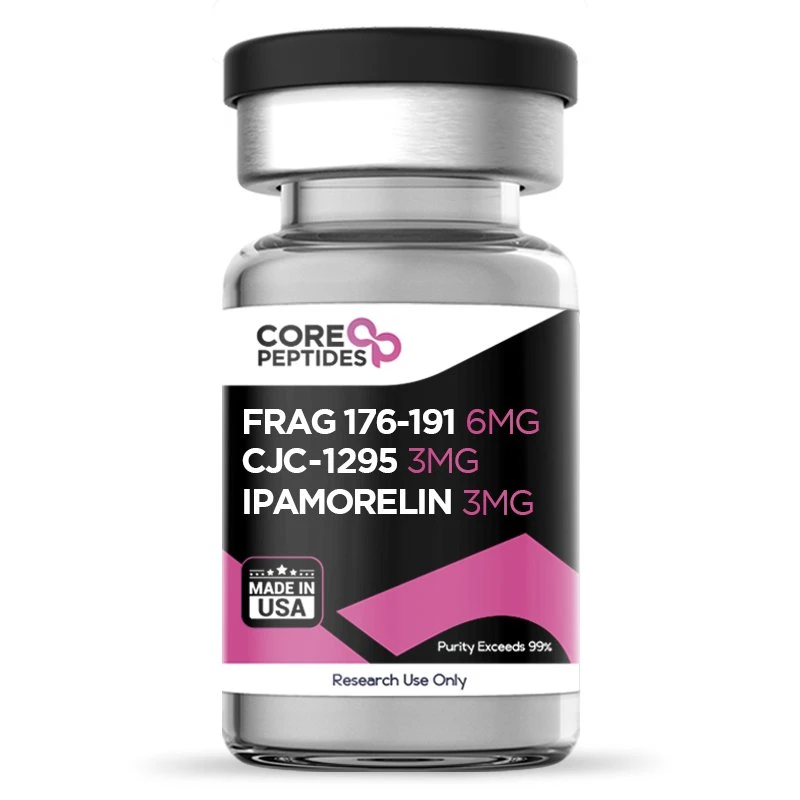
Fragment 176-191 & CJC-1295 & Ipamorelin Blend (12mg) – Research Peptide Blend
Fragment 176-191 & CJC-1295 & Ipamorelin Blend (12mg) is a multi-peptide research formulation combining three compounds that are investigated in different areas of growth-hormone and metabolic biology.
The blend contains Fragment 176-191, CJC-1295 NO DAC (Mod GRF 1-29), and Ipamorelin, providing researchers with a combined model for studying growth-hormone-related signalling and metabolic pathways.
The referenced formulation contains 6mg of Fragment 176-191, 3mg of CJC-1295 NO DAC, and 3mg of Ipamorelin, for a total peptide content of 12mg. The product is supplied as a lyophilised powder and the supplier lists a stated purity of >99%.
Each component has a distinct research profile. Fragment 176-191 is a C-terminal fragment of human growth hormone investigated primarily in relation to lipid and adipose-tissue biology.
CJC-1295 NO DAC, also known as Mod GRF 1-29, is a modified growth-hormone-releasing hormone analogue. Ipamorelin is a synthetic growth-hormone secretagogue investigated for its ability to stimulate growth hormone release through the growth-hormone secretagogue receptor pathway.
What Is the Fragment 176-191 & CJC-1295 & Ipamorelin Blend?
This research blend combines three synthetic peptides with complementary areas of scientific investigation:
- Fragment 176-191: A peptide corresponding to the C-terminal region of human growth hormone and studied in lipid metabolism and adipose-tissue research.
- CJC-1295 NO DAC: A modified analogue of growth hormone-releasing hormone (GHRH), also known as Mod GRF 1-29, studied for its effects on growth-hormone secretion.
- Ipamorelin: A synthetic pentapeptide and growth-hormone secretagogue investigated for its interaction with the growth-hormone secretagogue receptor.
Combining these molecules provides a research model for examining multiple aspects of the growth hormone axis within a single experimental formulation.
The three components should nevertheless be considered separate research molecules with different structures, mechanisms and biological targets. A combined formulation does not establish that their individual research findings will necessarily occur in the same way when the compounds are studied together.
Fragment 176-191 & CJC-1295 & Ipamorelin Blend – Product Highlights
- Total peptide content: 12mg
- Fragment 176-191: 6mg
- CJC-1295 NO DAC / Mod GRF 1-29: 3mg
- Ipamorelin: 3mg
- Physical form: Lyophilised powder
- Stated purity: >99%
- Product category: Research peptide blend
- Primary research areas: Growth-hormone signalling, peptide pharmacology and metabolic research
- Additional research areas: Lipid metabolism, adipose-tissue biology and pituitary GH regulation
- Intended use: Laboratory and scientific research only
Researchers should consult the applicable batch-specific Certificate of Analysis and supplier documentation for current analytical specifications.
Composition of the 12mg Peptide Blend
| Component | Quantity | Primary Research Area |
|---|---|---|
| Fragment 176-191 | 6mg | Lipid metabolism and adipose-tissue biology |
| CJC-1295 NO DAC / Mod GRF 1-29 | 3mg | GHRH signalling and growth-hormone secretion |
| Ipamorelin | 3mg | Growth-hormone secretagogue research |
| Total | 12mg | Combined GH-axis and metabolic research |
Fragment 176-191 Research Profile
Fragment 176-191 represents a C-terminal region of human growth hormone. It has been investigated separately from full-length growth hormone because researchers have sought to identify specific regions of the hormone that may contribute to its metabolic effects.
Research surrounding this fragment has focused particularly on lipolysis, lipid metabolism and adipose-tissue biology. Experimental work has examined its relationship with the mobilisation of stored lipids and pathways involved in energy metabolism.
Fragment 176-191 is therefore the metabolic-focused component of this three-peptide formulation. Its inclusion allows researchers to investigate growth-hormone-derived lipid pathways alongside peptides that influence GH secretion.
Importantly, Fragment 176-191 should not be regarded as equivalent to full-length human growth hormone. It represents only a small portion of the parent hormone and is investigated for selected biological properties.
CJC-1295 NO DAC / Mod GRF 1-29 Research Profile
CJC-1295 NO DAC is commonly associated with the designation Mod GRF 1-29. It is a modified analogue of growth hormone-releasing hormone designed for research into the regulation of growth-hormone secretion.
Growth hormone-releasing hormone is a hypothalamic signalling peptide that stimulates the pituitary gland to release growth hormone. CJC-1295-related research has therefore focused on how synthetic GHRH analogues can influence the GH axis.
It is important to distinguish CJC-1295 NO DAC from CJC-1295 containing the Drug Affinity Complex (DAC). These designations refer to different molecular configurations with different pharmacological characteristics.
The product referenced here specifically identifies the CJC-1295 component as NO DAC / Mod GRF 1-29.
Ipamorelin Research Profile
Ipamorelin is a synthetic pentapeptide classified as a growth-hormone secretagogue. Scientific research has examined its ability to stimulate growth hormone release through a growth-hormone secretagogue receptor pathway.
Early pharmacological research described Ipamorelin as a selective growth-hormone-releasing peptide with activity in laboratory and animal models. Subsequent pharmacokinetic and pharmacodynamic research in humans has examined its relationship with circulating growth hormone.
Ipamorelin is therefore the growth-hormone-secretagogue component of the formulation, while CJC-1295 NO DAC represents the GHRH-related component.
How the Three Peptides Differ
The three components are structurally and pharmacologically distinct.
| Peptide | General Classification | Research Focus |
|---|---|---|
| Fragment 176-191 | Growth-hormone-derived peptide fragment | Lipid metabolism and adipose tissue |
| CJC-1295 NO DAC | GHRH analogue | Growth-hormone secretion and GH-axis signalling |
| Ipamorelin | Growth-hormone secretagogue | GH release and secretagogue-receptor signalling |
This distinction is important when designing experiments because each molecule operates through a different biological mechanism.
CJC-1295 and Growth-Hormone Research
Growth hormone is regulated through a complex interaction between hypothalamic and pituitary signalling.
One of the principal regulators is growth hormone-releasing hormone (GHRH), which acts on receptors located on pituitary somatotroph cells. GHRH signalling promotes the synthesis and release of growth hormone.
CJC-1295 has been investigated as a synthetic analogue of GHRH. Published human research on CJC-1295 demonstrated that the compound could produce sustained changes in circulating GH and IGF-1 under the conditions studied.
However, those findings concern specific CJC-1295 formulations and experimental protocols. Researchers should not automatically transfer findings from CJC-1295 with DAC to the NO DAC / Mod GRF 1-29 component of this formulation.
Ipamorelin and Growth-Hormone Secretagogue Research
Ipamorelin has been investigated as a selective growth-hormone secretagogue.
Unlike GHRH analogues, growth-hormone secretagogues operate through a different signalling mechanism involving the growth-hormone secretagogue receptor (GHS-R). This receptor is closely associated with the biological activity of ghrelin.
Experimental studies have shown that Ipamorelin can stimulate GH release in cellular and animal models. Human pharmacokinetic and pharmacodynamic research has also characterised its relationship with GH concentrations.
These findings make Ipamorelin useful for experimental studies investigating how secretagogue signalling contributes to regulation of the GH axis.
Research Interest in Combining GHRH Analogues and Secretagogues
The combination of a GHRH analogue and a growth-hormone secretagogue is of interest because the two classes of compounds influence GH secretion through distinct pathways.
CJC-1295 NO DAC is associated with GHRH-receptor signalling, whereas Ipamorelin is investigated through the growth-hormone secretagogue receptor pathway.
Studying these pathways together can allow researchers to investigate questions surrounding:
- Growth-hormone secretory dynamics.
- Interaction between GHRH and secretagogue signalling.
- Pituitary somatotroph responses.
- GH-axis regulation.
- Changes in downstream IGF-1 signalling.
- Interactions between multiple peptide signalling systems.
The presence of Fragment 176-191 adds a separate metabolic research component, allowing investigators to examine the relationship between GH-related signalling and lipid metabolism.
Fragment 176-191 & CJC-1295 & Ipamorelin – Research Applications
The three-component formulation may be of interest in laboratory research involving:
- Growth-hormone biology: Investigation of GH secretion and regulation.
- GHRH signalling: Study of GHRH receptor-mediated pathways.
- Secretagogue research: Investigation of GHS-R-related signalling.
- Pituitary research: Study of somatotroph responses to peptide signals.
- IGF-1 research: Examination of downstream GH-axis biomarkers.
- Adipose-tissue research: Investigation of lipid metabolism and adipocyte biology.
- Lipolysis research: Study of triglyceride mobilisation and fatty-acid metabolism.
- Peptide pharmacology: Comparison of distinct peptide signalling mechanisms.
- Metabolic research: Investigation of interactions between endocrine and metabolic pathways.
- Structure-function studies: Examination of how different peptide structures influence biological signalling.
Fragment 176-191 and Adipose-Tissue Biology
Adipose tissue plays a major role in energy storage, lipid turnover and endocrine signalling.
Fragment 176-191 has been investigated in experimental models because of proposed effects on pathways associated with lipolysis and lipid utilisation.
Research in this area can include examination of adipocyte responses, fatty-acid mobilisation and metabolic signalling. The presence of this peptide in the blend therefore provides a distinct research focus that complements the GH-secretagogue properties of the other components.
These experimental observations should not be interpreted as evidence that the blend is an established weight-management or obesity treatment.
Growth Hormone and IGF-1 Research
The GH/IGF-1 axis is an interconnected endocrine signalling system involving growth hormone, insulin-like growth factor 1 and several regulatory hormones.
Growth hormone released by the pituitary can influence hepatic and peripheral IGF-1 production. IGF-1 subsequently participates in a wide range of biological processes involving growth, metabolism and tissue signalling.
Research involving CJC-1295 has examined changes in both GH and IGF-1. Studies involving Ipamorelin have likewise investigated GH release and its pharmacodynamic characteristics.
Combining these peptides with Fragment 176-191 creates a research formulation spanning both GH-axis signalling and growth-hormone-derived metabolic research.
Why Researchers Study Peptide Blends
Multi-peptide formulations can be useful experimental tools when researchers want to investigate interactions between distinct biological pathways.
In this formulation, the three compounds provide three related but separate research perspectives:
- Fragment 176-191: Investigation of a specific metabolic region of growth hormone.
- CJC-1295 NO DAC: Investigation of GHRH-related stimulation of the GH axis.
- Ipamorelin: Investigation of secretagogue-mediated GH release.
This arrangement can support comparative research into how different peptide signals affect the same broader endocrine system.
Fragment 176-191 & CJC-1295 & Ipamorelin Chemical Information
| Component | Formula Listed by Supplier | Molecular Weight |
|---|---|---|
| Fragment 176-191 | C78H125N23O23S2 | 1817.12 g/mol |
| CJC-1295 / Mod GRF 1-29 | C152H252N44O42 | 3367.9 g/mol |
| Ipamorelin | C38H49N9O5 | 711.8 g/mol |
The molecular information above follows the referenced supplier’s product information. Researchers should verify chemical identity and analytical characteristics against the applicable batch documentation.
Product Specifications
| Specification | Details |
|---|---|
| Product name | Fragment 176-191 & CJC-1295 & Ipamorelin Blend |
| Total quantity | 12mg |
| Fragment 176-191 | 6mg |
| CJC-1295 NO DAC | 3mg |
| Ipamorelin | 3mg |
| Physical form | Lyophilised powder |
| Stated purity | >99% |
| Product category | Peptide blend |
| Research focus | GH-axis, metabolic and peptide-signalling research |
| Intended use | Laboratory research only |
Purity and Quality Considerations
The referenced product listing states a purity of >99%. For laboratory research, however, purity should be evaluated alongside other quality characteristics.
Researchers may consider:
- Peptide identity.
- Individual component purity.
- Molecular mass confirmation.
- Sequence integrity.
- Potential degradation products.
- Aggregation characteristics.
- Batch-to-batch consistency.
- Biological activity where relevant to the experimental model.
Analytical techniques such as HPLC and mass spectrometry may be used to characterise research peptides. A current Certificate of Analysis should be consulted for batch-specific information.
Fragment 176-191 & CJC-1295 & Ipamorelin Blend vs Individual Peptides
| Research Material | Main Research Focus |
|---|---|
| Fragment 176-191 | Lipid metabolism and adipose-tissue research |
| CJC-1295 NO DAC | GHRH signalling and GH release |
| Ipamorelin | Secretagogue receptor signalling and GH release |
| Three-peptide blend | Combined investigation of GH-axis and metabolic signalling |
Studying the individual compounds separately can help researchers establish baseline responses before evaluating the more complex interactions produced by a multi-component formulation.
Understanding CJC-1295 NO DAC
The NO DAC designation is important because CJC-1295 exists in research contexts with different structural configurations.
CJC-1295 with DAC incorporates the Drug Affinity Complex, which was designed to extend the peptide’s circulating persistence. The formulation described on this page instead specifies CJC-1295 NO DAC / Mod GRF 1-29.
Consequently, studies involving long-acting CJC-1295 with DAC should not automatically be used to describe the pharmacology of the NO DAC component.
This distinction is particularly important when comparing published research, product specifications and experimental results.
Research Limitations
Several limitations should be considered when evaluating this three-peptide formulation:
- Limited evidence for the exact blend: Research on the individual components does not establish the efficacy or safety of this specific combination.
- Different mechanisms: The three peptides act through different biological pathways.
- Preclinical evidence: Much of the research surrounding Fragment 176-191 and related peptide applications is preclinical.
- Formulation differences: Research findings may depend on purity, formulation and experimental conditions.
- CJC-1295 nomenclature: Results involving CJC-1295 with DAC should be distinguished from Mod GRF 1-29 / NO DAC research.
- Human translation: Findings from laboratory and animal studies cannot automatically be extrapolated to human outcomes.
- Long-term effects: The long-term biological consequences of manipulating GH-axis signalling with experimental peptide combinations require further investigation.
Frequently Asked Questions
What is the Fragment 176-191 & CJC-1295 & Ipamorelin Blend?
It is a research peptide formulation containing Fragment 176-191, CJC-1295 NO DAC (Mod GRF 1-29) and Ipamorelin. The referenced formulation contains 12mg of total peptide material.
What does the 12mg blend contain?
The formulation contains 6mg Fragment 176-191, 3mg CJC-1295 NO DAC, and 3mg Ipamorelin.
What is Fragment 176-191 researched for?
Fragment 176-191 is primarily investigated in relation to lipid metabolism, lipolysis and adipose-tissue biology.
What is CJC-1295 NO DAC?
CJC-1295 NO DAC is also known as Mod GRF 1-29. It is a modified analogue of growth hormone-releasing hormone investigated for its effects on GH-axis signalling.
What is Ipamorelin?
Ipamorelin is a synthetic growth-hormone secretagogue investigated for its ability to stimulate GH release through the growth-hormone secretagogue receptor pathway.
Are CJC-1295 and Ipamorelin the same peptide?
No. CJC-1295 NO DAC is a GHRH analogue, whereas Ipamorelin is a growth-hormone secretagogue. They are structurally different and are investigated through different signalling pathways.
Is CJC-1295 NO DAC the same as CJC-1295 with DAC?
No. The NO DAC / Mod GRF 1-29 form differs from the DAC-containing configuration. Researchers should ensure that published studies correspond to the specific CJC-1295 form being investigated.
Why is Fragment 176-191 included in the blend?
Fragment 176-191 provides a distinct metabolic research component because this growth-hormone-derived peptide has been studied in relation to lipid metabolism and adipose-tissue biology.
What does the 5mg or 12mg specification mean?
For this product, the total formulation contains 12mg of peptide material. The 12mg is divided between the three components as specified above. It is a product quantity rather than a recommended human dose.
What form is the product supplied in?
The referenced product is supplied as a lyophilised powder.
What purity is listed for the blend?
The supplier lists a stated purity of >99%. Researchers should review the applicable Certificate of Analysis for batch-specific analytical information.
Has this exact three-peptide blend been clinically established?
No. Research on the individual components should not be interpreted as clinical evidence establishing the safety or effectiveness of this exact three-peptide formulation.
Is the blend approved as a medicine?
The referenced material is presented as a research product and should not be represented as an approved medicine or therapeutic treatment.
Research Summary
Fragment 176-191 & CJC-1295 & Ipamorelin Blend (12mg) combines three research peptides associated with different aspects of growth-hormone and metabolic biology.
Fragment 176-191 is investigated primarily in relation to lipid metabolism and adipose-tissue pathways. CJC-1295 NO DAC / Mod GRF 1-29 is a GHRH analogue studied for its role in growth-hormone secretion. Ipamorelin is a growth-hormone secretagogue investigated through the growth-hormone secretagogue receptor pathway.
The formulation contains 6mg Fragment 176-191, 3mg CJC-1295 NO DAC and 3mg Ipamorelin, providing 12mg of total peptide material in a lyophilised powder format.
Research involving CJC-1295 and Ipamorelin provides evidence that these molecules can influence GH secretion under specific experimental conditions, while research into Fragment 176-191 has focused on metabolic activity. However, evidence concerning the individual compounds should not be interpreted as proof of efficacy or safety for the exact combined formulation.
Research-Use Disclaimer
Fragment 176-191 & CJC-1295 & Ipamorelin Blend (12mg) is intended strictly for laboratory and scientific research purposes. It is not a medicine, dietary supplement, food product or approved therapeutic treatment.
The information provided on this page is intended for scientific and educational purposes only. It does not constitute medical advice and does not establish that this peptide blend can diagnose, treat, cure or prevent any disease or medical condition.
Research findings from cell cultures, animal models or studies involving individual peptide components should not automatically be extrapolated to this exact formulation or to human use.
This content does not provide instructions for human administration, dosing, injection, reconstitution for human use or self-experimentation. Researchers should follow appropriate laboratory protocols, supplier documentation, institutional requirements and applicable laws and regulations when handling experimental peptide materials.
Be the first to review “Fragment 176-191 & CJC-1295 & Ipamorelin Blend (12mg)”
Related products
Peptides for Sale
Peptides for Sale
Peptides for Sale
Peptides for Sale
Peptides for Sale
Peptides for Sale
Peptides for Sale
Peptides for Sale
Reviews
There are no reviews yet.