
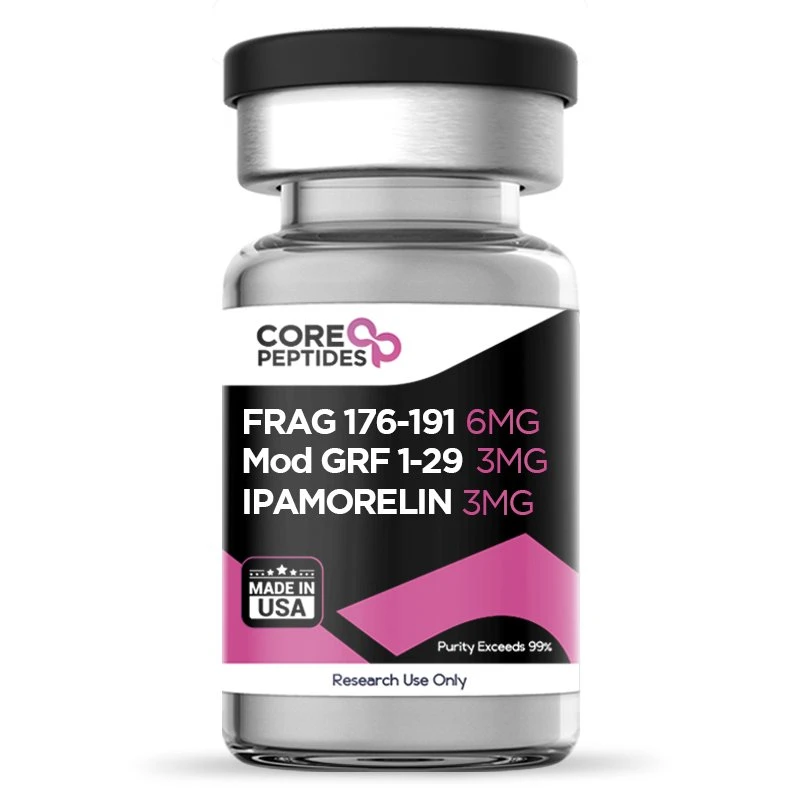

Fragment 176-191 & Mod GRF 1-29 & Ipamorelin Blend (12mg) – Research Peptide Blend
Fragment 176-191 & Mod GRF 1-29 & Ipamorelin Blend (12mg) is a multi-peptide research formulation combining three distinct compounds investigated in the fields of growth-hormone signalling, peptide pharmacology, metabolic biology and adipose-tissue research.
The formulation contains Fragment 176-191 (6mg), Mod GRF 1-29 (3mg), and Ipamorelin (3mg), providing a total of 12mg of peptide material. The referenced product is supplied as a lyophilised powder and is listed with a stated purity of >99%.
The three components have different molecular structures and research profiles, making the formulation relevant to laboratory studies examining interactions between metabolic and growth-hormone-related signalling pathways.
Fragment 176-191 is a growth-hormone-derived peptide fragment investigated primarily in relation to lipid metabolism and adipose-tissue biology. Mod GRF 1-29 is a modified analogue of growth hormone-releasing hormone (GHRH), while Ipamorelin is a synthetic growth-hormone secretagogue investigated for its effects on GH release through the growth-hormone secretagogue receptor pathway.
What Is the Fragment 176-191 & Mod GRF 1-29 & Ipamorelin Blend?
This 12mg research blend combines three peptides associated with complementary areas of scientific investigation:
- Fragment 176-191: A synthetic peptide derived from the C-terminal region of human growth hormone and studied in relation to lipid metabolism, adipose tissue and lipolytic pathways.
- Mod GRF 1-29: A modified, shortened analogue of growth hormone-releasing hormone that contains 29 amino acids and is investigated for its influence on growth-hormone signalling.
- Ipamorelin: A synthetic pentapeptide and growth-hormone secretagogue studied for its interaction with the growth-hormone secretagogue receptor.
Bringing these compounds together provides a research model that spans both growth-hormone-axis signalling and metabolic peptide research. Each component should nevertheless be evaluated independently because the three molecules have different structures, targets and mechanisms of action.
Fragment 176-191 & Mod GRF 1-29 & Ipamorelin Blend – Product Highlights
- Total peptide content: 12mg
- Fragment 176-191: 6mg
- Mod GRF 1-29: 3mg
- Ipamorelin: 3mg
- Form: Lyophilised powder
- Stated purity: >99%
- Product category: Research peptide blend
- Primary research areas: Growth-hormone signalling and metabolic biology
- Additional research areas: Adipose-tissue research, lipid metabolism, pituitary signalling and peptide pharmacology
- Intended application: Laboratory and scientific research
The composition, quantity, physical form and stated purity are based on the referenced supplier listing. Researchers should consult the applicable batch documentation and Certificate of Analysis for current analytical specifications.
12mg Blend Composition
| Component | Quantity | Research Focus |
|---|---|---|
| Fragment 176-191 | 6mg | Lipid metabolism and adipose-tissue biology |
| Mod GRF 1-29 | 3mg | GHRH-related and growth-hormone signalling |
| Ipamorelin | 3mg | Growth-hormone secretagogue research |
| Total | 12mg | Combined metabolic and GH-axis research |
Fragment 176-191 Research Profile
Fragment 176-191 is a short peptide derived from the C-terminal region of human growth hormone (hGH). Researchers have studied this region separately from the complete 191-amino-acid hormone to investigate whether specific metabolic properties can be associated with particular sections of the parent molecule.
Research involving Fragment 176-191 has focused particularly on lipolysis, lipid metabolism and adipose-tissue biology. Experimental studies have investigated its potential relationship with lipid mobilisation, fatty-acid utilisation and energy metabolism.
The supplier describes Fragment 176-191 as the component of this blend associated most closely with lipolytic research. Experimental studies in animal models have reported changes in body weight and body lipid levels, alongside observations concerning beta-3 adrenergic receptors and energy expenditure. These findings remain experimental and should not be interpreted as evidence of a clinically established effect in humans.
Mod GRF 1-29 Research Profile
Mod GRF 1-29 is a shortened and modified form of growth hormone-releasing hormone (GHRH). Unlike full-length GHRH, the peptide contains 29 amino acids and incorporates structural modifications intended to alter its stability and susceptibility to enzymatic degradation.
GHRH is an important regulator of growth-hormone secretion. It acts on receptors expressed by pituitary somatotroph cells, helping regulate the release of growth hormone.
Mod GRF 1-29 is therefore studied as a synthetic GHRH analogue in experimental investigations of the growth-hormone axis, peptide stability and receptor-mediated signalling.
The supplier identifies Mod GRF 1-29 with the alternative designation CJC-1295 without DAC. Researchers should distinguish this form from DAC-containing CJC-1295 formulations because the molecular characteristics and pharmacokinetic profiles are different.
Ipamorelin Research Profile
Ipamorelin is a synthetic pentapeptide classified as a growth-hormone secretagogue. Scientific research has examined its ability to stimulate GH release through a GHRP-like or growth-hormone secretagogue receptor pathway.
A published pharmacological study characterised Ipamorelin as a potent and selective GH secretagogue and demonstrated GH-releasing activity in laboratory and animal models. The study found that Ipamorelin stimulated GH release through a GHRP-like receptor mechanism.
These characteristics make Ipamorelin useful as an experimental tool for studying secretagogue-mediated regulation of growth-hormone release.
How the Three Peptides Differ
| Peptide | Classification | Primary Research Area |
|---|---|---|
| Fragment 176-191 | hGH-derived peptide fragment | Lipid metabolism and adipose tissue |
| Mod GRF 1-29 | Modified GHRH analogue | Growth-hormone-axis signalling |
| Ipamorelin | Growth-hormone secretagogue | GH release and secretagogue-receptor signalling |
The different research profiles of the three components are one reason this formulation is of interest for laboratory investigations examining multiple aspects of peptide-mediated endocrine signalling.
Mod GRF 1-29 and GHRH Signalling
Growth hormone-releasing hormone (GHRH) is a hypothalamic peptide involved in the physiological regulation of growth-hormone secretion.
GHRH binds to receptors on pituitary somatotroph cells and contributes to the release of growth hormone. Synthetic GHRH analogues such as Mod GRF 1-29 are studied to better understand this signalling pathway.
The shortened structure of Mod GRF 1-29 makes it particularly relevant to research examining the relationship between peptide structure, stability and receptor activity.
Because the formulation contains both Mod GRF 1-29 and Ipamorelin, it can also serve as an experimental model for investigating two different signalling routes involved in GH regulation.
Ipamorelin and Secretagogue Receptor Research
The growth-hormone secretagogue receptor (GHS-R) is a receptor associated with the regulation of growth-hormone release and is closely linked to the biological actions of ghrelin.
Ipamorelin has been investigated for its interaction with this receptor system. Early pharmacological research demonstrated GH-releasing activity in rat pituitary cells and animal models, supporting its classification as a growth-hormone secretagogue.
Research into Ipamorelin can therefore provide insight into how secretagogue signalling differs from GHRH-mediated signalling.
Why Combine Mod GRF 1-29 and Ipamorelin?
Mod GRF 1-29 and Ipamorelin represent two different classes of growth-hormone-regulating peptides.
Mod GRF 1-29 is associated with the GHRH pathway, whereas Ipamorelin is investigated through the growth-hormone secretagogue receptor pathway. Studying these pathways together can help researchers investigate how distinct signalling mechanisms influence pituitary GH release.
The inclusion of Fragment 176-191 adds a third research dimension centred on the metabolic properties associated with a specific region of growth hormone.
It is important, however, not to assume that combining the compounds necessarily produces a particular biological outcome. The exact interaction between the three components requires appropriate experimental investigation.
Fragment 176-191 & Mod GRF 1-29 & Ipamorelin Research Applications
The three-peptide formulation may be relevant to laboratory studies involving:
- Growth-hormone research: Investigation of mechanisms regulating GH secretion.
- GHRH signalling: Study of synthetic GHRH analogue activity.
- Secretagogue research: Investigation of GHS-R-mediated signalling.
- Pituitary biology: Study of somatotroph responses to peptide signals.
- Metabolic research: Investigation of relationships between endocrine signalling and metabolism.
- Adipose-tissue biology: Study of lipid storage and mobilisation.
- Lipolysis research: Investigation of triglyceride breakdown and fatty-acid mobilisation.
- Peptide pharmacology: Comparison of structurally different peptide classes.
- Structure-function studies: Investigation of how peptide modifications affect biological activity.
- GH-axis research: Examination of interactions between GHRH-related and secretagogue pathways.
Fragment 176-191 and Lipid Metabolism Research
One of the principal reasons for investigating Fragment 176-191 is its proposed relationship with lipid metabolism.
Experimental research has examined whether the peptide can influence processes associated with lipolysis and fat oxidation. Studies in experimental animals have reported reductions in body lipid levels and changes in pathways associated with adipose-tissue metabolism.
Some investigations have examined beta-3 adrenergic receptor pathways, while other findings have suggested that the observed metabolic effects may involve mechanisms beyond beta-adrenergic signalling alone.
These observations are useful for generating research hypotheses but do not establish a therapeutic effect in humans.
Growth-Hormone Axis Research
The growth-hormone axis involves a complex network of endocrine signals involving the hypothalamus, pituitary gland, growth hormone and downstream mediators such as insulin-like growth factor 1 (IGF-1).
GHRH is one of the principal stimulatory signals regulating GH release, while somatostatin provides inhibitory regulation. Secretagogue signalling provides another mechanism through which GH secretion can be influenced.
Mod GRF 1-29 and Ipamorelin are therefore useful research compounds for examining different parts of this regulatory system.
Fragment 176-191 provides an additional opportunity to investigate metabolic properties associated with a specific structural region of hGH.
Product Specifications
| Specification | Details |
|---|---|
| Product name | Fragment 176-191 & Mod GRF 1-29 & Ipamorelin Blend |
| Total quantity | 12mg |
| Fragment 176-191 | 6mg |
| Mod GRF 1-29 | 3mg |
| Ipamorelin | 3mg |
| Physical form | Lyophilised powder |
| Stated purity | >99% |
| Product type | Research peptide blend |
| Research areas | GH-axis, peptide pharmacology and metabolic research |
| Intended use | Laboratory research only |
The product specifications above reflect the referenced supplier listing. :contentReference[oaicite:8]{index=8}
Chemical Information
| Component | Molecular Formula | Molecular Weight |
|---|---|---|
| Fragment 176-191 | C78H125N23O23S2 | 1817.12 g/mol |
| Mod GRF 1-29 | C152H252N44O42 | 3367.9 g/mol |
| Ipamorelin | C38H49N9O5 | 711.8 g/mol |
The molecular information corresponds to the supplier’s published product information. Researchers should verify molecular identity, purity and other analytical parameters against the documentation supplied for the relevant batch.
Fragment 176-191, Mod GRF 1-29 and Ipamorelin: Research Distinctions
Although all three compounds are associated with growth-hormone research, they should not be treated as interchangeable.
- Fragment 176-191 is a structural fragment of hGH investigated largely for metabolic and adipose-tissue effects.
- Mod GRF 1-29 is a synthetic GHRH analogue investigated primarily for GH-axis signalling.
- Ipamorelin is a secretagogue investigated for its interaction with the GHS-R pathway and stimulation of GH release.
These distinctions are important when interpreting scientific literature because evidence for one component does not automatically validate the activity or safety of another component.
Mod GRF 1-29 vs CJC-1295 DAC
The terminology surrounding CJC-1295 can sometimes cause confusion in research literature and product catalogues.
Mod GRF 1-29 is commonly associated with the designation CJC-1295 without DAC. It should be distinguished from CJC-1295 containing the Drug Affinity Complex (DAC).
The two forms have different structural and pharmacokinetic characteristics. Consequently, research involving DAC-containing CJC-1295 should not automatically be used to describe the behaviour of Mod GRF 1-29.
The product discussed on this page specifically identifies its GHRH analogue as Mod GRF 1-29.
Quality and Purity Considerations
The referenced product listing states a purity of >99%. For scientific work, researchers should consider purity alongside other quality parameters rather than using purity as the sole indicator of suitability.
Important analytical considerations can include:
- Peptide identity.
- Sequence confirmation.
- Molecular mass.
- Individual component purity.
- Potential degradation products.
- Aggregation.
- Residual synthesis-related impurities.
- Batch-to-batch consistency.
Analytical methods such as reverse-phase HPLC and mass spectrometry can be used to assess peptide purity and identity. Researchers should refer to the relevant Certificate of Analysis for batch-specific information.
Research Considerations for Multi-Peptide Blends
Research involving multi-component peptide formulations requires additional controls compared with studies of individual compounds.
Researchers may need to consider whether an observed response is attributable to one component, multiple components, or an interaction between them.
Appropriate experimental design can include separate controls for each constituent, comparison with the complete blend and measurement of relevant biomarkers or signalling endpoints.
Because the three peptides have different biological targets, results should be interpreted according to the specific experimental model and endpoint being evaluated.
Frequently Asked Questions
What is Fragment 176-191 & Mod GRF 1-29 & Ipamorelin Blend?
It is a research peptide formulation containing Fragment 176-191, Mod GRF 1-29 and Ipamorelin. The referenced product contains 12mg of total peptide material.
What does the 12mg blend contain?
The formulation contains 6mg Fragment 176-191, 3mg Mod GRF 1-29 and 3mg Ipamorelin.
What is Fragment 176-191?
Fragment 176-191 is a synthetic peptide derived from the C-terminal region of human growth hormone and is investigated primarily in relation to lipid metabolism and adipose-tissue biology.
What is Mod GRF 1-29?
Mod GRF 1-29 is a shortened, modified analogue of growth hormone-releasing hormone. It is studied for its relationship with GHRH-mediated growth-hormone signalling.
What is Ipamorelin?
Ipamorelin is a synthetic pentapeptide and growth-hormone secretagogue. Research has demonstrated its ability to stimulate GH release through a GHRP-like receptor pathway in experimental models.
Are Mod GRF 1-29 and CJC-1295 the same?
Mod GRF 1-29 is commonly referred to as CJC-1295 without DAC in research and commercial contexts. However, researchers should verify the exact molecular designation because CJC-1295 with DAC represents a different formulation.
Is Fragment 176-191 the same as full-length growth hormone?
No. Fragment 176-191 represents only a small region of the full human growth hormone molecule and should not be considered equivalent to the complete hormone.
Why are these three peptides combined?
The formulation brings together peptides investigated in different areas of growth-hormone and metabolic research. Fragment 176-191 is associated with metabolic research, while Mod GRF 1-29 and Ipamorelin are investigated in relation to GH-axis signalling.
What form is the product supplied in?
The referenced product is supplied as a lyophilised powder. :contentReference[oaicite:13]{index=13}
What purity does the product have?
The supplier lists the product with a stated purity of >99%. Researchers should verify the relevant batch using the applicable analytical documentation.
Is the 12mg specification a recommended dose?
No. The 12mg figure describes the total quantity of peptide material contained in the product. It should not be interpreted as a recommended human dose or administration instruction.
Is this peptide blend an approved medicine?
The referenced product is presented as a research material and should not be represented as an approved medicine or established treatment.
Research Summary
Fragment 176-191 & Mod GRF 1-29 & Ipamorelin Blend (12mg) combines three distinct research peptides within a single formulation: Fragment 176-191 (6mg), Mod GRF 1-29 (3mg), and Ipamorelin (3mg).
Fragment 176-191 is studied primarily in relation to lipid metabolism and adipose-tissue biology. Mod GRF 1-29 is a modified GHRH analogue investigated in growth-hormone-axis research, while Ipamorelin is a growth-hormone secretagogue with published experimental evidence of GH-releasing activity.
The combination therefore provides a research model spanning metabolic peptide biology, GHRH signalling and secretagogue-mediated GH release. However, research on the individual compounds should not be interpreted as evidence establishing the efficacy or safety of the exact three-peptide blend.
Researchers should evaluate the formulation using appropriate laboratory controls, validated analytical methods and batch-specific documentation.
Research-Use Disclaimer
Fragment 176-191 & Mod GRF 1-29 & Ipamorelin Blend (12mg) is intended strictly for laboratory and scientific research purposes. It is not a medicine, dietary supplement, food product or approved therapeutic treatment.
The information presented on this page is provided for scientific and educational purposes and does not constitute medical advice. It should not be interpreted as evidence that the product can diagnose, treat, cure or prevent any disease or medical condition.
Evidence from cell studies, animal models or research involving individual components should not automatically be extrapolated to humans or to the complete three-peptide formulation.
This content does not provide instructions for human administration, dosing, injection, reconstitution for human use or self-experimentation. Researchers should follow appropriate laboratory procedures, supplier documentation, institutional requirements and all applicable laws and regulations when handling research materials.
Be the first to review “Fragment 176-191 & Mod GRF 1-29 & Ipamorelin Blend (12mg)”
Related products
Peptides for Sale
Peptides for Sale
Peptides for Sale
Peptides for Sale
Peptides for Sale
Peptides for Sale
Peptides for Sale
Peptides for Sale
Reviews
There are no reviews yet.