
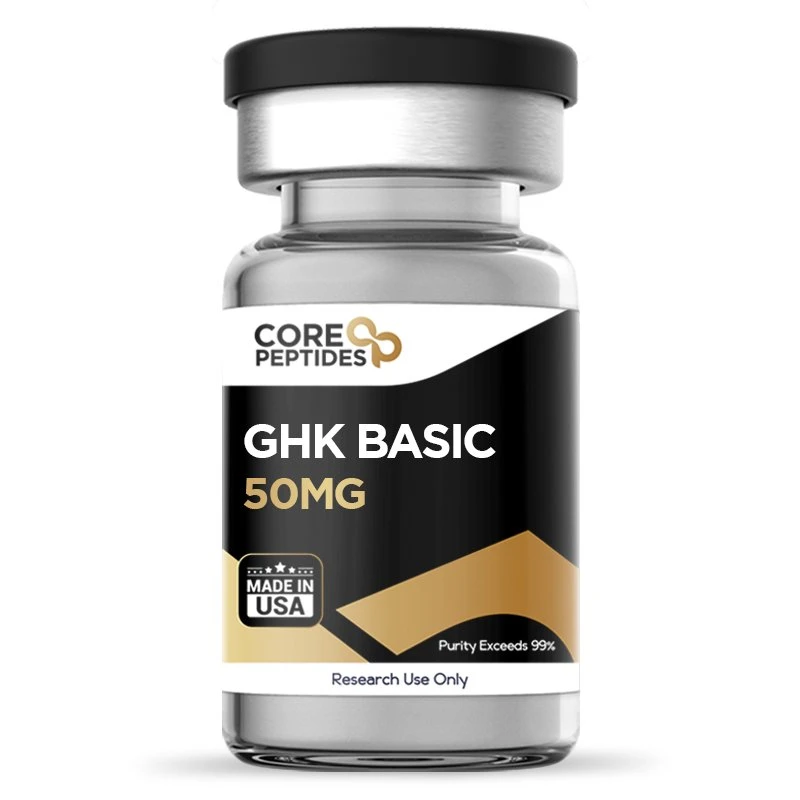
GHK Basic (50mg) – Research Peptide
GHK Basic (50mg) is a research-grade preparation of glycyl-L-histidyl-L-lysine, commonly abbreviated as GHK. GHK is a naturally occurring tripeptide that has been studied extensively for its biological interactions, particularly its relationship with copper ions, cellular signalling, tissue biology and extracellular-matrix processes.
Unlike GHK-Cu, which refers specifically to the copper-complexed form of the peptide, GHK Basic represents the copper-free peptide. This distinction is important for researchers because the biological behaviour of GHK and GHK-Cu can differ depending on the experimental environment and concentration.
The referenced product is supplied as a 50mg research peptide. It is intended for laboratory and scientific research rather than human therapeutic use.
What Is GHK Basic?
GHK Basic is the copper-free form of glycyl-L-histidyl-L-lysine, a naturally occurring tripeptide consisting of the amino acids glycine, histidine and lysine.
GHK has attracted scientific interest because it can interact strongly with copper ions. Research has established that GHK occurs naturally in human plasma and can form complexes with transition metals, particularly copper(II).
The peptide has been investigated in several areas of biological research, including cellular growth, skin biology, tissue remodelling, extracellular-matrix processes and copper-binding chemistry.
Because GHK can exist independently or as part of a copper complex, researchers should clearly distinguish GHK Basic from GHK-Cu when designing experiments or interpreting published research.
GHK Basic (50mg) – Product Highlights
- Product: GHK Basic
- Quantity: 50mg
- Peptide: Gly-His-Lys (GHK)
- Classification: Naturally occurring tripeptide
- Research focus: Peptide biology, copper-binding research and cellular studies
- Additional research areas: Skin biology, extracellular-matrix research and tissue biology
- Form: Research peptide preparation
- Intended use: Laboratory and scientific research
Researchers should consult the current supplier documentation and batch-specific Certificate of Analysis for detailed analytical specifications.
GHK Chemical Structure and Composition
GHK stands for glycyl-histidyl-lysine, reflecting the sequence of its three constituent amino acids:
| Position | Amino Acid | Three-Letter Code |
|---|---|---|
| 1 | Glycine | Gly |
| 2 | Histidine | His |
| 3 | Lysine | Lys |
The short sequence gives GHK a relatively simple molecular structure while allowing it to participate in metal-binding interactions. Research using spectroscopy and computational approaches has investigated the coordination chemistry between GHK and copper(II) ions.
GHK Basic vs GHK-Cu
One of the most important distinctions when researching GHK is the difference between the free peptide and its copper complex.
| Characteristic | GHK Basic | GHK-Cu |
|---|---|---|
| Peptide | Gly-His-Lys | Gly-His-Lys complexed with copper |
| Copper | Not intentionally supplied as a copper complex | Contains coordinated copper |
| Research focus | Peptide biology and metal-binding behaviour | Wound, extracellular-matrix and copper-complex research |
| Research consideration | Can interact with available metal ions | Already exists as a copper-peptide complex |
GHK is naturally capable of binding copper, and research has characterised the structure and coordination chemistry of Cu(II)-GHK complexes.
Consequently, findings obtained with GHK-Cu should not automatically be attributed to copper-free GHK Basic. Experimental conditions, copper availability and peptide concentration can all influence observed biological behaviour.
GHK and Copper-Binding Research
GHK is particularly interesting from a biochemical perspective because of its strong affinity for copper ions.
Early research identified GHK as a naturally occurring plasma constituent capable of associating with copper and iron. The work suggested that some of the biological activity attributed to the peptide may involve peptide-metal complexes.
Subsequent structural research examined Cu(II)-GHK using techniques including nuclear magnetic resonance spectroscopy, electron paramagnetic resonance and X-ray methods. These investigations provided detailed information about the coordination environment formed between copper and the peptide.
This makes GHK Basic a useful research material for investigations involving peptide-metal interactions, copper coordination chemistry and related biochemical processes.
GHK in Cellular and Tissue Research
Research into GHK has extended beyond metal-binding chemistry. The peptide and its copper complex have been studied in cell culture and experimental tissue models.
Research involving copper-GHK complexes has investigated processes including extracellular-matrix synthesis, fibroblast activity, glycosaminoglycan production and tissue remodelling.
Importantly, these studies often involve GHK-Cu rather than copper-free GHK. Researchers should therefore examine the precise compound used in each study before applying findings to GHK Basic.
GHK Basic and Skin Biology Research
GHK has generated significant interest in skin and dermatological research because both the free peptide and copper-associated forms have been investigated in cellular models.
Experimental research has examined GHK in relation to keratinocytes, fibroblasts, extracellular-matrix components and cellular signalling. One study specifically investigated copper-free GHK in cultured human keratinocytes and skin-equivalent models, reporting changes in cellular proliferation and markers associated with basal skin cells.
These findings make GHK Basic relevant to laboratory research involving skin-cell biology, peptide signalling and tissue-model systems.
However, laboratory findings should not be interpreted as evidence that a research-grade GHK product is an approved cosmetic or therapeutic treatment.
GHK and Extracellular-Matrix Research
The extracellular matrix provides structural support to tissues and participates in signalling between cells and their surrounding environment.
GHK-related research has investigated several extracellular-matrix components, including glycosaminoglycans, proteoglycans and collagen-associated processes.
For example, experimental research involving GHK-Cu reported stimulation of glycosaminoglycan synthesis in cultured human fibroblasts. The observed effects included changes in dermatan sulfate and heparan sulfate production.
Additional research in experimental wound models investigated changes in collagen and glycosaminoglycan production following exposure to the copper-peptide complex.
These studies provide a basis for continued investigation into peptide-mediated extracellular-matrix regulation.
GHK and Fibroblast Research
Fibroblasts are connective-tissue cells that play important roles in extracellular-matrix production and tissue remodelling.
GHK-related experimental research has examined fibroblast responses, including the production of extracellular-matrix molecules and enzymes involved in matrix remodelling.
Studies of GHK-Cu have reported effects on matrix metalloproteinase-2 and tissue inhibitors of metalloproteinases in cultured dermal fibroblasts.
These findings illustrate why GHK-related compounds continue to attract interest in cell biology, tissue engineering and extracellular-matrix research.
GHK Basic Research Applications
GHK Basic may be of interest to researchers investigating:
- Peptide chemistry: Study of short biological peptides.
- Copper-binding chemistry: Investigation of peptide-metal interactions.
- Cell biology: Evaluation of cellular responses to GHK.
- Skin biology: Research involving keratinocytes and skin-equivalent models.
- Fibroblast research: Investigation of connective-tissue cell behaviour.
- Extracellular-matrix biology: Study of matrix proteins and proteoglycans.
- Tissue research: Investigation of processes associated with tissue repair and remodelling.
- Peptide-metal complexes: Structural and biochemical characterisation of GHK interactions with copper.
- Structure-function studies: Examination of relationships between peptide structure and biological activity.
- Cosmetic science research: Laboratory investigation of peptides used in skin-care research.
Why Study Copper-Free GHK?
Studying copper-free GHK separately from GHK-Cu allows researchers to examine the behaviour of the peptide without intentionally introducing a preformed copper complex.
This can be useful when investigating:
- GHK’s intrinsic biological activity.
- Copper-binding affinity.
- Formation of GHK-metal complexes.
- Changes in peptide behaviour in the presence of copper.
- Differences between free GHK and GHK-Cu.
- Concentration-dependent cellular responses.
- Interactions between GHK and biological macromolecules.
The distinction can be particularly important in controlled laboratory experiments where copper concentration is independently regulated.
GHK and Copper Coordination
The ability of GHK to bind copper is a central feature of its biochemical profile.
Structural research has examined Cu(II)-GHK complexes and found stable coordination involving nitrogen and oxygen donor atoms from the peptide. Experimental spectroscopy and computational studies have provided additional insight into the geometry and stability of these complexes.
This chemistry provides researchers with an opportunity to investigate how short peptides can influence the availability, transport and coordination environment of metal ions.
GHK Basic and Oxidative-Stress Research
GHK and GHK-Cu have also been investigated in the context of oxidative stress and cellular protection.
A review of GHK-related research discussed potential antioxidant and anti-inflammatory properties and examined the peptide’s broader biological interactions.
However, review articles can incorporate evidence from multiple experimental systems, and findings involving GHK-Cu should not automatically be interpreted as evidence for copper-free GHK Basic.
Additional controlled studies are therefore important when determining the biological activity of a particular GHK formulation.
GHK Basic and Peptide Stability
Like many short peptides, GHK can be subject to enzymatic degradation under biological conditions.
Recent research has investigated modified GHK-containing peptide structures designed to improve resistance to proteolytic cleavage. Such work highlights an important consideration for peptide research: sequence identity alone does not determine stability.
Experimental conditions, formulation, temperature, pH and exposure to proteolytic enzymes can all influence peptide stability.
Researchers should therefore follow appropriate storage and handling information supplied for the specific research material and verify stability under their own experimental conditions.
GHK Basic Product Specifications
| Specification | Details |
|---|---|
| Product name | GHK Basic |
| Quantity | 50mg |
| Peptide sequence | Gly-His-Lys |
| Abbreviation | GHK |
| Classification | Tripeptide |
| Copper status | Copper-free peptide formulation |
| Research areas | Peptide chemistry, copper binding, cellular and tissue research |
| Product type | Research material |
| Intended use | Laboratory and scientific research |
GHK Basic vs Other Peptide Materials
| Material | Primary Research Characteristic |
|---|---|
| GHK Basic | Copper-free Gly-His-Lys tripeptide |
| GHK-Cu | GHK complexed with copper(II) |
| GHK-containing modified peptides | Modified structures designed for specific experimental properties |
These materials should not be treated as interchangeable. Their chemical structures, copper status, stability and experimental behaviour can differ significantly.
Analytical and Quality Considerations
For laboratory applications, researchers should evaluate peptide quality using appropriate analytical documentation rather than relying solely on product naming or appearance.
Relevant quality parameters may include:
- Peptide identity.
- Sequence confirmation.
- Purity.
- Molecular mass.
- Residual solvents or synthesis-related impurities.
- Water or moisture content.
- Potential degradation products.
- Batch-to-batch consistency.
Analytical methods such as HPLC and mass spectrometry are commonly used for peptide characterisation. Researchers should consult the current Certificate of Analysis for the specific batch being studied.
Important Considerations When Researching GHK
GHK is a well-studied biological tripeptide, but the scientific literature covers several different forms and experimental contexts.
Researchers should pay particular attention to:
- Whether a study used free GHK or GHK-Cu.
- The concentration used in the experimental system.
- Whether the research involved cells, animals or human subjects.
- The presence and concentration of copper ions.
- The formulation and purity of the peptide.
- The biological endpoint being measured.
This distinction helps prevent results obtained with GHK-Cu or modified GHK derivatives from being incorrectly attributed to GHK Basic.
Frequently Asked Questions
What is GHK Basic?
GHK Basic is the copper-free form of the naturally occurring tripeptide glycyl-L-histidyl-L-lysine, abbreviated as GHK.
What does GHK stand for?
GHK stands for glycine-histidine-lysine, the three amino acids that make up the tripeptide.
What is the difference between GHK Basic and GHK-Cu?
GHK Basic refers to the free peptide, whereas GHK-Cu refers to GHK complexed with copper(II). This chemical difference is important when interpreting research findings.
Does GHK naturally occur in the human body?
Yes. GHK has been identified as a naturally occurring tripeptide in human plasma and has been investigated for its ability to interact with metal ions, particularly copper.
Why is GHK interesting for copper research?
GHK has a strong affinity for copper ions and can form stable copper-peptide complexes. Researchers have characterised these interactions using several spectroscopic and computational techniques.
What areas of research involve GHK?
Research areas include peptide chemistry, copper coordination, cellular biology, skin biology, fibroblast research, extracellular-matrix biology and tissue remodelling.
Has GHK been studied in skin cells?
Yes. Experimental studies have investigated copper-free GHK in cultured human keratinocytes and skin-equivalent models, including effects on cellular proliferation and basal-cell markers.
Has GHK been studied with fibroblasts?
Yes. GHK and particularly GHK-Cu have been investigated in fibroblast models, including research into extracellular-matrix production and matrix-remodelling processes.
Is GHK Basic the same as GHK-Cu?
No. GHK Basic is the copper-free peptide, while GHK-Cu is a copper-peptide complex. Research findings for one should not automatically be applied to the other.
What is the quantity of this product?
The referenced product is supplied as a 50mg research peptide preparation.
Is GHK Basic a medicine?
No. The material described here is presented as a research product and should not be represented as an approved medicine or therapeutic treatment.
Can research findings be used to establish human health benefits?
No. Results from biochemical, cellular or animal studies do not automatically establish safety, efficacy or clinical benefits in humans.
Research Summary
GHK Basic (50mg) provides researchers with the copper-free form of glycyl-L-histidyl-lysine, a naturally occurring tripeptide with a well-established history of scientific investigation.
GHK is particularly notable for its ability to interact with copper ions. Research has investigated its coordination chemistry, cellular activity and relationship with processes involving skin cells, fibroblasts and extracellular-matrix biology.
The copper-free form is especially useful when researchers want to investigate GHK independently from a preformed copper complex. This allows experimental systems to control copper availability and examine how GHK behaves under different biochemical conditions.
Research involving GHK-Cu has reported effects in experimental models involving glycosaminoglycan synthesis, extracellular-matrix remodelling and wound-related processes, but these findings should not automatically be attributed to GHK Basic.
For accurate interpretation, researchers should distinguish between GHK, GHK-Cu and modified GHK derivatives, while considering the experimental model, concentration, formulation and analytical characteristics of the material under investigation.
Research-Use Disclaimer
GHK Basic (50mg) is intended strictly for laboratory and scientific research purposes. It is not a medicine, dietary supplement, food product or approved therapeutic treatment.
The information presented on this page is provided for scientific and educational purposes only and does not constitute medical advice. It should not be interpreted as evidence that GHK Basic can diagnose, treat, cure or prevent any disease or medical condition.
Research findings from biochemical experiments, cell cultures or animal models should not automatically be extrapolated to human outcomes. Researchers should evaluate the relevant scientific literature and batch-specific analytical documentation when designing experiments.
This content does not provide instructions for human administration, dosing, injection, reconstitution for human use or self-experimentation. Researchers should follow appropriate laboratory protocols, institutional requirements, supplier documentation and all applicable laws and regulations when handling research peptide materials.
Be the first to review “GHK Basic (50mg)”
Related products
Peptides for Sale
Peptides for Sale
Peptides for Sale
Peptides for Sale
Peptides for Sale
Peptides for Sale
Peptides for Sale
Peptides for Sale
Reviews
There are no reviews yet.