
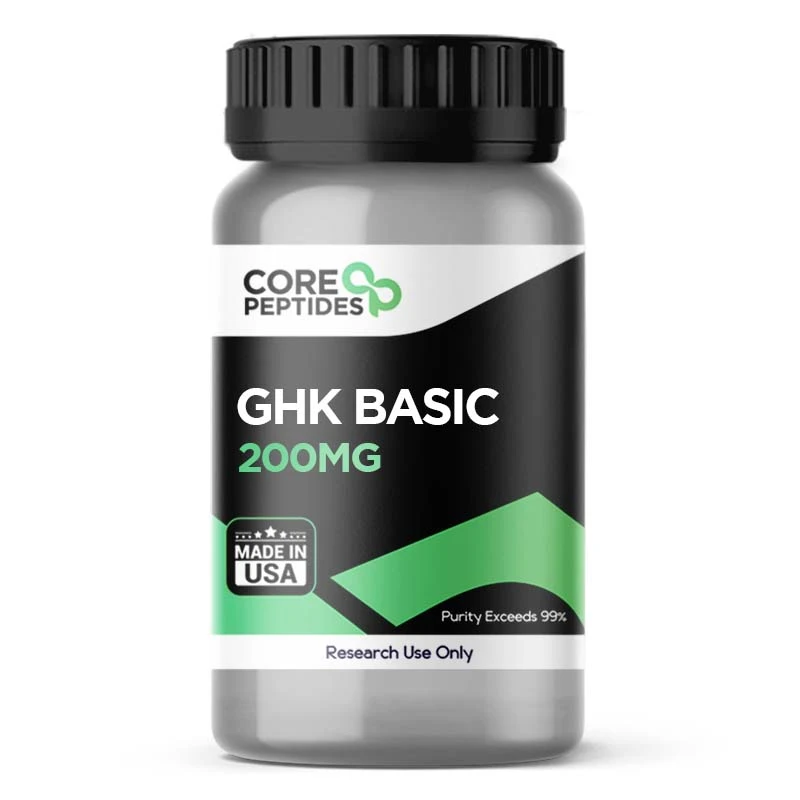
GHK Basic (Tripeptide-1) (200mg) – Research Peptide
GHK Basic (Tripeptide-1) (200mg) is a research-grade preparation of glycyl-histidyl-lysine (GHK), a naturally occurring tripeptide consisting of the amino acids glycine, histidine and lysine.
GHK has been investigated extensively for its biochemical properties, particularly its ability to interact with copper ions and its involvement in cellular and extracellular-matrix research.
The referenced product contains 200mg of GHK Basic (Tripeptide-1) and is supplied as a lyophilised powder with a stated purity of >99%. The supplier identifies the material as GHK Basic rather than the pre-formed copper complex GHK-Cu.
GHK is of particular interest in laboratory research because it can bind copper and form a GHK-Cu complex. Scientific studies have investigated this interaction alongside research into peptide chemistry, cellular signalling, tissue biology, extracellular-matrix processes and copper coordination.
What Is GHK Basic (Tripeptide-1)?
GHK Basic, also known as Tripeptide-1, is the copper-free form of glycyl-histidyl-lysine. It is a short biological peptide containing three amino acids:
- Glycine (Gly)
- Histidine (His)
- Lysine (Lys)
GHK occurs naturally in biological fluids and tissues and has been investigated as a biologically active peptide with a strong affinity for copper. Research has demonstrated that GHK can bind copper ions to form a GHK-Cu complex with a 1:1 peptide-to-copper relationship under studied conditions.
The ability to study GHK separately from copper-complexed GHK makes the basic peptide useful for controlled laboratory experiments where researchers wish to examine copper binding, peptide-metal interactions or the biological properties of the free peptide.
GHK Basic (Tripeptide-1) 200mg – Product Highlights
- Product name: GHK Basic (Tripeptide-1)
- Quantity: 200mg
- Peptide: Gly-His-Lys (GHK)
- Alternative name: Tripeptide-1
- Form: Lyophilised powder
- Stated purity: >99%
- Product category: Research peptide
- Research areas: Peptide chemistry, copper-binding studies, cellular biology and tissue research
- Intended use: Laboratory and scientific research
The quantity, physical form and stated purity are based on the referenced product listing. Researchers should review the relevant batch-specific Certificate of Analysis for current analytical information.
GHK Basic Composition
| Component | Description |
|---|---|
| Glycine | First amino acid in the GHK sequence |
| Histidine | Second amino acid and an important contributor to copper coordination |
| Lysine | Third amino acid in the peptide sequence |
| Complete peptide | Gly-His-Lys (GHK) |
GHK’s short three-amino-acid sequence gives it distinctive chemical properties while allowing it to participate in metal-binding interactions.
GHK Basic vs GHK-Cu
GHK Basic and GHK-Cu are closely related but should not be treated as identical research materials.
| Characteristic | GHK Basic | GHK-Cu |
|---|---|---|
| Peptide | Gly-His-Lys | Gly-His-Lys coordinated with copper |
| Copper | Not supplied as a pre-formed copper complex | Contains coordinated Cu(II) |
| Primary research interest | Free peptide and copper-binding behaviour | Copper-peptide biological and biochemical activity |
| Experimental consideration | Copper availability can be independently controlled | Copper is incorporated into the research material |
Scientific literature has examined both GHK and GHK-Cu. Researchers should therefore verify which form was used in a particular experiment before applying published findings to a different preparation.
GHK and Copper-Binding Research
One of the most extensively investigated characteristics of GHK is its ability to bind copper.
Research published in the Biochemical Journal investigated the interaction between Cu(II) and glycyl-L-histidyl-L-lysine using potentiometric titration and visible-absorption spectrophotometry. The study characterised the formation of copper-GHK complexes under controlled experimental conditions.
More recent experimental work using recombinant GHK tripeptides also demonstrated the formation of GHK-Cu complexes, with the researchers reporting a 1:1 GHK-to-copper relationship and Cu(II) coordination.
This copper-binding property makes GHK Basic particularly relevant to research involving peptide-metal coordination chemistry.
Tripeptide-1 and Peptide Chemistry
Tripeptide-1 is the INCI-style name commonly associated with the GHK sequence in cosmetic and biochemical contexts. From a structural perspective, it is a very short peptide composed of three amino acids.
Despite its small size, GHK has attracted considerable scientific attention because its histidine and peptide backbone participate in metal-ion coordination.
Researchers can use GHK Basic to examine how a short peptide interacts with copper and how metal binding influences molecular structure, stability and biochemical behaviour.
GHK Basic and Cellular Research
GHK-related compounds have been studied in numerous experimental systems involving cellular growth, tissue biology and extracellular-matrix processes.
Research involving GHK and GHK-Cu has included studies of fibroblasts, keratinocytes and other cellular models. However, it is important to distinguish the free peptide from the copper-complexed form when evaluating these studies.
For example, research on GHK-Cu has examined its influence on glycosaminoglycan synthesis in cultured human fibroblasts, including effects on dermatan sulfate and heparan sulfate production.
Such findings provide useful background for GHK research but should not be interpreted as evidence that GHK Basic produces identical effects under all experimental conditions.
GHK and Extracellular-Matrix Research
The extracellular matrix is a complex network of proteins and other molecules surrounding cells. It plays important roles in tissue structure, cell communication and remodelling.
GHK-related research has examined extracellular-matrix components including glycosaminoglycans and other matrix-associated molecules. In particular, GHK-Cu has been investigated in cultured fibroblasts for its effects on glycosaminoglycan synthesis.
This research contributes to broader scientific interest in GHK peptides and their potential roles in cellular and tissue biology.
GHK Basic and Skin Biology Research
GHK has also been investigated in experimental skin models. Research involving GHK-related compounds has examined cellular processes associated with fibroblasts, keratinocytes, extracellular-matrix components and tissue remodelling.
The copper-associated form has received particular attention in dermatological research, including studies examining copper-peptide penetration and biological activity. Research has also investigated the transport of GHK-Cu through different skin layers in vitro. :contentReference[oaicite:8]{index=8}
These studies are relevant to laboratory investigations of peptide chemistry and skin biology but do not establish that a research-grade GHK Basic preparation is a cosmetic or therapeutic treatment.
GHK Basic and Fibroblast Research
Fibroblasts are connective-tissue cells involved in extracellular-matrix production and tissue remodelling.
GHK-related research has investigated fibroblast activity and the production of extracellular-matrix molecules. Studies involving GHK-Cu have reported changes in glycosaminoglycan synthesis in cultured human fibroblasts.
Researchers interested in this area should carefully distinguish between experiments performed using GHK Basic and those using GHK-Cu, as copper complexation can alter the chemical and biological characteristics of the peptide.
GHK Basic Research Applications
GHK Basic (Tripeptide-1) may be relevant to laboratory research involving:
- Peptide chemistry: Characterisation of short biological peptides.
- Copper coordination: Investigation of GHK-Cu formation and copper binding.
- Metal-peptide interactions: Study of peptide interactions with transition-metal ions.
- Cell biology: Investigation of cellular responses to GHK.
- Skin biology: Research involving skin-cell and tissue models.
- Fibroblast research: Investigation of connective-tissue cell behaviour.
- Extracellular-matrix research: Study of matrix-associated biological processes.
- Structure-function research: Examination of relationships between peptide structure and biological activity.
- Cosmetic science: Laboratory investigation of peptide ingredients used in cosmetic research.
- Biochemical research: Study of peptide stability and metal-binding properties.
Why Researchers Study GHK Basic
The copper-free form of GHK provides a useful starting material for experiments where researchers want to control copper availability independently.
Potential research questions include:
- How strongly does GHK bind Cu(II) under specific experimental conditions?
- How does copper binding alter GHK’s molecular structure?
- How does free GHK behave compared with pre-formed GHK-Cu?
- How does copper concentration affect GHK complex formation?
- How stable is GHK under different experimental conditions?
- How does GHK interact with biological macromolecules?
- What cellular responses are associated specifically with free GHK?
These questions can be investigated using appropriate biochemical, analytical and cellular research methods.
GHK-Cu Formation and Copper Coordination
GHK Basic is capable of forming complexes with copper when copper ions are available in the experimental environment.
Studies have investigated the structural characteristics of Cu(II)-GHK complexes using spectroscopic and other analytical techniques. Research has demonstrated that the peptide can coordinate Cu(II), with histidine playing an important role in the interaction.
This means that the distinction between “GHK Basic” and “GHK-Cu” is not simply a naming difference. The presence of coordinated copper represents a meaningful chemical difference that should be accounted for in experimental design.
GHK Basic and GHK-Cu Research Distinctions
Published research often focuses specifically on GHK-Cu. Researchers should therefore avoid transferring conclusions from copper-complex studies directly to copper-free GHK without considering the experimental context.
Important variables include:
- Copper concentration.
- Peptide concentration.
- pH.
- Temperature.
- Buffer composition.
- Presence of competing metal ions.
- Cell type or experimental model.
- Duration of exposure.
Controlling these variables can help researchers establish whether an observed effect is associated with GHK itself, copper complexation or a combination of both.
GHK Basic Product Specifications
| Specification | Details |
|---|---|
| Product | GHK Basic (Tripeptide-1) |
| Quantity | 200mg |
| Sequence | Gly-His-Lys |
| Common abbreviation | GHK |
| Alternative name | Tripeptide-1 |
| Physical form | Lyophilised powder |
| Stated purity | >99% |
| Product type | Research peptide |
| Primary research areas | Peptide chemistry and copper-binding research |
| Additional areas | Cellular, skin and extracellular-matrix research |
| Intended use | Laboratory and scientific research |
The supplier lists the product as a 200mg lyophilised powder with stated purity above 99%.
GHK Basic Chemical Research
Short peptides such as GHK are useful models for studying the relationship between amino-acid sequence and molecular behaviour.
GHK contains histidine, an amino acid with a chemically important imidazole side chain. This contributes to the peptide’s ability to participate in metal-ion coordination.
Research into GHK-Cu has examined the coordination chemistry of copper with the peptide using techniques such as spectroscopy. These studies help explain how a small tripeptide can produce a defined metal-peptide complex.
Analytical Quality and Purity
The referenced product is listed with a stated purity of >99%. For laboratory applications, purity should be considered alongside peptide identity, molecular mass and other analytical characteristics.
Researchers may consider evaluating:
- Peptide identity.
- Sequence integrity.
- Purity.
- Molecular mass.
- Water or moisture content.
- Residual synthesis-related impurities.
- Potential degradation products.
- Batch-to-batch consistency.
Common analytical approaches for peptide characterisation include HPLC and mass spectrometry. Researchers should use the current Certificate of Analysis supplied for the specific batch where available.
GHK Basic Storage and Handling Considerations
Peptides are sensitive research materials whose stability can depend on environmental conditions. Factors such as temperature, moisture, light exposure, pH and repeated handling can influence peptide integrity.
Because specific storage requirements can vary according to formulation and supplier specifications, researchers should follow the current product documentation and batch-specific instructions rather than relying on generic peptide-storage recommendations.
Laboratory personnel should also use appropriate procedures for handling lyophilised research materials and maintain suitable documentation throughout an experiment.
Frequently Asked Questions
What is GHK Basic (Tripeptide-1)?
GHK Basic is the copper-free form of glycyl-histidyl-lysine, a naturally occurring tripeptide consisting of glycine, histidine and lysine.
What does Tripeptide-1 mean?
Tripeptide-1 is a name used for the three-amino-acid peptide sequence Gly-His-Lys, commonly abbreviated as GHK.
What is the quantity of GHK Basic?
The referenced product contains 200mg of GHK Basic (Tripeptide-1).
What form is GHK Basic supplied in?
The product is listed as a lyophilised powder.
What purity is listed for GHK Basic?
The supplier lists a stated purity of >99%. Researchers should verify the applicable batch documentation for detailed analytical information. :contentReference[oaicite:16]{index=16}
Is GHK Basic the same as GHK-Cu?
No. GHK Basic refers to the free peptide, while GHK-Cu refers to GHK complexed with copper. The two materials have different chemical compositions and should be evaluated separately.
Can GHK bind copper?
Yes. Research has demonstrated that GHK can bind Cu(II) and form a GHK-Cu complex.
What is GHK researched for?
Research areas include peptide-metal interactions, copper coordination, cellular biology, skin biology, fibroblast research and extracellular-matrix processes.
Why is copper relevant to GHK research?
GHK has a strong affinity for copper ions. The interaction between GHK and Cu(II) has been investigated using biochemical and spectroscopic techniques.
Has GHK-Cu been studied in fibroblasts?
Yes. Experimental studies have investigated GHK-Cu and its effects on glycosaminoglycan synthesis in cultured human fibroblasts.
Is GHK Basic an approved medicine?
No. The material described here is presented as a research product and should not be represented as an approved medicine or therapeutic treatment.
Is the 200mg quantity a recommended human dose?
No. The 200mg figure describes the amount of research material contained in the product. It should not be interpreted as a recommended dose or human-use instruction.
Research Summary
GHK Basic (Tripeptide-1) (200mg) is a research preparation of glycyl-histidyl-lysine, a naturally occurring tripeptide with a long history of biochemical investigation.
The peptide’s most distinctive chemical property is its ability to interact with copper ions. Scientific research has characterised the formation of GHK-Cu complexes and investigated the underlying coordination chemistry.
GHK-related research also encompasses cellular biology, fibroblast activity, extracellular-matrix processes and skin research. Much of the literature in these areas concerns GHK-Cu rather than free GHK, making it essential for researchers to distinguish between the copper-free peptide and the copper-complexed form.
The referenced 200mg GHK Basic (Tripeptide-1) product is supplied as a lyophilised powder and is listed with a stated purity of >99%.
Research-Use Disclaimer
GHK Basic (Tripeptide-1) (200mg) is intended strictly for laboratory and scientific research purposes. It is not a medicine, dietary supplement, food product or approved therapeutic treatment.
The information presented on this page is provided for scientific and educational purposes only and does not constitute medical advice. It should not be interpreted as evidence that GHK Basic can diagnose, treat, cure or prevent any disease or medical condition.
Findings from biochemical experiments, cell cultures or animal studies should not automatically be extrapolated to human outcomes. Researchers should evaluate the relevant scientific literature and batch-specific analytical documentation when designing experiments.
This content does not provide instructions for human administration, dosing, injection, reconstitution for human use or self-experimentation. Researchers should follow appropriate laboratory protocols, institutional requirements, supplier documentation and all applicable laws and regulations when handling research peptide materials.
Be the first to review “GHK Basic (Tripeptide-1) (200mg)”
Related products
Peptides for Sale
Peptides for Sale
Peptides for Sale
Peptides for Sale
Peptides for Sale
Peptides for Sale
Peptides for Sale
Peptides for Sale
Reviews
There are no reviews yet.