
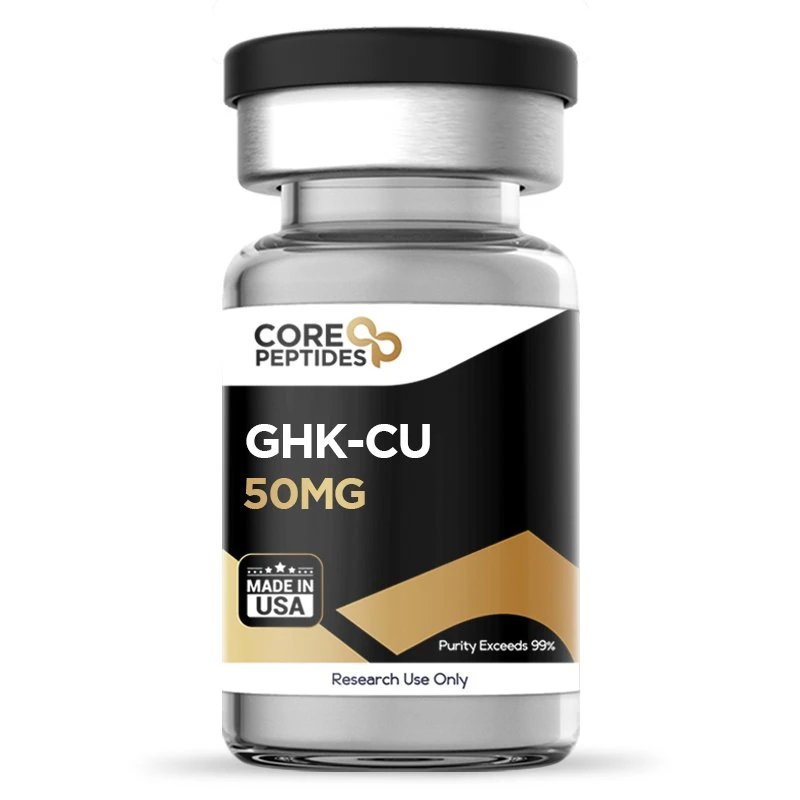
GHK-Cu (Copper) (50mg) – Copper Peptide Research Material
GHK-Cu (Copper) (50mg) is a research-grade copper peptide based on glycyl-L-histidyl-L-lysine (GHK) complexed with copper(II). Also known as a copper tripeptide, GHK-Cu has been extensively investigated in biochemical and laboratory research, particularly in areas involving copper coordination, peptide chemistry, fibroblast biology, extracellular-matrix processes and skin research.
GHK-Cu is chemically distinct from copper-free GHK Basic. While GHK Basic consists of the Gly-His-Lys peptide itself, GHK-Cu contains the peptide associated with copper. Scientific research has characterised this copper-peptide interaction using analytical methods including spectroscopy, potentiometry and calorimetry.
The referenced product contains 50mg of GHK-Cu (Copper) and is intended for laboratory and scientific research. It should not be represented as an approved medicine, dietary supplement or treatment for any medical condition.
What Is GHK-Cu (Copper)?
GHK-Cu is a copper complex of glycyl-L-histidyl-L-lysine, a naturally occurring tripeptide consisting of three amino acids:
- Glycine (Gly)
- Histidine (His)
- Lysine (Lys)
GHK has a strong affinity for copper and can form a copper-peptide complex generally referred to as GHK-Cu. Research has investigated the formation, structure, stability and biological properties of this complex for several decades.
Because copper is an integral part of the complex, GHK-Cu provides researchers with a defined system for investigating the interaction between a short biological peptide and a metal ion.
GHK-Cu (Copper) 50mg – Product Highlights
- Product name: GHK-Cu (Copper)
- Quantity: 50mg
- Peptide: Gly-His-Lys (GHK)
- Complex: GHK-Cu
- Common name: Copper peptide
- Research category: Peptide-metal complex
- Research areas: Copper coordination, peptide chemistry and cellular biology
- Additional research areas: Fibroblast, skin and extracellular-matrix research
- Intended use: Laboratory and scientific research
Researchers should consult the current product documentation and applicable batch-specific Certificate of Analysis for precise specifications, analytical results and storage information.
GHK-Cu Composition
| Component | Description |
|---|---|
| Glycine | First amino acid in the GHK peptide sequence |
| Histidine | Second amino acid and an important contributor to copper coordination |
| Lysine | Third amino acid in the peptide sequence |
| Copper | Metal ion associated with the GHK peptide |
| Complete complex | Gly-His-Lys-Cu(II) |
The copper component differentiates GHK-Cu from the uncomplexed GHK peptide and is central to its biochemical research profile.
GHK Basic vs GHK-Cu
GHK Basic and GHK-Cu share the same underlying peptide sequence but represent different research materials.
| Characteristic | GHK Basic | GHK-Cu |
|---|---|---|
| Peptide sequence | Gly-His-Lys | Gly-His-Lys |
| Copper | Free peptide | Complexed with copper(II) |
| Primary research interest | Free-peptide chemistry and copper-binding studies | Copper-peptide chemistry and biological research |
| Experimental approach | Copper may be introduced separately | Copper is already associated with the peptide |
This distinction is important when comparing scientific publications because biological studies using GHK-Cu cannot automatically be assumed to describe the behaviour of copper-free GHK.
GHK-Cu and Copper Coordination Research
One of the defining properties of GHK-Cu is the coordination of copper by the GHK peptide.
Research has investigated copper-GHK complexes using potentiometry, solution calorimetry, UV-visible spectroscopy, circular dichroism and electron paramagnetic resonance. These studies have examined the stoichiometry, stability and structural characteristics of copper complexes formed by GHK.
Earlier spectroscopic work also examined the interaction between Cu(II) and Gly-His-Lys and identified coordination behaviour involving nitrogen and oxygen atoms within the peptide under specific experimental conditions.
This makes GHK-Cu particularly relevant to research into metal-peptide coordination chemistry.
GHK-Cu and Peptide Chemistry
GHK-Cu provides a useful research model for studying how a short peptide interacts with a biologically relevant transition metal.
The three-amino-acid sequence of GHK is small, yet its interaction with copper produces a chemically distinct complex. Researchers can therefore investigate relationships between peptide sequence, metal coordination, molecular structure and biological behaviour.
Research has shown that GHK can form different copper complexes depending on experimental conditions such as pH and copper availability.
GHK-Cu and Fibroblast Research
Fibroblasts are connective-tissue cells involved in producing and organising extracellular-matrix components. They are commonly used in laboratory studies examining skin and connective-tissue biology.
Experimental research has investigated GHK-Cu in cultured human fibroblasts. One study reported a dose-dependent increase in the synthesis of certain glycosaminoglycans following exposure to the copper-peptide complex under the tested conditions.
Additional research investigated GHK-Cu’s effects on matrix metalloproteinase-2 and tissue inhibitors of metalloproteinases in cultured fibroblasts, providing further evidence of interest in the complex’s influence on extracellular-matrix remodelling pathways.
These are experimental findings and should not be interpreted as evidence of equivalent effects in humans.
GHK-Cu and Extracellular-Matrix Research
The extracellular matrix consists of proteins, carbohydrates and other molecules that provide structural support and participate in communication between cells and their surrounding environment.
GHK-Cu has been investigated in relation to several extracellular-matrix components. Research involving cultured human fibroblasts reported changes in glycosaminoglycan synthesis, including effects on extracellular dermatan sulfate and cell-associated heparan sulfate.
Research using experimental wound models has also investigated GHK-Cu in relation to collagen, glycosaminoglycans and other connective-tissue components.
GHK-Cu and Skin Biology Research
GHK-Cu has received considerable scientific interest in skin-related research because of its interaction with fibroblasts and extracellular-matrix processes.
A scientific review of GHK research describes investigations into GHK and GHK-Cu involving skin remodelling, wound-related processes, antioxidant activity and inflammatory pathways. The review also highlights the need for further preclinical and clinical investigation.
Laboratory research can therefore use GHK-Cu to investigate peptide-related processes in skin-cell and tissue models without assuming that experimental observations establish clinical efficacy.
GHK-Cu and Tissue Research
Experimental research has investigated GHK-Cu in animal models of tissue repair. A study using rat experimental wounds examined the effect of the copper-peptide complex on connective-tissue accumulation and measured parameters including total protein, collagen, DNA, elastin and glycosaminoglycans.
Such studies provide useful information about the biological behaviour of GHK-Cu in controlled experimental systems. However, animal research cannot by itself establish safety or effectiveness for human use.
GHK-Cu and Glycosaminoglycan Research
Glycosaminoglycans (GAGs) are carbohydrate-based components of the extracellular matrix and contribute to tissue structure and cellular interactions.
In cultured human fibroblasts, GHK-Cu was reported to increase total GAG synthesis in a concentration-dependent manner under the conditions studied. The research identified effects involving dermatan sulfate and heparan sulfate.
Additional experimental wound research investigated GHK-Cu in relation to collagen and glycosaminoglycan accumulation, further supporting scientific interest in the peptide complex and extracellular-matrix biology.
GHK-Cu Research Applications
GHK-Cu (Copper) may be relevant to laboratory investigations involving:
- Copper coordination: Investigation of GHK-Cu formation and copper binding.
- Peptide chemistry: Characterisation of short peptide-metal complexes.
- Metal-peptide interactions: Study of copper coordination and molecular structure.
- Cell biology: Investigation of cellular responses to copper-peptide complexes.
- Fibroblast research: Study of connective-tissue cell behaviour.
- Extracellular-matrix research: Investigation of glycosaminoglycans and matrix-associated processes.
- Skin biology: Research involving skin-cell and tissue models.
- Tissue research: Investigation of experimental models involving tissue remodelling.
- Structure-function research: Evaluation of how copper coordination influences peptide behaviour.
Why Researchers Study GHK-Cu
GHK-Cu combines a short naturally occurring peptide with copper, creating a scientifically interesting system for biochemical and cellular research.
Potential research questions include:
- How does copper coordination influence GHK structure?
- How stable is GHK-Cu under different experimental conditions?
- How does GHK-Cu compare with copper-free GHK?
- How does copper availability influence complex formation?
- How does GHK-Cu interact with extracellular-matrix components?
- What cellular responses occur following exposure to GHK-Cu in controlled models?
- How does GHK-Cu influence fibroblast-associated processes?
GHK-Cu and Extracellular-Matrix Remodelling
Research into GHK-Cu has extended beyond simple copper binding to examine its interactions with biological systems involved in extracellular-matrix turnover.
For example, research in cultured fibroblasts reported effects on matrix metalloproteinase-2 and tissue inhibitors of metalloproteinases. The authors concluded that GHK-Cu could modulate aspects of extracellular-matrix remodelling in their experimental model.
These findings illustrate why GHK-Cu continues to be investigated in connective-tissue and cellular research.
GHK-Cu and Experimental Wound Models
GHK-Cu has been studied in controlled wound models to investigate its effects on connective-tissue components.
In a rat experimental-wound study, researchers assessed the effects of GHK-Cu on parameters including collagen, elastin, glycosaminoglycans and other tissue-associated markers.
A separate study investigated GHK-Cu in rat wounds and dermal fibroblast cultures, reporting changes in the expression of extracellular-matrix molecules and proteoglycans.
These results are useful for preclinical research but should not be interpreted as proof of a therapeutic effect in humans.
GHK-Cu Physicochemical Research
Understanding the physicochemical characteristics of GHK-Cu is important for researchers investigating peptide stability and formulation.
A physicochemical study examined the solubility, distribution coefficient and stability of GHK-Cu and used validated reversed-phase HPLC alongside mass spectrometry to characterise the peptide. The research found that GHK-Cu is highly hydrophilic and identified degradation products under certain stressed conditions. :contentReference[oaicite:16]{index=16}
Such research demonstrates the importance of considering pH, oxidative conditions, temperature and formulation components when studying GHK-Cu.
GHK-Cu and Analytical Characterisation
For research applications, appropriate analytical characterisation helps establish the identity and quality of a peptide-metal complex.
Depending on the experimental purpose, researchers may evaluate:
- Peptide identity.
- Copper-peptide complex identity.
- Purity.
- Molecular mass.
- Copper content and stoichiometry.
- Potential degradation products.
- Residual synthesis-related impurities.
- Batch-to-batch consistency.
Analytical methods used in published GHK-Cu research include HPLC, mass spectrometry, UV-visible spectroscopy, circular dichroism, potentiometry and electron paramagnetic resonance.
GHK-Cu (Copper) Product Specifications
| Specification | Details |
|---|---|
| Product name | GHK-Cu (Copper) |
| Quantity | 50mg |
| Peptide | Gly-His-Lys (GHK) |
| Metal component | Copper |
| Complex | GHK-Cu(II) |
| Common description | Copper peptide |
| Research category | Peptide-metal complex |
| Primary research areas | Copper coordination and peptide chemistry |
| Additional research areas | Fibroblast, skin and extracellular-matrix research |
| Intended use | Laboratory and scientific research |
GHK-Cu Storage and Handling Considerations
Peptide research materials can be sensitive to environmental conditions, including temperature, moisture, light, pH and oxidative stress.
Published physicochemical research has demonstrated that GHK-Cu can undergo hydrolytic degradation under certain stressed conditions, while also showing stability under particular aqueous and buffered conditions.
For this reason, researchers should follow the supplier’s current storage instructions and batch-specific documentation rather than relying on generic peptide-storage advice.
Laboratory personnel should use appropriate procedures for handling research materials and maintain suitable records throughout storage and experimentation.
GHK-Cu and Scientific Literature
GHK-Cu has been investigated across several scientific disciplines. Published research has examined:
- Copper coordination chemistry.
- Peptide-metal complex formation.
- Fibroblast biology.
- Extracellular-matrix remodelling.
- Glycosaminoglycan synthesis.
- Skin and connective-tissue research.
- Experimental wound models.
- Physicochemical stability and formulation.
A review of the literature describes GHK and GHK-Cu as subjects of continuing preclinical research and highlights several areas requiring further investigation.
Frequently Asked Questions
What is GHK-Cu (Copper)?
GHK-Cu is a copper complex formed from the tripeptide glycyl-L-histidyl-L-lysine (GHK) and copper(II).
What does GHK stand for?
GHK represents the three amino acids glycine, histidine and lysine.
What does “Cu” mean in GHK-Cu?
“Cu” is the chemical symbol for copper. In GHK-Cu, copper is associated with the GHK peptide to form a copper-peptide complex.
What is the quantity of this GHK-Cu product?
The product specified here contains 50mg of GHK-Cu (Copper).
Is GHK-Cu the same as GHK Basic?
No. GHK Basic is the copper-free Gly-His-Lys peptide, whereas GHK-Cu is the copper-associated complex. The two materials should be treated as distinct research substances.
Why is GHK-Cu studied?
GHK-Cu is studied for its copper-binding chemistry and in experimental research involving fibroblasts, extracellular-matrix processes, skin biology and tissue models.
Has GHK-Cu been studied in fibroblasts?
Yes. Research has investigated GHK-Cu in cultured human fibroblasts, including studies of glycosaminoglycan synthesis and extracellular-matrix-related processes.
Has GHK-Cu been studied in animal models?
Yes. Experimental research has examined GHK-Cu in rat wound models and assessed various connective-tissue and extracellular-matrix markers.
Is GHK-Cu an approved medicine?
The research material described here should not be presented as an approved medicine or therapeutic treatment. Experimental findings do not automatically establish clinical safety or efficacy in humans.
Can laboratory findings about GHK-Cu be applied directly to people?
No. Results from biochemical, cell-culture and animal studies depend on the experimental conditions and cannot automatically be extrapolated to human outcomes.
Why is the distinction between GHK and GHK-Cu important?
The presence of copper changes the chemical composition of the material. Research has specifically investigated the structure and behaviour of GHK-Cu as a copper-peptide complex, so findings involving GHK-Cu should not automatically be attributed to copper-free GHK.
Research Summary
GHK-Cu (Copper) (50mg) is a copper-peptide research material based on glycyl-L-histidyl-L-lysine complexed with copper(II). The interaction between GHK and copper has been extensively investigated using biochemical and spectroscopic techniques, making GHK-Cu an established subject of peptide-metal coordination research.
Research has also examined GHK-Cu in cultured fibroblasts, extracellular-matrix models and experimental wound systems. Studies have investigated glycosaminoglycan synthesis, matrix remodelling and connective-tissue-associated processes.
Additional physicochemical research has investigated the solubility and stability of GHK-Cu, providing useful information for peptide formulation and analytical studies.
Overall, GHK-Cu represents an interesting research material for investigations spanning copper coordination, peptide chemistry, cellular biology, extracellular-matrix science and skin-related research.
Research-Use Disclaimer
GHK-Cu (Copper) (50mg) is intended strictly for laboratory and scientific research purposes. It is not a medicine, dietary supplement, food product or approved therapeutic treatment.
The information presented on this page is provided for scientific and educational purposes only and does not constitute medical advice. It should not be interpreted as evidence that GHK-Cu can diagnose, treat, cure or prevent any disease or medical condition.
Findings from biochemical experiments, cell cultures and animal studies should not automatically be extrapolated to human outcomes. Researchers should evaluate the relevant scientific literature and batch-specific analytical documentation when designing experiments.
This content does not provide instructions for human administration, dosing, injection, reconstitution for human use or self-experimentation. Researchers should follow appropriate laboratory protocols, institutional requirements, supplier documentation and all applicable laws and regulations when handling research peptide materials.
Be the first to review “GHK-Cu (Copper) (50mg)”
Related products
Peptides for Sale
Peptides for Sale
Peptides for Sale
Peptides for Sale
Peptides for Sale
Peptide Blends for Sale
Peptides for Sale
Peptide Blends for Sale
Reviews
There are no reviews yet.