
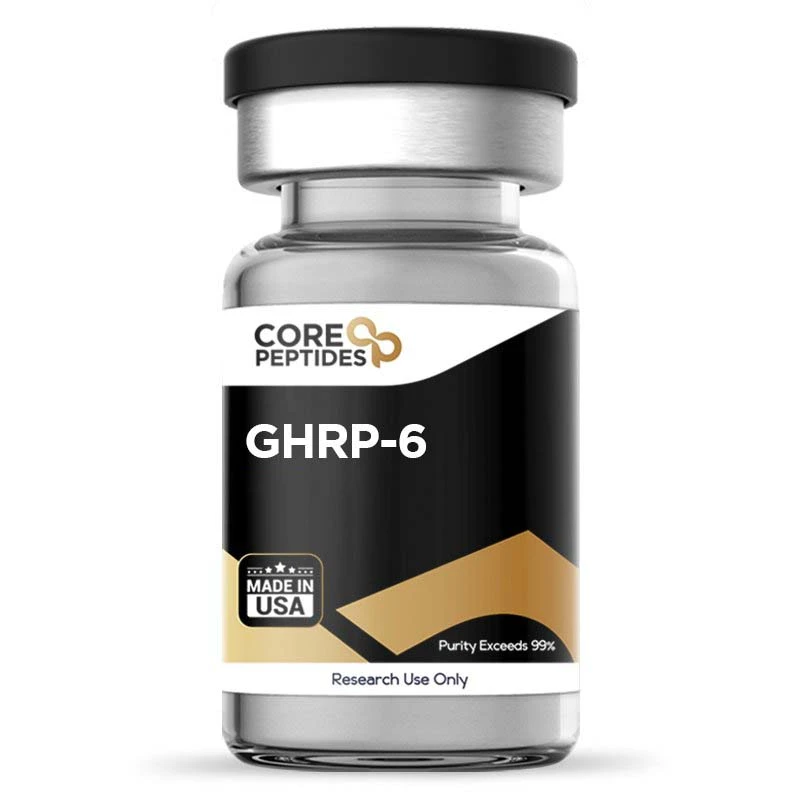

GHRP-6 (5mg / 10mg) – Growth Hormone-Releasing Peptide Research Material
GHRP-6 (5mg / 10mg), or Growth Hormone-Releasing Peptide-6, is a synthetic hexapeptide that has been extensively investigated as a growth hormone secretagogue.
Scientific research has examined GHRP-6 for its interaction with the growth hormone secretagogue receptor (GHS-R), its influence on growth hormone (GH) secretion and its relationship with the ghrelin signalling system.
GHRP-6 is particularly relevant to research involving endocrinology, pituitary hormone secretion, ghrelin receptor signalling and growth hormone physiology.
Experimental studies have demonstrated that GHRP-6 can stimulate GH release in humans, with endogenous growth hormone-releasing hormone (GHRH) contributing substantially to the maximal GH response.
The referenced product is available in 5mg and 10mg quantities and is intended for laboratory and scientific research. It should not be represented as an approved medicine, dietary supplement or treatment for human use.
What Is GHRP-6?
GHRP-6 stands for Growth Hormone-Releasing Peptide-6. It is a synthetic six-amino-acid peptide belonging to the growth hormone secretagogue family.
Scientific literature describes GHRP-6 as a potent GH secretagogue that can stimulate growth hormone secretion in humans and other experimental models. Research has also established a connection between GHRP-6 and the ghrelin receptor, providing an important model for studying growth hormone secretagogue signalling.
Unlike growth hormone itself, GHRP-6 is studied for its ability to influence endogenous hormone secretion through receptor-mediated signalling. This makes it useful for laboratory investigations into the mechanisms regulating the GH axis.
GHRP-6 (5mg / 10mg) – Product Highlights
- Product name: GHRP-6
- Full name: Growth Hormone-Releasing Peptide-6
- Peptide type: Synthetic hexapeptide
- Available quantities: 5mg and 10mg
- Research classification: Growth hormone secretagogue
- Primary research area: Growth hormone secretion
- Receptor research: Growth hormone secretagogue receptor / ghrelin receptor
- Additional research areas: Endocrinology, pituitary signalling and metabolic research
- Intended use: Laboratory and scientific research
Researchers should consult the supplier’s current documentation and batch-specific analytical information for precise specifications, purity, storage conditions and other quality-control details.
GHRP-6 and Growth Hormone Research
Growth hormone is a peptide hormone produced primarily by the anterior pituitary gland. Its secretion is regulated by several interacting hormonal pathways, including growth hormone-releasing hormone and somatostatin.
GHRP-6 has been studied because it can stimulate the release of growth hormone. Early human research characterised GHRP-6 as a synthetic compound capable of producing dose-related GH responses.
Subsequent research examined the mechanisms responsible for this response. One human study found that blocking endogenous GHRH substantially reduced the GH response to GHRP-6, indicating that endogenous GHRH is important for much of the maximal response observed in humans.
These findings make GHRP-6 a useful research tool for investigating the interaction between growth hormone secretagogues and the hypothalamic-pituitary GH axis.
GHRP-6 and the Ghrelin Receptor
One of the most important areas of GHRP-6 research concerns its relationship with the ghrelin receptor, also known as the growth hormone secretagogue receptor (GHS-R).
Research comparing peptide growth hormone secretagogues has identified GHRP-6 as an agonist of the ghrelin receptor.
Structural research has also provided detailed information about how GHRP-6 interacts with the ghrelin receptor. Cryo-electron microscopy studies have examined the receptor bound to GHRP-6 and identified structural features involved in receptor activation.
This makes GHRP-6 particularly valuable for research into peptide-receptor recognition, receptor activation and ghrelin-related signalling.
GHRP-6 and GHRH Signalling
GHRP-6 does not operate in isolation from the broader growth hormone regulatory system. Research has investigated the relationship between GHRP-6 and growth hormone-releasing hormone (GHRH).
In human experiments, administration of a GHRH antagonist substantially reduced the GH response to GHRP-6. The findings indicated that endogenous GHRH is required for most of the GH response to GHRP-6 under the experimental conditions studied.
This interaction is an important consideration in laboratory studies examining the integration of different pathways controlling pulsatile GH secretion.
GHRP-6 and Pituitary Research
The pituitary gland plays a central role in endocrine regulation, including the secretion of growth hormone.
Because GHRP-6 can stimulate GH secretion, it has been used experimentally to investigate pituitary responsiveness and the regulatory mechanisms involved in GH release.
Research can use GHRP-6 to explore questions such as:
- How does the pituitary respond to growth hormone secretagogue receptor activation?
- What role does endogenous GHRH play in the GHRP-6 response?
- How does GHRP-6 interact with other regulators of GH secretion?
- How does receptor activation influence downstream endocrine signalling?
These questions are relevant to experimental endocrinology and hormone physiology.
GHRP-6 and Ghrelin Signalling Research
Ghrelin is a naturally occurring peptide hormone involved in several physiological processes, including regulation of appetite and growth hormone secretion.
GHRP-6 provides researchers with a synthetic ligand for investigating the ghrelin receptor. Research comparing ghrelin and GHRP-6 has demonstrated that both can activate ghrelin receptor signalling, although their molecular structures and biological properties are not identical.
Studies of this system can help researchers understand how peptide ligands interact with G-protein-coupled receptors and how receptor activation translates into intracellular signalling.
GHRP-6 and Receptor Pharmacology
GHRP-6 is also relevant to receptor pharmacology because it provides a defined peptide ligand for studying the growth hormone secretagogue receptor.
Published research has investigated GHRP-6 using receptor-binding and signal-transduction assays, including studies of calcium mobilisation, inositol phosphate turnover and other intracellular signalling pathways.
More recent structural research has used cryo-electron microscopy to investigate the molecular recognition of GHRP-6 by the ghrelin receptor.
These studies demonstrate the continuing scientific interest in GHRP-6 as a tool for understanding peptide-receptor interactions.
GHRP-6 and Appetite Research
Because GHRP-6 interacts with the ghrelin receptor system, it is also relevant to research examining appetite and energy-regulation pathways.
Ghrelin is widely recognised as an important regulator of food intake and energy balance, while GHRP-6 has been used experimentally to investigate signalling through the same receptor system.
Research in this area can help clarify the relationship between growth hormone secretion and other physiological processes associated with ghrelin receptor activation.
GHRP-6 and Metabolic Research
The connection between GHRP-6, the ghrelin receptor and growth hormone secretion makes the peptide relevant to experimental metabolic research.
Laboratory investigations may examine interactions between:
- Growth hormone secretion.
- Ghrelin receptor activity.
- Hypothalamic signalling.
- Pituitary endocrine responses.
- Energy-regulation pathways.
- Appetite-related signalling.
Experimental findings should always be interpreted according to the specific model, concentration, exposure conditions and study design rather than being assumed to predict clinical outcomes.
GHRP-6 and Cellular Research
GHRP-6 has also been investigated in cellular and molecular research models.
For example, experimental work has examined GHRP-6 signalling in neuronal models expressing components of the ghrelin system. Research in rat models and cultured cells has investigated pathways including Akt signalling and IGF-I-related molecular responses following exposure to GHRP-6.
Such studies provide researchers with opportunities to investigate the molecular consequences of growth hormone secretagogue receptor activation beyond the pituitary gland.
GHRP-6 Research Applications
GHRP-6 may be relevant to laboratory studies involving:
- Growth hormone research: Investigation of GH secretion and regulation.
- Ghrelin research: Study of ghrelin receptor signalling.
- Receptor pharmacology: Examination of peptide-receptor binding and activation.
- Endocrinology: Investigation of hypothalamic and pituitary hormone pathways.
- Cell signalling: Study of intracellular pathways activated by GHRP-6.
- Metabolic research: Investigation of energy-regulation and appetite-related signalling.
- Structural biology: Study of molecular recognition between GHRP-6 and GHS-R.
- Analytical research: Development of laboratory methods for peptide identification and characterisation.
GHRP-6 Compared with GHRP-2
GHRP-6 and GHRP-2 are both synthetic growth hormone secretagogues, but they are distinct peptide compounds.
| Characteristic | GHRP-6 | GHRP-2 |
|---|---|---|
| Full name | Growth Hormone-Releasing Peptide-6 | Growth Hormone-Releasing Peptide-2 |
| Peptide class | Growth hormone secretagogue | Growth hormone secretagogue |
| Research focus | GH secretion and ghrelin receptor signalling | GH secretion and ghrelin/GHS receptor signalling |
| Structural type | Hexapeptide | Distinct synthetic growth hormone secretagogue peptide |
Although the compounds share a broad research classification, they should not be treated as interchangeable. Experimental protocols should specify the exact peptide under investigation.
GHRP-6 Compared with GHRH Peptides
GHRP-6 should also be distinguished from growth hormone-releasing hormone analogues such as Mod GRF 1-29 and CJC-1295.
| Research Material | General Research Classification |
|---|---|
| GHRP-6 | Growth hormone secretagogue associated with GHS-R/ghrelin signalling |
| GHRH analogues | Compounds investigated through the GHRH receptor pathway |
| Growth hormone | The hormone itself rather than a secretagogue |
This distinction is important when comparing experimental results because different peptide classes interact with different components of the endocrine system.
GHRP-6 Product Quantities
The referenced product is available in 5mg and 10mg quantities.
| Option | Research Material |
|---|---|
| 5mg | GHRP-6 research peptide |
| 10mg | GHRP-6 research peptide |
The stated quantity represents the amount of research material supplied. It should not be interpreted as a recommended human dose or administration schedule.
GHRP-6 Product Specifications
| Specification | Details |
|---|---|
| Product name | GHRP-6 |
| Full name | Growth Hormone-Releasing Peptide-6 |
| Peptide type | Synthetic hexapeptide |
| Available quantities | 5mg / 10mg |
| Research classification | Growth hormone secretagogue |
| Primary research area | Growth hormone secretion |
| Receptor system | Growth hormone secretagogue receptor / ghrelin receptor |
| Additional research areas | Endocrinology, receptor pharmacology and metabolic research |
| Intended use | Laboratory and scientific research |
Why Researchers Study GHRP-6
GHRP-6 has a substantial history in experimental endocrinology and receptor research. Its scientific value comes from the ability to investigate several connected biological pathways using one well-characterised synthetic peptide.
Key areas of interest include:
- Growth hormone secretion.
- Growth hormone secretagogue receptor activation.
- Ghrelin receptor biology.
- Interactions between GHRP-6 and endogenous GHRH.
- Pituitary hormone regulation.
- Peptide-receptor recognition.
- Intracellular signalling pathways.
- Appetite and metabolic signalling.
Structural studies have further strengthened the research value of GHRP-6 by providing detailed insight into its interaction with the ghrelin receptor.
GHRP-6 and Scientific Literature
GHRP-6 has been investigated in a broad range of scientific studies spanning endocrinology, receptor pharmacology, structural biology and cellular research.
Early human research demonstrated that GHRP-6 produces a dose-related GH response.
Later research showed that endogenous GHRH contributes significantly to the GH response produced by GHRP-6 in humans.
Receptor studies have identified GHRP-6 as a ligand of the ghrelin receptor and have examined the downstream signalling associated with receptor activation.
More recent structural biology research has used cryo-electron microscopy to investigate how GHRP-6 is recognised by and activates the ghrelin receptor at the molecular level.
Frequently Asked Questions
What is GHRP-6?
GHRP-6 is a synthetic growth hormone-releasing peptide and growth hormone secretagogue that has been studied extensively for its effects on GH secretion and ghrelin receptor signalling.
What does GHRP-6 stand for?
GHRP-6 stands for Growth Hormone-Releasing Peptide-6.
Is GHRP-6 a growth hormone?
No. GHRP-6 is a growth hormone secretagogue rather than growth hormone itself. Research focuses on its ability to stimulate signalling associated with endogenous GH release.
Does GHRP-6 interact with the ghrelin receptor?
Yes. Scientific research identifies GHRP-6 as an agonist of the ghrelin receptor, also known as the growth hormone secretagogue receptor.
Has GHRP-6 been studied in humans?
Yes. Human studies have investigated GHRP-6 and its effects on growth hormone secretion. Research has also examined how endogenous GHRH contributes to the GH response.
What role does GHRH play in GHRP-6 research?
Human research indicates that endogenous GHRH contributes substantially to the GH response produced by GHRP-6. Blocking GHRH signalling substantially reduced the response in experimental studies.
Is GHRP-6 the same as GHRP-2?
No. Both are growth hormone secretagogues, but GHRP-6 and GHRP-2 are different synthetic peptides with distinct structures and experimental characteristics.
What quantities are available?
The referenced product is available in 5mg and 10mg quantities.
Why is GHRP-6 useful for receptor research?
GHRP-6 provides a defined peptide ligand for investigating growth hormone secretagogue/ghrelin receptor activation, signalling and molecular recognition. Structural studies have directly examined the interaction between GHRP-6 and the ghrelin receptor.
Is GHRP-6 approved as a general therapeutic product?
Regulatory status varies according to jurisdiction and intended application. The research material described here should not be presented as an approved general-purpose medicine or therapeutic product.
Can experimental GHRP-6 findings be directly applied to humans?
No. Results from biochemical, cellular and animal studies depend on the specific experimental conditions and cannot automatically be extrapolated to human clinical outcomes.
Research Summary
GHRP-6 (5mg / 10mg) is a synthetic six-amino-acid growth hormone secretagogue that has been extensively investigated in endocrine and receptor research. Studies have demonstrated its ability to stimulate GH secretion and have examined the role of endogenous GHRH in mediating the response.
GHRP-6 is also closely associated with the ghrelin receptor. Research has characterised its receptor activity using biochemical and functional assays, while structural biology studies have provided detailed information about GHRP-6 recognition by the receptor.
Additional experimental research has investigated GHRP-6 in cellular and metabolic models, making it relevant to studies involving pituitary endocrinology, receptor pharmacology, intracellular signalling and ghrelin-related physiology.
Overall, GHRP-6 represents a well-established research peptide for investigations involving growth hormone secretion, ghrelin receptor signalling, peptide-receptor interactions and endocrine physiology.
Research-Use Disclaimer
GHRP-6 (5mg / 10mg) is intended for laboratory and scientific research purposes only. It is not a food product, dietary supplement or general-purpose therapeutic product.
The information provided on this page is for scientific and educational purposes and does not constitute medical advice. It should not be interpreted as evidence that GHRP-6 can diagnose, treat, cure or prevent any disease or medical condition.
Findings from biochemical, cellular, animal and human research should be interpreted within the specific context in which they were obtained. Experimental research does not automatically establish clinical safety, efficacy or an appropriate therapeutic application.
This content does not provide instructions for human administration, dosing, injection, reconstitution for human use or self-experimentation. Researchers should follow appropriate laboratory protocols, supplier documentation, institutional requirements and all applicable laws and regulations when handling research peptides.
| Please select a size | 5mg, 10mg |
|---|
Be the first to review “GHRP-6 (5mg / 10mg)”
Related products
Peptides for Sale
Peptides for Sale
Peptides for Sale
Peptides for Sale
Peptide Blends for Sale
Peptides for Sale
Peptides for Sale
Peptide Blends for Sale
Reviews
There are no reviews yet.