
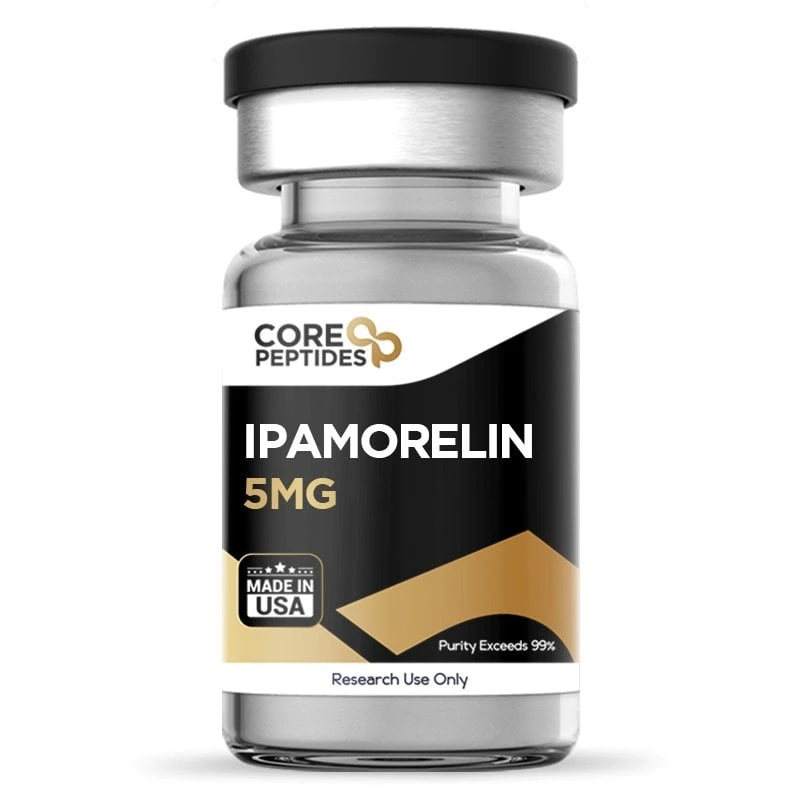
Ipamorelin (5mg) – Selective Growth Hormone Secretagogue Research Peptide
Ipamorelin (5mg) is a synthetic pentapeptide belonging to the growth hormone secretagogue (GHS) family. It has been investigated extensively for its ability to stimulate growth hormone (GH) release through the growth hormone secretagogue receptor (GHS-R) pathway. Research has characterised Ipamorelin as a selective GH-releasing peptide with activity in both cellular and animal models.
Ipamorelin is particularly relevant to laboratory research involving growth hormone physiology, pituitary signalling, GHS-R pharmacology, endocrine regulation and peptide-receptor interactions. Published research has also investigated its pharmacokinetic and pharmacodynamic properties in experimental and controlled human settings.
The referenced product is supplied as 5mg of Ipamorelin and should be regarded as a research material rather than a medicine, dietary supplement or product intended for self-administration.
What Is Ipamorelin?
Ipamorelin is a synthetic pentapeptide developed as a growth hormone secretagogue. Its reported sequence is Aib-His-D-2-Nal-D-Phe-Lys-NH2. The compound was described in the scientific literature in the late 1990s during research into selective growth hormone-releasing peptides.
Unlike growth hormone itself, Ipamorelin does not supply recombinant GH directly. Instead, it has been studied for its ability to activate the growth hormone secretagogue signalling pathway and promote the release of endogenous GH from pituitary cells.
Early pharmacological research described Ipamorelin as a potent GH secretagogue with a degree of selectivity for GH release that distinguished it from several earlier growth hormone-releasing peptides.
Ipamorelin (5mg) – Product Highlights
- Product name: Ipamorelin
- Quantity: 5mg
- Peptide type: Synthetic pentapeptide
- Research classification: Growth hormone secretagogue
- Primary research pathway: Growth hormone secretagogue receptor (GHS-R)
- Primary research focus: Growth hormone secretion
- Additional research areas: Pituitary endocrinology, receptor pharmacology and endocrine signalling
- Research format: Peptide research material
- Intended application: Laboratory and scientific research
Researchers should consult current supplier documentation and batch-specific analytical data for the exact specifications, purity, storage requirements and quality-control information applicable to the material supplied.
How Does Ipamorelin Work?
Ipamorelin is studied primarily because of its interaction with the growth hormone secretagogue receptor, also known as GHS-R. This receptor is part of the signalling system involved in the regulation of growth hormone secretion.
Experimental research demonstrated that Ipamorelin stimulates GH release from primary rat pituitary cells and that its activity is mediated through a GHRP-like receptor pathway. In animal models, Ipamorelin also produced measurable increases in circulating GH.
The receptor system is closely related to the biological activity of ghrelin, a naturally occurring peptide hormone. Research into GHS-R signalling has therefore become an important area of endocrine and metabolic science.
Ipamorelin and Growth Hormone Secretion
The principal scientific interest in Ipamorelin concerns its ability to stimulate growth hormone release.
In the original pharmacological characterisation of Ipamorelin, the peptide stimulated GH release in primary rat pituitary cells with potency and efficacy comparable to GHRP-6. Similar GH-releasing activity was observed in experimental animal models.
These observations established Ipamorelin as an important experimental compound for studying the mechanisms controlling GH secretion.
Human pharmacokinetic and pharmacodynamic research has subsequently examined the relationship between Ipamorelin concentrations and GH responses in healthy volunteers.
Ipamorelin and the Growth Hormone Secretagogue Receptor
GHS-R is a G protein-coupled receptor involved in growth hormone secretagogue signalling. It is expressed in the pituitary and hypothalamus, as well as in other tissues.
Ipamorelin’s interaction with this receptor pathway is one of the main reasons it has become a useful compound for research into endocrine receptor pharmacology.
Studies comparing Ipamorelin with other secretagogues have demonstrated that it can stimulate GH release through a GHRP-like receptor while displaying a comparatively selective endocrine profile.
Ipamorelin and Pituitary Research
The pituitary gland plays a central role in GH regulation because specialised somatotroph cells produce and release growth hormone.
Cell-based studies have investigated Ipamorelin directly in pituitary models. Research using primary rat pituitary cells found concentration-dependent GH release following exposure to Ipamorelin.
These experimental models allow researchers to investigate peptide-receptor interactions without the complexity of a whole-organism endocrine system.
Ipamorelin is therefore relevant to research into pituitary somatotroph activity, hormone secretion and GHS-R-mediated signalling.
Ipamorelin and Selective GH Research
One of the characteristics that distinguishes Ipamorelin from some earlier growth hormone-releasing peptides is its reported selectivity for GH release.
In the original pharmacological study, researchers investigated several pituitary hormones alongside GH. Under the experimental conditions used, Ipamorelin did not produce significant changes in FSH, LH, prolactin or TSH, while the study also reported a lack of significant ACTH and cortisol stimulation compared with GHRH.
This selective profile was a major factor in the scientific interest surrounding Ipamorelin and its development as a research compound.
Ipamorelin Compared with GHRP-6
Ipamorelin and GHRP-6 are both growth hormone secretagogues and have been studied extensively in relation to GHS-R signalling.
| Characteristic | Ipamorelin | GHRP-6 |
|---|---|---|
| Peptide type | Synthetic pentapeptide | Synthetic growth hormone-releasing peptide |
| Research classification | Growth hormone secretagogue | Growth hormone secretagogue |
| Primary research interest | Selective GH release and GHS-R signalling | GH release and GHS-R signalling |
| Pituitary research | Extensively investigated | Extensively investigated |
The original pharmacological research found broadly comparable GH-releasing activity between Ipamorelin and GHRP-6 in several experimental models, while also identifying differences in their broader endocrine profiles.
Ipamorelin Compared with GHRP-2
Ipamorelin and GHRP-2 are both synthetic compounds investigated as growth hormone secretagogues, but they have different peptide structures and pharmacological characteristics.
| Research Material | General Classification | Primary Research Interest |
|---|---|---|
| Ipamorelin | Selective growth hormone secretagogue | GH release and GHS-R signalling |
| GHRP-2 | Growth hormone secretagogue | GH release and GHS-R-related signalling |
| GHRP-6 | Growth hormone secretagogue | GH release and ghrelin/GHS-R research |
These peptides should not be treated as interchangeable research materials because their molecular structures, receptor interactions and experimental profiles differ.
Ipamorelin and GHRH Research
Growth hormone-releasing hormone (GHRH) is a principal physiological regulator of pituitary GH secretion. Researchers have investigated how Ipamorelin interacts functionally with the GHRH pathway.
Because GHRH and growth hormone secretagogues can influence GH release through distinct signalling mechanisms, comparing their effects provides useful information about the regulation of pituitary somatotrophs.
Research into Ipamorelin therefore contributes to a broader understanding of how multiple endocrine signalling systems converge on growth hormone secretion.
Ipamorelin and Human Pharmacokinetic Research
Controlled human research has investigated the pharmacokinetic and pharmacodynamic characteristics of Ipamorelin.
A pharmacokinetic-pharmacodynamic study in healthy male volunteers examined different experimental infusion rates and measured both circulating Ipamorelin and GH. The researchers reported dose-proportional pharmacokinetic behaviour and a transient GH response following experimental exposure.
Such research is useful for understanding the relationship between peptide concentration, exposure and endocrine response.
Ipamorelin and Experimental Animal Research
Ipamorelin has been studied in several animal models as part of investigations into growth hormone secretion and endocrine physiology.
The original pharmacological research reported GH release in rats and swine, with measurable responses following experimental administration.
Separate animal research has investigated Ipamorelin in relation to skeletal muscle and bone responses in adult rats. These studies reported changes in muscle strength and bone formation under specific experimental conditions involving glucocorticoid exposure.
Such findings remain preclinical and should not be interpreted as evidence of established therapeutic effects in humans.
Ipamorelin and Endocrine Research
Ipamorelin is relevant to several interconnected areas of endocrine research, including:
- Growth hormone secretion.
- Pituitary somatotroph function.
- Growth hormone secretagogue receptor signalling.
- GHRH and GH-axis interactions.
- Endocrine receptor pharmacology.
- Hormonal feedback mechanisms.
- Peptide pharmacokinetics.
- Growth hormone pharmacodynamics.
These research areas help scientists investigate the mechanisms controlling GH release and the role of secretagogue signalling within the endocrine system.
Ipamorelin Research Applications
As a research compound, Ipamorelin may be relevant to a range of laboratory disciplines:
- Endocrinology: Investigation of growth hormone physiology.
- Pituitary research: Study of somatotroph responsiveness and GH release.
- Receptor pharmacology: Investigation of GHS-R activity and signalling.
- Peptide research: Characterisation of synthetic growth hormone secretagogues.
- Pharmacokinetics: Investigation of peptide distribution, clearance and exposure.
- Pharmacodynamics: Study of relationships between peptide exposure and GH responses.
- Cell biology: Investigation of peptide-induced endocrine signalling.
- Animal research: Experimental investigation of GH-related physiological processes.
Ipamorelin and Growth Hormone Signalling
Growth hormone secretion is controlled by a complex interaction between hypothalamic signals, pituitary receptors and feedback from peripheral tissues.
Ipamorelin provides a useful experimental model for studying one component of this system: growth hormone secretagogue signalling through GHS-R.
Research into this pathway can help scientists distinguish between different mechanisms of GH stimulation and investigate how receptor-selective compounds influence pituitary endocrine activity.
Ipamorelin Chemical and Research Information
Ipamorelin is a synthetic pentapeptide with the sequence Aib-His-D-2-Nal-D-Phe-Lys-NH2. The compound’s structure and pharmacology were described in the original scientific characterisation of Ipamorelin. :contentReference[oaicite:14]{index=14}
| Specification | Details |
|---|---|
| Product | Ipamorelin |
| Quantity | 5mg |
| Peptide type | Synthetic pentapeptide |
| Peptide sequence | Aib-His-D-2-Nal-D-Phe-Lys-NH2 |
| Research classification | Growth hormone secretagogue |
| Primary receptor pathway | Growth hormone secretagogue receptor |
| Primary research focus | Growth hormone secretion |
For product-specific purity, formulation, storage and analytical specifications, researchers should refer to the current batch documentation supplied with the material.
Why Researchers Study Ipamorelin
Ipamorelin remains of scientific interest because it provides a defined synthetic model for investigating growth hormone secretagogue activity.
Key research characteristics include:
- Its well-characterised synthetic pentapeptide structure.
- Its ability to stimulate GH release in experimental models.
- Its activity through the GHS-R signalling pathway.
- Its comparatively selective endocrine profile in early pharmacological studies.
- Its use in controlled pharmacokinetic and pharmacodynamic research.
- Its relevance to pituitary and endocrine receptor research.
The original research described Ipamorelin as a potent and selective growth hormone secretagogue, providing a foundation for subsequent studies of the compound and related GHS compounds.
Frequently Asked Questions About Ipamorelin
What is Ipamorelin?
Ipamorelin is a synthetic pentapeptide classified as a growth hormone secretagogue. It has been studied for its ability to stimulate growth hormone release through the GHS-R pathway.
Is Ipamorelin growth hormone?
No. Ipamorelin is not growth hormone. It is a synthetic peptide studied for its ability to stimulate the release of endogenous growth hormone.
What receptor does Ipamorelin interact with?
Ipamorelin is associated with the growth hormone secretagogue receptor pathway. Experimental research demonstrated that its GH-releasing activity is mediated through a GHRP-like receptor.
What is Ipamorelin primarily researched for?
The principal research interest is growth hormone secretion. Additional areas include pituitary endocrinology, GHS-R pharmacology, peptide signalling and pharmacokinetics.
Has Ipamorelin been studied in humans?
Yes. Controlled human research has investigated the pharmacokinetics and pharmacodynamics of Ipamorelin and measured corresponding GH responses in healthy volunteers.
How does Ipamorelin compare with GHRP-6?
Both are growth hormone secretagogues, and early research found comparable GH-releasing activity in several experimental models. However, they are different peptides with distinct pharmacological profiles.
What quantity does this product contain?
The referenced product is supplied in a 5mg quantity. This refers to the amount of research material supplied and should not be interpreted as a human dose or treatment recommendation.
Is Ipamorelin suitable for self-administration?
This product description is intended for scientific and research purposes. It does not provide instructions for human administration, dosing or self-experimentation.
Can research findings about Ipamorelin be considered medical advice?
No. Findings from laboratory, animal and controlled human studies must be interpreted within the specific context of each study and do not by themselves establish clinical safety, efficacy or an appropriate therapeutic use.
Research Summary
Ipamorelin (5mg) is a synthetic pentapeptide and growth hormone secretagogue that has been investigated extensively for its effects on growth hormone release. Early pharmacological research demonstrated GH-releasing activity in pituitary cell models and experimental animals and characterised Ipamorelin as a relatively selective GH secretagogue.
Subsequent research has investigated Ipamorelin in controlled human pharmacokinetic and pharmacodynamic studies, providing additional information about peptide exposure and associated GH responses.
Overall, Ipamorelin is particularly relevant to research involving growth hormone physiology, GHS-R receptor biology, pituitary signalling, endocrine pharmacology and peptide pharmacokinetics.
Research-Use Disclaimer
Ipamorelin (5mg) should be treated as a laboratory and scientific research material. This information is provided for educational and research purposes and does not constitute medical advice.
The content should not be interpreted as a recommendation to diagnose, treat, cure or prevent any disease or medical condition. Results obtained in cellular, animal or human research models may vary according to experimental design and cannot automatically be translated into clinical recommendations.
This page does not provide instructions for human administration, dosing, injection, reconstitution for human use or self-experimentation. Researchers should follow appropriate laboratory procedures, supplier documentation, institutional requirements and all applicable laws and regulations when handling research peptides.
Be the first to review “Ipamorelin (5mg)”
Related products
Peptides for Sale
Peptides for Sale
Peptides for Sale
Peptides for Sale
Peptides for Sale
Peptides for Sale
Peptides for Sale
Peptides for Sale
Reviews
There are no reviews yet.